All the latest quantum computer articles

See the latest stories on quantum computing from eeNews Europe

Monday, March 20, 2017

Complete security certification for IoT device makers

By Nick Flaherty www.flaherty.co.uk

Managing security keys and certificates is a considerable challenge in the Internet of Things (IoT), especially for device makers. Developing a secure public key infrastructure (PKI) is expensive and not a core part of the IoT activity, and yet it is essential.

Icon Labs is addressing this with the Floodgate Certificate Authority (CA) to provide a private PKI infrastructure for device makers using a real time operating system (RTOS).
Floodgate CA is the server side portion of Icon Labs’ PKI solution and provides certificate management for companies choosing to implement their own certificate-based authentication using public key infrastructure.

IoT security requires strong authentication. All IoT devices, including the smallest endpoints, must support mutual authentication, ensuring all communication is between known, trusted devices, and that all access is authorized. Certificate-based authentication using Public Key Infrastructure provides a proven, reliable authentication method. This is provided with connection technologies such as cellular modems, but not for other types of connectivity.

The Floodgate CA can be deployed on a hardened server or hierarchy of servers in a private environment to provide a closed PKI system without dependence upon public certificate authorities or other third-parties. It can also operate as a sub-CA of a public CA, allowing OEMs to choose the operating model based on their IoT authentication requirements.

Floodgate CA can be used with any PKI client, including Icon Labs’ Floodgate PKI Client Toolkit; an embeddable PKI client for IoT devices. Floodgate PKI Client enables even the smallest of IoT devices to generate keys, create certificate signing requests, and retrieve signed certificates from the Certificate Authority.

“This is the only security solution that provides both the client and server side required to automate secure provisioning and enrollment,” said Alan Grau, President of Icon Labs. “The Floodgate Certificate Authority and Floodgate PKI Client toolkit enables developers to easily and efficiently integrate certificate-based machine-to-machine authentication for IoT devices.”

The PKI client supports SCEP, EST, and OCSP on all RTOS, embedded Linux, and Windows devices. The Floodgate Certificate Authority encompasses a wide-range of potential use cases including key management, generating public key infrastructure certificates, and injecting pre-generated keys during the manufacturing process.

Related stories: 

Friday, March 17, 2017

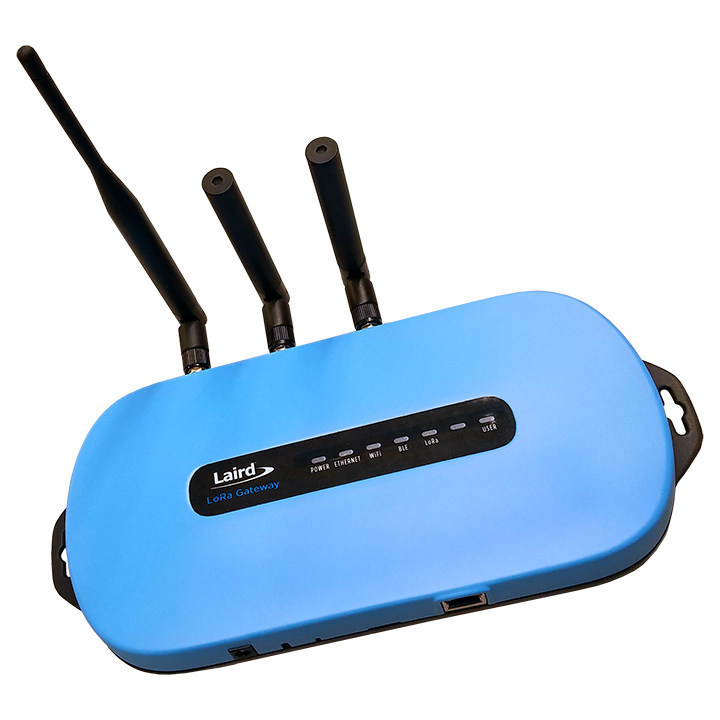
Laird moves up the IoT value chain with LoRa gateway

By Nick Flaherty www.flaherty.co.uk

Wireless module maker Laird is moving up the value chain in the Internet of Things with a long range, low power gateway using the LoRa protocol.

"The Sentrius RG1xx has been purpose-built from the ground up to create a secure, scalable, robust LoRa network solution," said Scott Lordo, senior vice president of Laird. "The RG1xx, paired with the other elements of Laird's growing Sentrius LPWAN ecosystem, enables cost-effective and end-to-end control of public and private LoRa networks alike."


The move brings together all the elements that Laird already provides for OEMs and developers  to accelerate IoT development for many of the most challenging industrial settings and applications, ranging from smart metering to equipment monitoring to municipal asset management and more.

In industrial automation, for example, full-scale networks can be used to track assets that are spread across a vast facility. A LoRa network can easily span an entire campus and gather sensor data that can provide deep insights needed to maintain efficiency, productivity and be used to make the best business decisions possible. The Sentrius RG1xx gateway helps to make a proprietary network easy to build, scale, and maintain.

The gateway uses Laird's enterprise grade 802.11 a/b/g/n MIMO Wi-Fi, wired Ethernet, Bluetooth and BLE connectivity within a single LoRa gateway, linking short-range, low-power wireless technologies with Low-Power Wide Area Network (LPWAN) technology to dramatically expand the geographic range of IoT implementations.

LoRa provides secure, bi-directional data transfer and communications with IoT networks over long distances of up to 10 miles for years without a battery change.

Based on the Semtech SX1301 / SX1257 chipset designs enabling eight channels and 27 dBm transmit power, the gateway is designed to work with Laird's LoRa ecosystem of Sentrius RM1xx LoRa + BLE certified modules and LPWAN antennas and provides compatibility with third party Cloud and LoRa partners and other LoRaWAN client devices.

The Sentrius RG1xx gateway also comes equipped with intuitive web-based configuration, integrated LoRa packet forwarder software, and default settings for multiple LoRa network server vendors. It is fully certified for FCC, IC, CE, along with a Bluetooth SIG listing.

"With multiple wired and wireless interface options, the RG1xx gives you complete design freedom to create a private end-to-end LPWAN network, which eliminates the need for a network carrier subscription," said Lordo. "The RG1xx gateway, paired with the RM1xx series of LoRa and BLE modules and Laird's LPWAN antennas, will give developers and OEMs control of their cost-effective LoRa ecosystem."

Given Laird has all the elements available already, having samples of the Sentrius RG1xx for select customers in May seems a little late. Full production follows after that, presumably if there is enough interest.

www.lairdtech.com

Other Related articles

Wednesday, March 15, 2017

Researchers hack accelerometers with sound waves

By Nick Flaherty www.flaherty.co.uk

Researchers at the University of Michigan have hacked MEMS accelerometers in smartphones and IoT designs using sound waves.

By tuning into the resonant frequencies of the micro-machined sensors, the researchers, led by Kevin Fu, associate professor of computer science and engineering, could deceive 15 different models of accelerometers into registering movement that never occurred. 

"The fundamental physics of the hardware allowed us to trick sensors into delivering a false reality to the microprocessor," said Fu. "Our findings upend widely held assumptions about the security of the underlying hardware. If you look through the lens of computer science, you won't see this security problem. If you look through the lens of materials science, you won't see this security problem. Only when looking through both lenses at the same time can one see these vulnerabilities."

The researchers performed several proof-of-concept demonstrations: They used a $5 speaker to inject thousands of fictitious steps into a Fitbit. They played a malicious music file from a smartphone's own speaker to control the phone's accelerometer trusted by an Android app to pilot a toy remote control car. They used a different malicious music file to cause a Samsung Galaxy S5's accelerometer to spell out the word "WALNUT" in a graph of its readings.

"Analogue is the new digital when it comes to cybersecurity," said Fu. "Thousands of everyday devices already contain tiny MEMS accelerometers. Tomorrow's devices will aggressively rely on sensors to make automated decisions with kinetic consequences."

Autonomous systems like package delivery drones and self-driving cars, for example, base their decisions on what their sensors tell them, said Timothy Trippel, a doctoral student in computer science and engineering and first author of the paper: WALNUT: Waging Doubt on the Integrity of MEMS Accelerometers with Acoustic Injection Attacks.

Trippel noticed additional vulnerabilities in these systems as the analog signal was digitally processed. Digital "low pass filters" that screen out the highest frequencies, as well as amplifiers, haven't been designed with security in mind, he said. In some cases, they inadvertently cleaned up the sound signal in a way that made it easier for the team to control the system.

The researchers recommend ways to adjust hardware design to eliminate the problems. They also developed two low-cost software defenses that could minimize the vulnerabilities, and they've alerted manufacturers to these issues.

The university is pursuing patent protection for the intellectual property and is seeking commercialization partners to help bring the technology to market.

www.umich.edu

Related stories: 

First edge analytics integration for VxWorks

By Nick Flaherty www.flaherty.co.uk

The Embedded blog keeps a close eye on the use of edge computing (otherwise known as good old embedded design), particularly for the potential for integrating analytics at the edge. So the move by Greenwave Systems, not a common name in embedded designs, to be the first to link up with Wind River for the VxWorks real time operating system is an interesting move. 

The boom in the number of sensors and the amount of data being produced means more analysis will have to be done at the edge, through microcontrollers with real time operating systems, FPGAs or even AI engines.

As part of this move, Greenwave has ported it AXON Predict engine to VxWorks to allow customised analytics that adds computational power and real-time intelligence throughout Industrial IoT (IIoT) embedded designs. It extends analytics and machine learning capabilities down to the chip level — and at all points in between.
“We sought to give VxWorks developers a tool with the prowess to analyze and autonomously respond to high-volume streaming sensor data at the source; our partnership with Greenwave will enable us to do just that,” said Michel Genard, general manager of operating system platforms, Wind River. “AXON Predict will provide developers with embedded analytics that learn patterns, provide insights and take actions inside connected device operations and behaviors. We’re very pleased to be working with Greenwave to offer a compelling solution to advance IIoT.”

This visual edge analytics engine, AXON Predict, will allow VxWorks developers to build a set-and-forget application with intelligence and process critical data at the edge of a network in real-time. This enables machines and smart sensors to collect information at every step of the network, automatically detect anomalies and take immediate action right at the source of input. Enhanced security features bolster the analytics engine and will provide enterprises with yet another layer of data and device protection.

“We’re excited to deliver Wind River security and predictive maintenance solutions that its VxWorks developer community can embed on their devices,” said Simon Arkell, general manager of software platforms and analytics at Greenwave Systems. “Our technology will enable them to build secure, smart things that reduce asset maintenance costs and add new functionality across myriad industries. As the first analytics solution to integrate with VxWorks, AXON Predict will automate operational efficiency in a way that was previously unattainable by those building connected devices and systems within the RTOS.”

www.greenwavesystems.com 

Related stories:

Scalable platform for 7GHz IoT radar sensor

By Nick Flaherty www.flaherty.co.uk

Novelda in Sweden has launched a Developer Platform for sensing applications based on its second-generation ultra-wideband (UWB) impulse radar system-on-chip (SoC). 

This allows OEMs and system developers can easily implement sophisticated sensors in the INternet of Things that can detect small movements, determine presence and room occupancy, and monitor respiration and other human vital signs with unprecedented accuracy and discrimination.
Supporting various host environments, such as MATLAB, Python, C++ and C, the XeThru platform provides everything developers need to rapidly start prototyping their radar application designs. The hardware bundles an X4 SoC with an MCU board and a PCB antenna, while communications software provides an API layer that enables access to the full functionality of the SoC, and open source reference code allows the use of digital signal processing libraries to extend system performance.

Integrated into a single chip, the X4 UWB impulse radar SoC combines a transmitter, which can operate at center frequencies of either 7.29 GHz or 8.748 GHz for unlicensed operation in worldwide markets, with a direct RF sampling receiver and a fully programmable system controller. 

The X4 SoC delivers some key performance improvements over the previous design: its frame size is now configurable for different applications and the range, for simultaneous observation, has been increased from 1m to 10m, making it 10x faster and much more suitable for presence detection; its on-chip advanced power management functions enable low-power duty cycle control and dramatically reducing power dissipation; and its higher level of integration reduces external component BOM costs by more than 50%.

“The real benefit of the XeThru X4 Platform is in kick-starting the development of more advanced radar sensing applications, allowing customers who aren’t radar experts to do more than simply build a system with off-the-shelf sensors”, said Cornelia Mender, CEO, adding, “That said, we will also be upgrading our own presence detection and respiration sensors to take advantage of the enhanced performance of the X4 chip. And for customers who start with our X4M03 hardware and want to go straight to production, we will be offering the X4M02 as a single-board module that is 100% code compatible but at a lower cost in higher volumes”.

Intended specifically to aid the development of sensors based on UWB radar technology, the components of the XeThru Developer Platform include:
  • X4M03 Radar System - three interconnecting circuit boards that provide all the hardware required to prototype a target application - the X4SIP02 radarsubsystem (the X4 chip mounted on a small daughter board), the X4A02 antenna board, and the XTMCU02 MCU board.
  • XeThru Module Connector – a software suite allowing easy access to all X4M03 resources and streaming data through an API. XeThru Module Connector is distributed as a DLL / Shared Object and runs on WIN / Linux / MAC operating systems. The API is supported by Matlab, Python and C++/C.
  • XeThru Embedded Platform - open source reference code, supplied as an Atmel Studio 7 project, that will run on the X4M03 and allow developers to implement their own radar module firmware, taking advantage of an API layer that provides access to the full parameter control of the X4 SoC and the ability to process data using standard DSP libraries.
The X4 Impulse Radar SoC is the smallest UWB radar chip currently available in the market and offers unprecedented ease-of-use and BOM cost advantages. As a UWB radar solution it has been highly optimized for occupancy and respiration sensing applications and provides sub-mm accuracy with a simultaneous observation range up to 10m. Operating at below 10GHz allows it to see through obstacles and its ultra-high spatial resolution allows the detection of multiple objects. Specified for industrial temperature range applications from -40C to +85C, the chip includes advanced power management features to ensure low power consumption (typically < 120 mW).

www.xethru.com

Related stories:

Tuesday, March 14, 2017

UK spinout aims to connect the Internet of Things

An interesting story from Bristol with Sixis Technology  being launched to roll out a rugged IoT gateway.

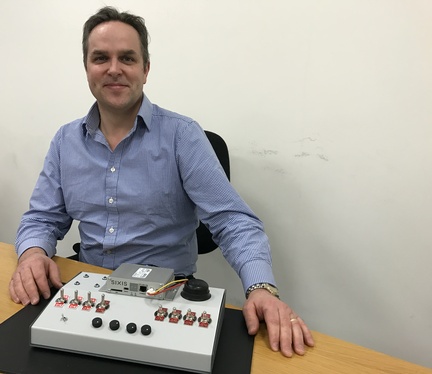
Chris Begent with the Sixis Mini on top of a demo unit 
Sixis is a subsidiary of Telemisis which supplies end-to-end monitoring systems for power and telecoms networks. The gateway hardware and connection manager server-side software has been spun off into the new venture for other markets such as water monitoring and smart cities.

 “We aim to help system integrators and developers of Industrial IoT applications to bring their products to market more quickly and at a lower cost, by providing them with a complete Industrial IoT device solution,” said Chris Begent, Co-founder of Sixis.

“We’ve poured over 100 man-years of experience into the design and manufacture of every Sixis device solution, laying a solid foundation for any Industrial IoT application”, said the other co-founder, Tony Richardson. “The technology is already deployed with customers in over 100 countries across six continents.” One Telemisis customer has over 9000 of the gateways deployed around the world.

The Sixis Connection Manage handles communications between all Sixis devices and is deployed as part of an application on a customer server. This handles the secure communications with the gateway and provides remote device management and configuration, remote control of equipment, and ensures accurate sensor data collection and integrity. An open API allows system developers to easily include the application in a network."

See the story at UK spinout aims to connect the Internet of Things | Electronics EETimes

Other stories: 


Barco Silex and Imagination collaborate on IoT chip security

By Nick Flaherty www.flaherty.co.uk

In an interesting move that highlights the fractured nature of security, Imagination is working with Belgian display company Barco Silex to add custom security to the MIPS family of processors.

Rather than using its own security technology, Imagination will integrate Barco Silex’ eSecure embedded security into a new Trusted Element (TE) IP product. The licensable TE will enhance security for customers’ connected devices.

eSecure turns ASIC and SoC designs into fully-secured hardware platforms. Under the agreement, Barco Silex will provide an embedded security solution based on eSecure which will embed a MIPS microAptiv CPU as an ultra-low power controller. Imagination will then provide customers with a range of robust security options designed around eSecure for their MIPS-based SoCs for systems as diverse as data center equipment to low-power IoT wireless sensor nodes. 

This will give Imagination’s TE secure boot, root of trust, authentication for systems that operate in a trusted execution environment, and more. In a system that uses Imagination’s OmniShield-ready MIPS CPUs for multi-domain security, this combination will provide high levels of system security performance and capabilities for connected devices.

“In an increasingly connected world, having security embedded in hardware is a must,” says Jim Nicholas, EVP, MIPS business unit at Imagination. “Imagination has been at the forefront of driving multi-domain hardware security with our OmniShield technology. Now with Barco Silex’ eSecure, we have selected a state-of-the-art solution to add a new level of hardware security to our 32/64-bit MIPS processor based subsystems. Today, our MIPS CPUs already power billions of products. By integrating this exceptional security platform, we are further strengthening that position.”

Barco Silex’ eSecure module functions as hardware root-of-trust, guaranteeing the authenticity and integrity of the application’s hardware, software, data, and communication. It offloads all security operations to hardware and scales according to the needs of the application. eSecure takes care of the secure storage and management of keys, and its cryptographic engine supports the latest algorithms for TLS/DTLS 1.3, Thread Networking, Apple HomeKit, Bluetooth, ZigBee and more.

“We are very pleased be part of this ambitious collaboration. It squarely fits with our ambition to help create secure and intuitive IoT devices, networking platforms from device to cloud and enterprise systems,” comments Thierry Watteyne, CEO of Barco Silex. “This agreement recognizes the quality of our security solutions and the reach of our expertise. In addition it will help our developers to further push our embedded security platforms beyond the state-of-the-art, especially in terms of optimizing the low-power/high-security ratio in chip architectures.”

Imagination’s range of Trusted Element IP will be available for licensing in mid-2017. 

Related stories:

Ubiik launches Weightless-P Kit

By Nick Flaherty www.flaherty.co.uk

Taiwanese board maker Ubiik has launched hardware and SDKs for the Weightless-P LPWAN technology for the Internet of Things (IoT). 

“From the beginning it was obvious that ultra high network capacity, a robust coding scheme and FOTA (firmware-over-the-air) were must-have features,” said Fabien Petitgrand, Ubiik CTO and one of the key architects of the Weightless-P standard. "It is equally clear that current alternative technologies are unable to support any of these prerequisites.”
Weightless-P sees the open standard as a key advantage for low power wide area networking (LPWAN). “History has taught us that ultimately only open standards prevail,” said Professor William Webb, CEO of the Weightless SIG. “There are no other LPWAN standards in licence exempt spectrum, none.”

“We believe that open standards and robust technologies are the keys to unleashing the full potential of the IoT,” said Tien-haw Peng, Founder and CEO of Ubiik. “By leading the development and commercialisation of Weightless-P, we are enabling a new wave of products simply not possible with existing LPWAN technology.

The Ubiik team members along with members of the Weightless SIG are exhibiting Weightless-P base stations and end device modules for IoT solutions requiring high capacity, long range, years of battery life and true bi-directional communication.

www.ubiik.com
Related stories: 

Monday, March 13, 2017

Power news this week

POWER NEWS from EETIMEs EUROPE this week

Littelfuse boosts backing for Monolith Semi
.Littelfuse boosts backing for Monolith Semi
Brazilian smart city power chip maker choses MIPS
.Brazilian smart city power chip maker choses MIPS
Renesas absorbs Intersil into new multimarket division
.Renesas absorbs Intersil into new multimarket division
[Alt-Text]
.

TECHNOLOGIES TO WATCH

Roll-to-roll flexible perovskite solar cells hit record efficiency
.Roll-to-roll flexible perovskite solar cells hit record efficiency
Graphene 'leaf' collects and stores energy for next generation solar panels
.Graphene 'leaf' collects and stores energy for next generation solar panels
Ferroelectric nanoparticles improve lithium-sulfur batteries
.Ferroelectric nanoparticles improve lithium-sulfur batteries

NEW PRODUCTS

NVIDIA reduces power for Jetson TX2 AI board
.NVIDIA reduces power for Jetson TX2 AI board
Wafer scale packaging for 4A FET
.Wafer scale packaging for 4A FET
New small package for high voltage intelligent power devices targets fan motors
.New small package for high voltage intelligent power devices targets fan motors

TECHNICAL PAPERS

CUI: How to Stay Ahead of Efficiency Regulations for Power Adapters
.CUI: How to Stay Ahead of Efficiency Regulations for Power Adapters
Enpirion: An engineer’s guide to the key steps to powering an FPGA design
.Enpirion: An engineer’s guide to the key steps to powering an FPGA design
Intersil: Powering IoT infrastructure systems
.Intersil: Powering IoT infrastructure systems

Multicore controller combines real-time and network redundancy protocols in a single chip for Industry 4.0

By Nick Flaherty www.flaherty.co.uk

Renesas has used a multicore architecture to combine real time network protocols and redundancy protocols in a single chip for the next generation of industrial systems.

The R/N Series of industrial networking communication processors simplify network-based application development in network switches, gateways, programmable logic controllers (PLCs), operator terminals, and remote I/O units. 

With differing time constraints and network control technologies, existing factory networks consist of field networks, which implement communication between control devices and other devices, and control networks, which implement communication between control devices and other control devices. Field networks require real-time control and use real-time industrial network protocols such as EtherCAT, EtherNet/IP, ETHERNET Powerlink, PROFINET, Sercos, and CANopen. In contrast, control networks, which prioritize reliability, use network redundancy protocols such as Rapid Spanning Tree Protocol (RSTP), Parallel Redundancy Protocol (PRP), and High-Availability Seamless Redundancy (HSR).

So far there has been little development in unifying these two types of networks, which meant that when developing network devices, it was necessary to use components supporting one or another of the available protocols.

The RZ/N brings together multiple industrial networking technologies within a single chip, enabling system manufacturers to develop systems supporting a variety of industrial network protocols and network redundancy protocols in less time. Renesas also delivers broad 
The ecosystem support is essential for system manufacturers’ software development, offering a general application programmable interface (API) that provides a unified support for network protocol stacks implemented by partners, in addition to compiler and OS environments. 

The RZ/N lineup comprises three product groups for scalability: 
  • RZ/N1D Group for high-end applications
  • RZ/N1S Group for mid-range applications
  • RZ/N1L Group for low-end applications.
The multi-core architecture includes an Integrated R-IN Engine and five-port Gigabit Ethernet switch for single-chip support of leading industrial network protocols and network redundancy protocols

The R-IN Engine uses an ARM Cortex-M3 processor to provide both real-time processing of communication data and redundancy protocol operation. The R-IN Engine improves power consumption and throughput, reduces jitter, and has already been successfully implemented in existing products and will be further developed in future. The RZ/N Series supports on a single chip a variety of industrial network protocols and network redundancy protocols.

The RZ/N1D has dual ARM Cortex-A7 cores for applications such as network switches, PLCs, and gateways. The RZ/N1S uses a single A7 for nano-PLCs and operator terminals. The RZ/N1L is aimed at industrial equipment communication blocks or slave devices such as remote I/O units and enables system developers to develop devices that are more compact and low cost.

With the recent advancement of Industry 4.0 to implement network connections in factories for increased efficiency, there are growing demands for network devices with support for industrial network protocols enabling real-time processing, protocol gateway functionality, protected networking functionality, and support for network redundancy protocols to ensure highly reliable and efficient communication.

To assist system manufacturers with evaluation, Renesas has developed CPU modules populated with the new RZ/N Series, boards equipped with a variety of peripheral functions, and solution kits configured including OS and protocol stacks sample software from Renesas partners. Renesas is also working with industry-leading protocol vendors to make available to system developers protocol stacks from PORT, TMG Technologie und Engineering, CANNON-Automata, and Net Module, among others.

Renesas provides a Generic Abstraction layer API that will deliver unified support for a variety of industrial network protocols without performance tradeoffs. Using such API will enable system developers to combine supported protocols as needed with minimal impact on the application software, and to shorten the development time of industrial network devices by as much as 50 percent. System developers can also use compiler environments including IAR Embedded Workbench from IAR Systems and OS environments including Linux, VxWorks and ThreadX from Express Logic.
www.renesas.com

ARM M4F controller adds more power flexibility for IoT performance

By Nick Flaherty www.flaherty.co.uk

STMicroelectronics has led the way with microcontrollers based around the ARM Corex-M4F DSP core, coupled with key peripherals.

Now it has added larger memories, enhanced graphics support, extra peripherals, and increased power-saving flexibility for the STM32L4.

Bigger on-chip RAM, now up to 320 Kbytes, sits alongside the new ST Chrom-ART Accelerator graphics engine for smoother display performance in energy-conscious applications such as IoT devices and smart watches. 

There is also up to 1 Mbyte Flash, an extra CAN interface, a camera interface and crystal-less Full Speed (FS) USB OTG. A new high-pin-count UFBGA169 package option gives extra flexibility for the new peripherals, 

Adding security capability, the STM32L4A6 with hardware cryptographic acceleration implements SHA-256 and AES-128/192/256 algorithms.


The EEMBC CoreMark score of 273 is an indicator of the performance while the ULPBench score of 217 confirms the energy efficiency. Active-mode current of just 37µA/MHz enables longer runtime on small batteries and extends scope to create energy-neutral products powered from ambient sources.

ST has also extended the flexibility of the STM32L4 power architecture, giving developers the option to power the core from an external DC/DC converter for extra efficiency. The FlexPowerControl architecture includes a new shutdown mode for additional energy savings, alongside multiple independent core and peripheral supplies, and a separate VBAT domain with charging circuitry that gives flexibility to use or recharge battery energy. 

There are seven main STM32L4 low-power modes supported, with options such as retaining I/O levels and SRAM contents, each with several sub-modes that allow precision trimming of power consumption as application demand varies.

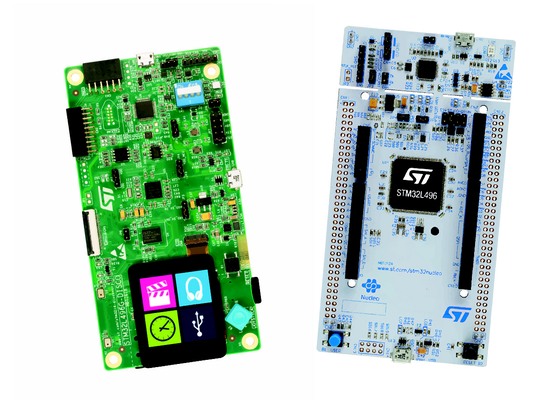
There are STM32Cube development tools and software, two Nucleo-144 boards, and the STM32L496 Discovery Kit (STM32L496G-DISCO) with on-board audio/graphics features and Arduino, Pmod and ST's own STMod+ connectivity support. The NUCLEO-L496ZG-P features an on-board DC/DC converter for powering the core directly, which allows developers to easily use the flexible power architecture in the most energy-conscious applications. The legacy-compatible NUCLEO-L496ZG is also available, and offers the same features as existing Nucleo-144 boards.

Pricing starts from $4.63 for the STM32L496RET6 with 512 Kbytes Flash and 320 Kbytes SRAM in LQFP64 package, for orders of 10,000 pieces per year.

The development boards start at $19 for the legacy-compatible Nucleo-144 board (NUCLEO-L496ZG), which is available now. The Discovery Kit (STM32L496G-DISCO) is also available now, priced $70. The NUCLEO-L496ZG-P board with external DC/DC converter will be available to distributors in April 2017.

For further information see st.com/stm32l4x6

Related stories: 

Friday, March 10, 2017

Artesyn boosts Open Compute applications with NVIDIA Tesla P4 server


By Nick Flaherty www.flaherty.co.uk

Server designs are changing,  bringing more challenges to the embedded system designer.

Artesyn Embedded Technologies for example, has developed a new hyperscale media acceleration server sled based on the CG-OpenRack-19 architecture, which is inspired by rack-scale architectures.

The new CG19-GPU sled will be used by carriers to add NVIDIA Tesla P4 GPU processing to their network infrastructure systems. Optimised support for GPU and media processing workloads enables carriers to enhance their networks with improved video streaming and services that use video, such as digital advertising and augmented reality. Carriers also benefit from dramatically increased performance density and the ability to deploy new applications such as advanced analytics.

CG-OpenRack-19 is an open-source specification for scalable carrier-grade rack-level systems that integrate high-performance compute, storage and networking in a standard rack. It is designed to enable applications to be deployed quickly on off-the-shelf servers and storage systems. 

“Carrier networks need to rapidly deploy new applications on datacenter infrastructure, and open source hardware standards such as CG-OpenRack-19 are critical to this network transformation," said Linsey Miller, vice president of marketing for Artesyn Embedded Technologies. "We are bringing our deep knowledge of how to apply off-the-shelf technology along with our breadth of product and third-party ecosystem to solve today’s application deployment challenges, so that service providers can buy with confidence.”

“NVIDIA lets companies like Artesyn, and its telecom customers, deploy a GPU computing platform that powers AI applications capable of creating additional growth opportunities,” said Craig Weinstein, ‎vice president of the America's Partner Organization at NVIDIA. “The Tesla P4 hyperscale GPU enables superior carrier services including, virtual reality, augmented reality and improved video streaming.”


Related rack and NVIDIA stories on the Embedded blog: 

NVIDIA pushes artificial intelligence into embedded designs with Jetson TX2
Microsoft Azure backs ARM chips for servers
King Cobra rugged server design provides a “total rack in 2U" ..
Arrow invests in Swindon for Artesyn configurable power supplies...

Thursday, March 09, 2017

NVIDIA pushes artificial intelligence into embedded designs with Jetson TX2

By Nick Flaherty www.flaherty.co.uk

NVIDIA has launched the second generation of its Jetson processor board to provide artificial intelligence (AI) at the network edge with less power consumption
The Jetson TX2 keeps the same 50mm x 87mm credit card form factor as the first generation but updates the processor and memory bandwidth to provide twice the performance, handling four 4K video streams, or a lower power envelope of 7.5W for two streams.
This allows Jetson TX2 to run larger, deeper neural networks on edge devices in the Internet of Things (IoT) in embedded designs from manufacturing, industrial and retail markets to AI in drones.
“Jetson TX2 brings powerful AI capabilities at the edge, making possible a new class of intelligent machines,” said Deepu Talla, vice president and general manager of the Tegra business at NVIDIA. “These devices will enable intelligent video analytics that keep our cities smarter and safer, new kinds of robots that optimize manufacturing, and new collaboration that makes long distance work more efficient.” 

The Pascal chip uses  256 GPU cores alongside two of NVIDIA's customised Denver 2 64bit ARM processors and four standard ARM A57 cores. The board adds support for 4K x 2K 60fps encode and decode and 12 CSI lanes supporting up to 6 cameras with 2.5 Gbytes/s per lane. The memory has been increased to 8Gbytes of LPDDR4 and the bandwidth doubled to 58.3 Gbyte/s.
The board runs NVIDIA's Linux for Tegra operating system and its latest software development kit (SDK) for AI computing, JetPack 3.0. This includes the choice of TensorRT 1.0, a high-performance neural network inference engine for production 
deployment of deep learning applications, cuDNN 5.1, a GPU-accelerated library of primitives for deep neural networks or VisionWorks 1.6, a software development package for computer vision and image processing, as well as the latest graphics drivers and APIs, including OpenGL 4.5, OpenGL ES 3.2, EGL 1.4 and Vulkan 1.0, along with CUDA 8, which turns the GPU into a general-purpose massively parallel processor.

The development board ships now with the modules shipping in volume in Q2.

Microsoft Azure backs ARM chips for servers

By Nick Flaherty www.flaherty.co.uk

Microsoft is optimising its Azure cloud services infrastructure for ARM64 servers. After a numer of false starts in ARM-based servers, this will see Qualcomm and Cavium collaborating on current and future datacentre requirements and new architectures.

Microsoft is running internal cloud-based workloads on ARM-based processors side by side with production workloads. “We have been running evaluations side by side with our production workloads and what we see is quite compelling," said Dr. Leendert van Doorn, Distinguished Engineer at Microsoft Azure. "The high Instruction Per Cycle (IPC) counts, high core and thread counts, the connectivity options and the integration that we see across the ARM ecosystem is very exciting and continues to improve. We feel ARM servers represent a real opportunity and some Microsoft cloud services already have future deployment plans on ARM servers.”

Qualcomm is demonstrating its Centriq 2400 10nm, 48-core server processor.


The demonstration with Cavium runs on their flagship 2nd generation 64-bit ThunderX2 ARMv8-A server processor SoCs for datacenter, cloud and high performance computing applications.

Cavium, who collaborated with leading server supplier Inventec, and Qualcomm have each developed an Open Compute-based motherboard compatible with Microsoft’s Project Olympus that allows Microsoft to deploy the new servers in the Azure datacentres.

Other chip makers are also developing single chips with large number of ARM cores for server applications.

Phytium Technology in China last year showed a chip with 64 64bit ARMv8 cores. The FT-2000/64 has 4.8 bn transistors on a die 25.20 millimeters in width and 25.38 millimeters in length within a chip package 55 millimeters in width and 55 millimeters in length.

Engineers from Phytium said the new chip, with 64-bit arithmetic is able to perform 512 billion floating-point operations per second (FLOPS) at base frequency of 2.0 GHz and 100W of power dissipation.

Phytium has designed its own cores, known as FTC661s, with a license for the ARMv8 architecture.

Related stories:

Wednesday, March 08, 2017

Low cost crypto chip to secure the Internet of Things

By Nick Flaherty www.flaherty.co.uk

Microchip has turned to ARM for a hardware cryptography-enabled microcontroller which addresses the increasing need for security measures, such as secure boot, driven by the continual growth of Internet of Things (IoT) applications.

The CEC1702 is a full-featured ARM Cortex-M4-based microcontroller with a complete hardware cryptography-enabled solution in a single package. Microchip has been focussed on the competing MIPS core and has its own highly successful 8 and 16bit PIC families, but acquired ARM chip expertise when it bought Atmel.

The CEC1702 offers easy-to-use encryption, authentication, private and public key capabilities and allows customer programming flexibility to minimise customer risk and can be used as a standalone controller or a security sub-system.

The chip also provides significant performance improvements when compared to firmware-based solutions. The device’s hardware cryptographic cipher suite reduces compute time by orders of magnitude over software solutions by providing, for example, a 20-50x performance improvement for PKE acceleration as well as 100x improvement for encryption/decryption. This robust hardware-based feature set results in applications that can run security measures quickly, effectively and with significantly lower cost and power consumption.

The device provides:
  • Pre-boot authentication of system firmware: Providing an immutable identity and a root of trust to ensure that the firmware is untouched and has not been corrupted
  • Firmware update authentication: Verifying that the firmware update has not been corrupted and is from a trusted source
  • Authentication of system-critical commands: Attesting that any system-critical command is from a known source with authorisation to make the given change, preventing potentially devastating actions
  • Protection of secrets with encryption: Safeguarding code and data to prevent theft or malicious activities
Microchip simplifies the addition of authentication and encryption to connected designs by offering a full development suite including hardware and software tools as well as peripheral libraries and crypto Application Programme Interfaces (APIs) to accelerate design cycles.

The CEC1702Q-B1- SX is in production volume. http://www.microchip.com/promo/CEC1702

Related stories: 

Power news this week

.
Innogy to set up European charging network
.Innogy to set up European charging network
Semitrex rebrands to Helix Semiconductors
.Semitrex rebrands to Helix Semiconductors

Solid state lithium battery triples capacity
.Solid state lithium battery triples capacity
[Alt-Text]
.

TECHNOLOGIES TO WATCH

Researchers build GaN on SOI wafer
.Researchers build GaN on SOI wafer
Nanoparticles create ceramics at room temperature
.Nanoparticles create ceramics at room temperature
Streetlight doubles up as car charging station
.Streetlight doubles up as car charging station

NEW PRODUCTS

Defibrillation and ESD protection for medical designs with 100x less leakage current
.Defibrillation and ESD protection for medical designs with 100x less leakage current
Compact 1A 6MHz step-down DC-DC converter for height-constrained devices
.Compact 1A 6MHz step-down DC-DC converter for height-constrained devices
Semtech targets simultaneous wireless charging for multiple small devices
.Semtech targets simultaneous wireless charging for multiple small devices

TECHNICAL PAPERS

CUI: How to Stay Ahead of Efficiency Regulations for Power Adapters
.CUI: How to Stay Ahead of Efficiency Regulations for Power Adapters
Enpirion: An engineer’s guide to the key steps to powering an FPGA design
.Enpirion: An engineer’s guide to the key steps to powering an FPGA design