All the latest quantum computer articles

See the latest stories on quantum computing from eeNews Europe
Showing posts with label SSD. Show all posts

Wednesday, August 10, 2011

New SATA µSSD Specification for Embedded Solid State Drives

By Nick Flaherty www.flaherty.co.uk

Connector-free, high-capacity, embedded SSDs for a new generation of tablets and ultrathin notebooks

Memory maker SanDisk has implemented the new SATA µSSD specification into its SanDisk iSSD product line of postage stamp-sized embedded SSDs. SATA-IO, an industry consortium dedicated to sustaining the quality, integrity and dissemination of serial ATA (SATA) technology, introduced the standard today.
The number of media tablets shipped worldwide is expected to grow from 17.8 million units in 2010 to 53.5 million units in 2011 according to IDC.
The Serial ATA International Organization (SATA-IO) is also developing SATA Express, a new specification that combines SATA software infrastructure with the PCI Express (PCIe) interface. SATA Express enables the development of new devices that use the PCIe interface and maintain compatibility with existing SATA applications. The technology will provide a cost-effective means to increase device interface speeds to 8Gb/s and 16Gb/s.
Embedded SSDs offer fast performance in a tiny footprint, making them an attractive solution for all categories of ultrathin devices. The SATA µSSD specification (see below) eliminates the module connector from the traditional SATA interface, enabling developers to produce a single-chip SATA implementation for embedded storage applications. Among the first products to implement the new standard, the SanDisk iSSD series is an ideal storage solution for OEMs developing the next generation of thin, powerful mobile computing platforms.
“To widely adopt a new component technology, manufacturers need to have confidence in its performance, longevity and cost-effectiveness,” said Jeff Janukowicz, research manager, solid state storage technology at IDC. “Today’s announcement of an industry-wide standardization for embedded SSDs, combined with OEM requirements for size and performance gains in storage, should help propel the market for these tiny, versatile drives.”
“Connector-free embedded SSDs allow OEMs to develop a new generation of thin yet powerful tablets and ultrathin notebooks,” said Kevin Conley, senior vice president, client storage solutions, SanDisk. “Initiatives such as the µSSD specification promote the development of new standards for storage solutions that help manufacturers continually refine their end consumer product and drive new industry sectors.”
The SATA µSSD standard-conforming SanDisk iSSD series utilizes a new electrical pin-out that allows SATA delivery using a single ball grid array (BGA) package. The BGA package sits directly on the motherboard, allowing for form factors as small as 16mm x 20mm x 1.2mm (up to 32GB)/1.4mm (for 64GB) and 16mm x 20mm x 1.85mm (for 128GB). The SanDisk iSSD i100 SSD is available in 8 gigabyte (GB)1 to 128GB capacities, offering OEMs a flexible range of storage options.
“The market for tablets and ultrathin computing devices continues to grow along with the need for small form factor storage solutions,” said Mladen Luksic, president, SATA-IO. “We are excited to have industry-wide support for the µSSD specification and look forward to seeing many µSSD-based products available in the near future.”
SATA Express will provide a low-cost solution to fully use the performance of SSDs, while storage devices not requiring the speed of SATA Express will continue to be served by existing SATA technology. The specification will define new device and motherboard connectors that will support both new SATA Express and current SATA devices.
“The SATA Express specification provides SSD and hybrid drive manufacturers the advantages of performance and scalability enabled by PCIe 3.0 – which is available now – and the ubiquity of SATA,” said Mladen Luksic, SATA-IO president. “We expect the SATA Express specification to be completed by the end of 2011.”

The Complete SATA Ecosystem
SATA Express is one of several specifications from SATA-IO designed to offer low-cost, high performance storage solutions optimized for specific device segments. Since its introduction in 2001, SATA technology has penetrated 99% of the PC market and evolved to provide options for a number of applications beyond traditional hard disk storage. SATA is now implemented in a variety of applications including solid state and optical drives, embedded mobile devices, consumer electronics products and enterprise storage. Key specifications for implementing SATA technology beyond the HDD device segment include:
  • mSATA: A low-profile solution for mobile computing devices and other small form factor applications.
  • SATA Universal Storage Module (USM): An integrated SATA interface for providing portable, volume storage I/O to consumer electronics devices, as well as PC applications.
  • SATA µSSD: an embedded, single-chip solution that connects directly to the motherboard to enable ultra-thin form factor devices.
More information on these and other SATA specifications is available at www.sata-io.org.


Enhanced by Zemanta

Tuesday, May 10, 2011

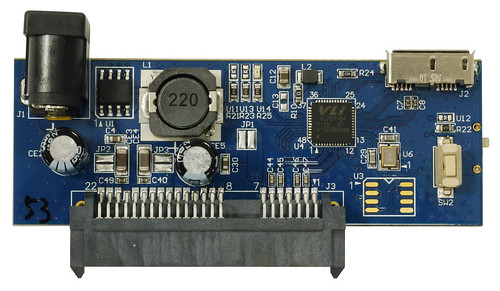
VIA Labs links USB3.0 to SATA

V bridge controller provides more flexibility for embedded designs
By Nick Flaherty www.flaherty.co.uk

Embedded chip developer VIA Labs has had its VL701 Low-Power USB 3.0 to SATA Bridge Controller certified by the USB Implementers Forum (USB-IF) as adhering to strict power-consumption criteria for bus-powered devices. VIA Labs is currently the first and only company to achieve USB-IF Bus-Powered certification using a traditional hard disk drive, which draws more power than flash-based devices.
The comprehensive suite of tests conducted as part of the USB-IF Compliance and Certification Program ensures that certified products are interoperable with existing USB devices while also offering all the speed and power enhancements of the USB 3.0 specification.
With the industry's first fully-integrated 5V switching regulator, the VL701 is a highly integrated single chip solution that allows users to connect any SATA hard disk drive (HDD), solid state drive (SSD), or optical disc drive (ODD) to their PC via USB 3.0. With data transfer rates of up to 5Gbps, data stored on SATA devices can be effortlessly transferred to a PC in a fraction of the time it would usually take compared to USB 2.0 or Firewire.
Cal-Comp Electronics and Communications, a leading Electronics Manufacturing Services (EMS) and Original Design Manufacturer (ODM) that contracts with many name-brand customers worldwide, adopted and integrated the USB-IF Certified VL701 it into its upcoming USB 3.0 external storage products.
“The VL701 is an advanced, highly-integrated USB 3.0 to SATA Bridge that lets users experience the benefits of USB 3.0 using hard drives, optical drives, and even SSDs,” said David Hsu, Associate Vice President, VIA Labs, Inc. “The low power aspect is compelling for both end-users and manufacturers by enabling lower operating temperatures and longer battery life without sacrificing performance.”
Enhanced by Zemanta

Tuesday, April 26, 2011

Toshiba launches 19nm process NAND flash memory for 128Gbytes in a single package

By Nick Flaherty www.flaherty.co.uk 

Despite production problems in the wake of the Japan earthquake and power shortages, Toshiba Electronics Europe has made NAND flash memories with 19nm process technology, the finest level yet achieved. This latest technology advance has already been applied to 2-bit-per-cell 64-gigabit (Gb) and Toshiba says it will also add 3-bit-per-cell products fabricated with the 19nm process technology to its product line-up. This will make solid state disk drives significantly more cost effective.
Samples of 2-bit-per-cell 64-gigabit will be available from the end of this month with mass production scheduled for the third quarter of the year (July to September 2011).
The 19nm process technology will further shrink chip size, allowing Toshiba to assemble sixteen 64Gbit NAND flash memory chips in one package and to deliver 128GB devices for application in smartphones and tablet PCs. The 19nm process products are also equipped with Toggle DDR2.0, which enhances data transfer speed.
As the market for mobile equipment, such as smartphones, tablet PCs, and SSDs (solid state drives) expands, demand for smaller, higher density memory products grows. By accelerating process migration in NAND flash memory, Toshiba aims to reinforce and extend its leadership in the NAND flash memory market.


Enhanced by Zemanta

Friday, March 18, 2011

Solid State Drives Boom in 2011

Twin engines of consumer and enterprise usage will fuel growth to over $4bn

By Nick Flaherty www.flaherty.co.uk

Have we finally turned the corner to see solid state drives start to really take off? IHS iSuppli thinks so, predicting a near doubling of revenues this year to hit more than $4 billion and extending a robust performance in the storage market for the second year in a row.
SSD revenue this year is projected to hit $4.4 billion, up 91.3 percent from $2.3 billion in 2010. Growth in 2011 continues the expansion of the market starting last year, when the industry crossed the $1 billion threshold, figures indicate. This is becoming more apparent with SSD maker OCZ buying controller chip designer Indilinx this week.SSD revenue will continue to push ahead in the near future, even though the succeeding years will yield less impressive growth rates ranging from 7 to 25 percent. By 2014, SSD revenue is anticipated to reach $7.2 billion.


Ramping up in Consumer and Enterprise Segments
A number of compelling factors this year is spurring growth in SSDs—a type of storage technology comprised mostly of semiconductors and without any movable parts, unlike their rival hard disk drives made of magnetic media. Not only has pricing dropped for the NAND flash memory chips used in SSDs, solid state drives also are picking up real traction in both the consumer and enterprise markets.
The industry’s hottest segment in 2011 will be SSDs for consumer usage, IHS predicts, as shipments of SSD-outfitted high-end notebooks skyrocket. Last year’s Apple Inc.’s MacBook Air, for instance, succeeded in highlighting the SSD as a tangible differentiator—as opposed to soft attributes like design and build quality—for high-end notebooks. By designing around a small storage footprint and throwing in the fast performance typical of NAND flash, Apple delivered an attractive computing experience otherwise not achievable through a hard drive, thereby demonstrating the virtues inherent in SSD-equipped computers.
SSD’s other growth segment this year lies in the enterprise, which increasingly employs flash storage to overcome performance bottlenecks. In applications like online transaction processing and financial analysis, SSD drives using single-level-cell (SLC) NAND are preferred in order to enable optimal bandwidth and longevity. In addition, “enterprise-grade” multi-level-cell (MLC) NAND flash also has picked up steam as vendors improve MLC performance and controller sophistication, with a majority of enterprise SSDs now shipping with MLC flash.
Boosting SSD’s cachet within the enterprise segment, transformative applications—such as tiered server and storage system designs—are occurring, made possible by solid state technology. Other new applications capitalizing on the advantages of NAND flash also are getting ready to take off, further distancing SSDs from their hard disk drive legacy.
IHS revenue prospects for SSD this year have been consistent with last year’s outlook, but the sentiment then wasn’t as buoyant coming on the heels of a slow first half. SSDs had struggled earlier in 2010—partly due to a rise in NAND prices, and also because hard disc drives continued to increase their capacity and price advantage. But now, given the star turn for SSDs in ultraportable notebooks as well as an enhanced profile in the enterprise, the success projected by IHS for the industry has become a reality.
Mirroring the notable results in revenue, SSD shipments this year will be on an upswing, projected to reach approximately 15 million units, an increase of more than 118 percent from 6.9 million in 2010. Yet SSD shipments remain miniscule compared to those for hard disk drives, which will total roughly 161 million units in the first quarter of 2011 alone. At the same time, the hard disk drive market is consolidating and seeing much slower growth.

Read More > SSD Boom in 2011 Fueled by Twin Engines


Enhanced by Zemanta

Thursday, June 17, 2010

Toshiba Launches Industry’s Largest Embedded NAND Flash Memory Modules

32nm Embedded Memory up to 128GB NAND and Controller in a Single Package

By Nick Flaherty www.flaherty.co.uk
Toshiba has launched a 128-gigabyte (GB) embedded NAND flash memory module, the highest capacity yet achieved in the industry. The module is fully compliant with the latest e•MMC standard, and is designed for application in a wide range of digital consumer products, including smartphones, tablet PCs and digital video cameras. Samples will be available from September, and mass production will start in the fourth quarter (October to December) of 2010.

The new 128GB embedded device integrates sixteen 64Gbit (equal to 8GB) NAND chips fabricated with Toshiba's cutting-edge 32nm process technology and a dedicated controller into a small package only 17 x 22 x 1.4mm. Toshiba is the first company to succeed in combining sixteen 64Gbit NAND chips, and applied advanced chip thinning and layering technologies to realize individual chips that are only 30 micrometers thick.

Toshiba's modules now range from 2GB to 128GB and integrate a controller to manage basic control functions for NAND applications, and are compatible with the JEDEC eMMC Version 4.4 and its features. New samples of 64GB chips will also be available from August.

Demand continues to grow for large density chips that support high resolution video and deliver enhanced storage, particularly in the area of embedded memories with a controller function that minimizes development requirements and eases integration into system designs.

New Product Line-up

Product Number

Capacity

Package

Sample Shipment

Mass Production

THGBM2T0DBFBAIF

128GB

237Ball FBGA

17x22x1.4mm

Sep. 2010

4Q, 2010

(Oct.-Dec.)

THGBM2G9D8FBAIF

64GB

237Ball FBGA

17x22x1.4mm

Aug. 2010

4Q, 2010

(Oct.-Dec.)


Key Features


1. The JEDEC eMMC V4.4 compliant interface handles essential functions, including writing block management, error correction and driver software. It simplifies system development, allowing manufacturers to minimize development costs and speed up time to market for new and upgraded products.

2. Embedded in a system, the module can record up to 2,222 hours of music at a 128Kbps bit rate, 16.6 hours of full spec high definition video and 38.4 hours of standard definition video

3. The 128GB device stacks sixteen 64Gbit chips fabricated with leading-edge 32nm process technology. Application of advanced chip thinning, layering and wire bonding technologies has allowed Toshiba to achieve individual chips only 30 micrometers thick, and to layer and bond them in a small package. The result is an embedded NAND flash memory module with the industry’s highest density.

4. The new products are sealed in a small FBGA package only 17 x 22 x 1.4mm and has a signal layout compliant with the JEDEC eMMC V4.4.


Specifications

e
MMC

Interface

JEDEC eMMCTM V4.4 standard HS-MMC interface

Power Supply Voltage

2.7V to 3.6V (memory core);

1.65V to 1.95V / 2.7V to 3.6V (interface)

Bus width

x1, x4, x8

Write Speed*

21MB per sec. (Sequential/Interleave Mode)

21MB per sec. (Sequential/No Interleave Mode)

Read Speed*

46MB per sec. (Sequential Mode/Interleave Mode)

55MB per sec. (Sequential/No Interleave Mode)

Temperature range

-25degrees to +85degees Celsius

Package

153Ball FBGA +84 support balls

Enhanced by Zemanta

Wednesday, May 12, 2010

ACAL samples next generation 2.5in solid state drives (SSDs) for embedded


  • Over 2x faster Read/Write transfer rates than previous Wester Digital drives
  • Speed Assurance for consistent performance across the life-time of the drive
  • Support for advanced features: TRIM, NCQ and SMART
  • 5 year warranty and Western Digital FIT Lab certified
  • Available in 32GB, 64GB and 128GB capacities

ACAL Technology is sampling the latest generation of 2.5 inch SATA Solid State Drives (SSD) from Western Digital which more than doubles the read/write transfer rates of the previous generation combined with drive endurance and consistently high sequential write speeds. The N1x series of SSDs is based on Single-Level Cell (SLC) media for write-intensive, embedded OEM applications with up to 24/7 operation.
It features a native SATA 3.0 Gigabit per second (Gb/s) interface which delivers target read speeds of up to 240 megabytes per second (Mb/s) and write transfer rates of up to 140Mb/s. The drives are available with capacities of 32, 64 and 128GB. In addition to patented and patent-pending Western Digital technologies, the drives support Native Command Queueing (NCQ), SMART and Windows 7 TRIM commands. Based on proven Western Digital technology, the SSDs have a high tolerance to shock or vibration and can operate across a temperature range of 0 to 70 degrees Centigrade.
“The new single-level cell N1x SSDs complement Western Digital’s recent Multi-Level Cell (MLC) WD SiliconEdge Blue devices," said Richard Pollard, European Product Manager at ACAL Technology. "The combination of these two technologies means that OEMs across the cost/performance spectrum can access SSDs featuring Western Digital’s innovative Speed Assurance technology. This eliminates the need for an external ‘wiper’ utility and ensures that the drives operate at consistently high speed, regardless of the amount of stored data and with no degradation over the life of the drive.”
 The applications which would benefit most from the N1xx’s speed and longevity include database or multimedia servers, digital graphics rendering, NAS server and storage arrays, storage appliances and video on demand as well as telecom and wireless networking infrastructure. 
Samples of the N1xx SSDs are available now, from ACAL Technology, on a sale or return basis at http://www.acaltechnology.com/uk/wd1
Reblog this post [with Zemanta]