All the latest quantum computer articles

See the latest stories on quantum computing from eeNews Europe

Wednesday, January 09, 2019

Major boost for in-mold electronics

By Nick Flaherty www.flaherty.co.uk

Integrating components into the thermoplastic of devices to create 3D embedded systems is set for dramatic growth according to a new report by IDTechEx. 

In-mold electronics (IME) is a process of integrating printed decorations and electronic circuitry with thermoforming and molding. The results are 3D-shaped objects with embedded circuits of differing degrees of complexity. 

The commercial uptake of IME has a complex history with Ford embracing this technology for an automotive interior device, but the product had to be recalled. Despite this setback the market is on the cusp of large adoption. Very large addressable markets are at different stages of adopting this technology with automotive interiors and touchpads for white goods providing the most significant volumes. IDTechEx forecast the market for IME devices to exceed $1.11bn by 2029.

The capacity to print electronic circuitry on a 2D substrate prior to converting this into a functional 3D part has many manufacturing and material challenges. The report, In-Mold Electronics 2019-2029: Technology, Market Forecasts, Players covers the commercial and emerging solutions from the key players as this technology progresses from R&D to gaining high-volume end-user designs.

The advantages of IME include light weight, space-saving, robustness, accelerated time-to-market, and high throughput capabilities. However, the technology does not come without its drawbacks in: shape limitations, yield, software immaturity, environmental stability, and post-processing. These merits and hurdles are detailed within the report with upcoming solutions in the material-space for the functional inks, substrates, and adhesives facilitating this.

The prototypes have been diverse, ranging from simple devices for wearable technology, automotive light heating, antennas, and white goods touchpads to more complex sensors, actuators, and displays.

IME is not the only technological solution to 3D electronics. Aerosol jet printing, Mold Interconnected Devices (including laser direct structuring, two-shot molding, and film inserting), and 3D printing electronics are all rapidly emerging and gaining traction. This report benchmarks these technologies and looks at some of the key players and latest advancements.

www.IDTechEx.com/ime

Tuesday, January 08, 2019

64 core 7nm ARM server processor tops performance chart

By Nick Flaherty www.flaherty.co.uk

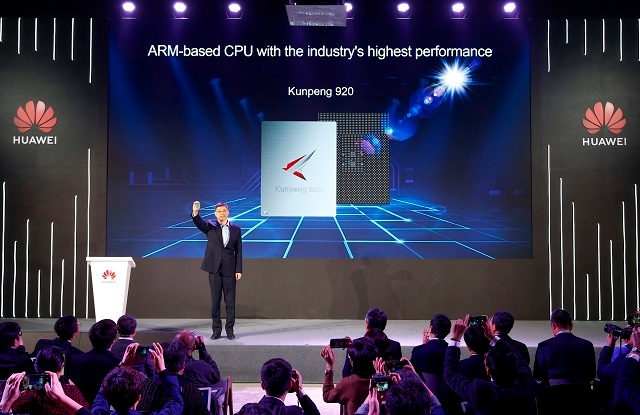
Huawei has launched the industry's highest-performance ARM-based CPU. 

The 7nm Kunpeng 920 is aimed at data, distributed storage, and ARM-native application applications and is based on ARMv8 architecture license. It significantly improves processor performance by optimizing branch prediction algorithms, increasing the number of OP units, and improving the memory subsystem architecture. 

At typical frequencies, the Kunpeng 920 CPU scores over 930 in the SPECint Benchmarks test, which is 25% higher than the industry benchmark. At the same time, power efficiency is 30% better than that offered by industry counterparts. Kunpeng 920 integrates 64 cores at a frequency of 2.6 GHz alongside 8-channel DDR4. 

System integration is also increased significantly through the two 100G RoCE ports as well as PCIe 4.0 and CCIX interfaces, providing 640 Gbps total bandwidth. In addition, the single-slot speed is twice that of the incumbent offering, effectively improving the performance of storage and various accelerators.


"Huawei has continuously innovated in the computing domain in order to create customer value. We believe that, with the advent of the intelligent society, the computing market will see continuous growth in the future. Currently, the diversity of applications and data is driving heterogeneous computing requirements. Huawei has long partnered with Intel to make great achievements. Together we have contributed to the development of the ICT industry. Huawei and Intel will continue our long-term strategic partnerships and continue to innovate together," said William Xu, Director of the Board and Chief Strategy Marketing Officer of Huawei (above).

"At the same time, the ARM industry is seeing a new development opportunity. The Kunpeng 920 CPU and TaiShan servers newly released by Huawei are primarily used in big data, distributed storage, and ARM-native applications. We will work with global partners in the spirit of openness, collaboration, and shared success to drive the development of the ARM ecosystem and expand the computing space, and embrace a diversified computing era."

Huawei has released its TaiShan series servers powered by Kunpeng 920, including three models: one with a focus on storage, another on high density, and a third focused on balancing both requirements. The TaiShan servers are built for big data, distributed storage, and ARM-native application scenarios.
TaiShan will enable computing platforms with high performance and low power consumption for enterprises. For example, in big data scenarios, the TaiShan servers are tuned for optimal many-core high concurrency and resource scheduling to deliver a 20% computing performance boost. Based on the TaiShan servers, Huawei Cloud also provides elastic cloud services, bare metal services, and cloud phone services.

Huawei has been working with industry organizations such as Green Computing Consortium (GCC), Linaro, and Open Edge and HPC Initiative (OEHI) to build an open, collaborative industry ecosystem, alongside partners such as Hortonworks, Microsoft, Oracle, SAP, SUSE, Ubuntu, and China Standard Software.

On the hardware side, Huawei is a core member of Linaro. On the basic software side, Huawei is a Platinum member of the OpenStack Foundation and a founding member of Cloud Native Computing Foundation (CNCF). With regard to applications, Huawei has joined the GCC. GCC has released the Green Computing Consortium Server Technical Standards Report, along with other efforts to build a green open source computing community. Huawei is also a member of the OEHI.

The development and convergence of ARM-based applications on smart terminals are accelerating, along with cloud-device collaboration, with new applications in cloud computing driving data diversity. For example, big data applications, distributed storage, and some edge computing scenarios have specific energy efficiency requirements for many-core high-performance computing. 


First 3D atomic-scale quantum chip architecture

By Nick Flaherty www.flaherty.co.uk


Researchers in Australia have shown for the first time that they can build atomic precision qubits in a 3D device - another major step towards a universal quantum computer.

The team of researchers, led by Professor Michelle Simmons, director of the Centre of Excellence for Quantum Computation and Communication Technology (CQC2T) at the University of New South Wales, have demonstrated that they can extend their atomic qubit fabrication technique to multiple layers of a silicon crystal - achieving a critical component of the 3D chip architecture that they showed in 2015.

The group is the first to demonstrate the feasibility of an architecture that uses atomic-scale qubits aligned to control lines - which are essentially very narrow wires - inside a 3D design.

The team was also able to align the different layers in their 3D device with nanometer precision - and showed they could read out qubit states single shot, i.e. within one single measurement, with very high fidelity.

"This 3D device architecture is a significant advancement for atomic qubits in silicon," says Professor Simmons. "To be able to constantly correct for errors in quantum calculations - an important milestone in our field - you have to be able to control many qubits in parallel.

"The only way to do this is to use a 3D architecture, so in 2015 we developed and patented a vertical crisscross architecture. However, there were still a series of challenges related to the fabrication of this multi-layered device. With this result we have now shown that engineering our approach in 3D is possible in the way we envisioned it a few years ago."

Now the team has demonstrated how to build a second control plane or layer on top of the first layer of qubits.

"It's a highly complicated process, but in very simple terms, we built the first plane, and then optimised a technique to grow the second layer without impacting the structures in first layer," said CQC2T researcher Dr Joris Keizer.

"In the past, critics would say that that's not possible because the surface of the second layer gets very rough, and you wouldn't be able to use our precision technique anymore - however we have shown that we can do it, contrary to expectations."

The team also demonstrated that they can then align these multiple layers with nanometer precision.

"If you write something on the first silicon layer and then put a silicon layer on top, you still need to identify your location to align components on both layers. We have shown a technique that can achieve alignment within under 5 nanometers, which is quite extraordinary," said Dr Keizer.

The researchers were also able to measure the qubit output of the 3D device with what's called single shot - i.e. with one single, accurate measurement, rather than having to rely on averaging out millions of experiments. "This will further help us scale up faster," Dr Keizer explains.

"We are working systematically towards a large-scale architecture that will lead us to the eventual commercialisation of the technology," said Prof Simmons.

Spin off company Silicon Quantum Computing Pty Limited (SQC), has been working to create and commercialise a quantum computer based on a suite of intellectual property developed at CQC2T and its own proprietary intellectual property.

"While we are still at least a decade away from a large-scale quantum computer, the work of CQC2T remains at the forefront of innovation in this space. Concrete results such as these reaffirm our strong position internationally," she said.


Related stories:

Ultra-low power IMU is optimised for wearables


By Nick Flaherty www.flaherty.co.uk

Bosch Sensortec has developed an ultra-low power smart Inertial Measurement Unit (IMU) specifically targeted at wearable applications. It offers a strongly improved accelerometer offset and sensitivity performance, enabled by the newest Bosch MEMS process technology and simplified calibration.

The BMI270 includes intuitive gesture, context and activity recognition with an integrated plug-and-play step counter, which is specially optimised for accurate step counting in wrist-worn devices. The IMU is also well suited for other types of wearable devices, such as hearables, smart clothes, smart shoes, smart glasses and ankle bands.

As an ultra-low power IMU, the BMI270 significantly extends system battery life by handling multiple activity tracking, step counting and gesture recognition functions independently of the main system processor, without having to wake it up. These processor-independent functions include tasks such as sending an interrupt when a certain number of steps is reached, or geofencing to activate GPS when the user stands up and starts walking.

A key point is that the gesture and activity recognition features run in the ultra-low power domain, with current consumption of just 30 μA. This noticeably reduces power consumption and users can benefit from extended battery charging intervals.

"The BMI270 combines robustness, accuracy and ultra-low power consumption, making it ideal for wearables," says Dr. Stefan Finkbeiner, CEO of Bosch Sensortec. "It also features a dedicated set of functions developed for wrist-worn and other wearable devices, giving wearable manufacturers and vendors the capability to develop differentiated products with a competitive edge."

The smart IMU is available in two application-specific versions. The 'gesture' version, which detects gestures including flick in/out, arm up/down, and wrist tilt. This version is fully compliant with Wear OS by Google, ensuring a user-friendly and feature-rich experience for end users. The 'context and activity' version has advanced features for recognising context activity and activity change, for example standing, walking or being in a vehicle.

Embedded designers benefit from the sensor performance of the IMU and can customise it based on the specific use case with gesture and context/activity features.

 The sensor includes a 2 kB FIFO and the motionless Component Retrimming (CRT) that provides built-in gyroscope self-calibration without a rotation stimulus, which saves OEMs valuable time and costs during testing and manufacturing. The embedded plug and play features of the BMI270 help to substantially cut time to market.

The BMI270 measures only 2.5 x 3.0 x 0.8 mm3, and is pin-to-pin compatible with the BMI160, BMI260, BMI261 and BMI263.

The BMI270 will be available for distribution in the second quarter 2019.

www.bosch-sensortec.com


Related stories:

Monday, January 07, 2019

Quad core Smart Audio board adds Google Assistant

By Nick Flaherty www.flaherty.co.uk

Frontier Smart Technologies has launched a quad-core board with Google Assistant support for smart audio designs in the smart home.

Minuet 2 is a turnkey solution which allows OEMs and ODMs to integrate Google Assistant and Chromecast into high-performance smart audio products. Minuet 2 meets the latest requirements from Google – providing manufacturers with a high-quality, cost-effective technology solution that keeps pace with developments in the smart IoT space.


Built around the AMLogic A113X SoC with four Cortex A53 64-bit processor cores and a high-performance Marvell Wi-Fi/BT SoC which supports 802.11ac 2x2 and BT/BTL 4.2, the Minuet 2 is designed to be used at the centre of hi-fidelity smart audio products, such as soundbars, wireless speakers, AVRs, surround sound systems and hi-fi systems.

Minuet 2 can also be used to add Google Assistant into non-audio IoT products - providing an intuitive user interface for smart home and B2B devices.

Multiple interfaces are provided on Minuet 2 ensuring that it can be used in a variety of use cases. These include a range of audio interfaces such as multiple microphone connections using PDM, a generous number of I2S input and output channels and SPDIF. A number of system interfaces are also provided, including an ethernet interface, USB 2.0, general purpose IO plus I2C and UART serial connections.

Minuet 2 has been designed as a major component in a complete hardware and software system that includes Frontier’s SmartSDK, a fully featured Linux based software framework for audio products, and a fully qualified reference design. Alongside the module and software, Frontier also provides customization and pre-compliance services that minimize the time and cost required to get these sophisticated products to market.

“Minuet 2 brings a new level of performance to turnkey solutions for embedding Google Assistant and Chromecast," said Steve Evans, General Manager and Vice President Smart IoT,  "The combination of a quad core SoC with highly reliable audio streaming using 802.11ac 2x2 Wi-Fi will enable brands and ODMs to build high quality smart audio products with Google Assistant built-in with predictable development schedules. As a pre-certified solution, Minuet 2 will help keep time-to-market to a minimum. Frontier’s Asia-based customer support networks will help ODMs through the entire product development process.”

Another component offered with Minuet 2 is Frontier Nuvola, a cloud-based service managed by Frontier. Frontier Nuvola provides secure OTA software updates and other device management functions ensuring that critical updates and new features can be pushed out to installed devices.

Minuet 2 is expected to be ready for mass production in the middle of 2019.

Virtual touchscreen for every surface for smart homes and IoT - video


By Nick Flaherty www.flaherty.co.uk

Bosch Sensortec is launching an Interactive Projection Module that turns any surface into a virtual touchscreen, creating personal assistants from ordinary shelves and doors.

The BML100PI will ship in Q2 2020 and provides always-in-focus laser projection for simultaneous multi-layer touchscreens as a complete ready-to-use system. A generated laser beam creates a focus-free image on any surface and then scans it line-by-line to detect any gestures or finger movements. No calibration or adjustment is required for accurate gesture and touch recognition. Bosch Sensortec’s Interactive Projection Module provides a touchscreen with a highly intuitive user experience for any smart home appliances as a fully flexible alternative compared to a static, physical screen.
Home device manufacturers can use the BML100PI to create 'smart shelves' consisting of several simultaneous projections on the individual shelves for example in fridges, cupboards, kitchen cabinets or wardrobes. One module can provide touchscreen functionality on up to six different surfaces. 

For example, a single module can project a weather forecast, the user’s individual daily schedule as well as reminders of upcoming events on to a wardrobe. This information is processed and appropriate clothing is recommended to match the weather forecast and/or planned personal activities. The created look can then be shared with friends via social media – directly on the shelf surface. If an item of clothing is missing or in the laundry bin, the smart shelf can suggest new clothing for the user to order in an online fashion store or it can schedule a date for the laundry service, which is directly synced with the user’s calendar.

"With this Interactive Projection Module any regular shelf can easily be transformed into a personal assistant for the user, greatly enhancing the level of convenience in people’s daily lives," said Dr. Stefan Finkbeiner, CEO of Bosch Sensortec.

The BML100PI is a compact plug-and-play solution that enables manufacturers of smart home appliances and furniture to create entirely new, exciting use cases. This creates a huge potential for product differentiation for manufacturers.

One key feature is that the module can project a sharp image on to any type of surface, regardless of whether it is dark, colored, wet, stepped or curved. It can thus provide interactive projection e.g. in bedrooms, home appliances or kitchen gadgets where suitable projection surfaces are often lacking.

The BML100PI offers low power consumption of typically 2 W. With its footprint of only 47 mm x 43 mm it is smaller than a credit card. This enables manufacturers to simply integrate it into practically all new and existing smart home appliances – significantly easier than existing projection or display solutions on the market.

In addition to the BML100PI module, Bosch Sensortec offers the BML100P variant, which provides the same projection features but without the touch functionality.


Power news this week ... Maxwell sells off high voltage line ... power trends for 2019

Power news at the start of 2019 from eeNews Europe ... By Nick Flaherty www.flaherty.co.uk

Swarms of tiny robots to monitor infrastructure pipes
. Swedish startup beats E Ink on low-power

 Maxwell sells off its Swiss high voltage line
Siemens opens smart building HQ in Zug
 Perovskite solar panel startup raises $4.6m
Power trends for 2019

Friday, January 04, 2019

Huawei tops IHS Markit ranking in IoT platform vendors in 2018

By Nick Flaherty www.flaherty.co.uk

Market analysts IHS Markit have cited Chinese supplier Huawei as the world's leading vendor of systems for the Internet of Things (IoT). 

Cisco Systems, Microsoft, and PTC rounded out the top four ranking. Alibaba, Amazon Web Services, General Electric, IBM and SAP are also covered in the latest "IoT Platforms Vendor Scorecard" report.

“Huawei was the leading IoT platform vendor, based on its market-leading number of devices under management, the high rate of device growth under management, its strategic commitment to the internet of things (IoT) market, and the technical innovation the company has achieved with respect to its platform,” said Sam Lucero, senior principal analyst, IoT, IHS Markit.

Cisco Systems was particularly notable for the range of IoT platform functionalities targeted. Microsoft benefited from its massive investment in IoT and strong enterprise sales force, while PTC excelled in its intense focus on the market and the broad ecosystem of partners it has established.

The “IoT Platforms Vendor Scorecard” report evaluates vendors in the context of market presence and market momentum. For market presence, IHS Markit examined elements including the volume of devices currently managed on the vendor’s platform, the vendor’s overall financial strength and their strategic commitment to the IoT platforms market. For market momentum, IHS Markit assessed factors including the growth rate of devices on the vendor’s platform, the range of IoT platform functions targeted, the breadth of vertical markets targeted, the strength of IoT ecosystem development efforts and the technical innovation relative to IoT platforms.

www.ihsmarkit.com

Related stories:

CEVA launches hybrid DSP/controller architecture for the IoT

By Nick Flaherty www.flaherty.co.uk

CEVA has developed an extendable, combined digital signal processor and microcontroller for chips in the Internet of Things (IoT).

The CEVA-BX combines the inherent low power requirements of DSP kernels with the high-level programming and compact code size requirements of a large control code base. Using an 11-stage pipeline and 5-way VLIW micro-architecture, it offers parallel processing with dual scalar compute engines, load/store and program control that reaches a speed of 2 GHz at TSMC 7nm process node using common standard cells and memory compilers. 

The CEVA-BX Instruction Set Architecture (ISA) incorporates support for Single Instruction Multiple Data (SIMD) widely used in neural network inference, noise reduction and echo cancellation, as well as half, single and double precision floating point units for high accuracy sensor fusion and positioning algorithms.

“Consumer, automotive, industrial and healthcare devices are increasingly integrating multiple sensors, such as cameras, microphones, environmental and motion detectors, which produce data that must be fused, interpreted, and processed on-device before being sent via a wireless link to the cloud," said Mike Demler, Senior Analyst at The Linley Group. "Processing these heavy-duty signal-processing workloads in edge devices requires an efficient combination of control and DSP capabilities. The CEVA-BX eliminates the need for separate CPUs and DSP coprocessors, employing a hybrid architecture that delivers excellent all-round performance for smart devices.”

CEVA-BX employs key architecture principles of advanced micro-processor architectures such as a large orthogonal general purpose register set for maximum C compiler efficiency, innovative Branch Target Buffer (BTB) for minimising branch overhead, hardware loop buffer for reduced power consumption of code loops, fully cached memory subsystem, and native support for all standard C types. 

The CoreMark/MHz score of 4.5 reflects the control capabilities of the architecture. CEVA-BX customers are able to add proprietary ISA into the architecture using the CEVA-Xtend, to accelerate proprietary algorithms and take advantage of CEVA’s automatic Queue and Buffer management mechanisms to integrate co-processors and create a cluster of CEVA-BX cores.

“The CEVA-BX architecture ... offers a high performance hybrid architecture that is a single compute island for all DSP and control workloads that are commonplace in intelligent connected devices. Using a high level programming model and parallel processing it addresses the main performance shortfalls and programming difficulties of older special purpose DSPs and controllers,” said Moshe Sheier, vice president of marketing at CEVA.

The CEVA-BX is initially offered in two configurations - the CEVA-BX1 with single 32X32-bit MAC and quad 16X16-bit MACs and the CEVA-BX2 with quad 32X32-bit MACs and octal 16X16-bit MACs, that are also capable of supporting 16x8-bit and 8x8-bit MAC operations. It addresses intensive workloads such as 5G PHY control, multi-microphone beamforming and neural networks for speech recognition, with up to 16 GMACs per second. 

The CEVA-BX1 serves low to mid-range DSP workloads, such as cellular IoT, protocol stacks, and always-on sensor fusion, with up to 8 GMACs per second. Security is addressed using dedicated trusted execution modes to comply with the stringent safety standards. 

The CEVA-BX family is accompanied by a comprehensive software development tool chain, including an advanced LLVM compiler, Eclipse based debugger, DSP and neural network compute libraries, neural network frameworks support such as Android NN API, ARM NN, and Tensorflow Lite, and choice of Real Time Operating Systems (RTOS). 

The CEVA-BX cores are available now to lead customers and by end of Q1/2019 for general licensing.

Edge and AI in top tech trends of 2019

By Nick Flaherty www.flaherty.co.uk

IHS Markit analysts identified three key trends expected to have a major effect on both commercial and consumer markets in the coming year:

1. Video everywhere
The increasing ubiquity of video is forcing significant industry change, as a growing number of players vie for consumer attention and revenue and as businesses adapt to cope with the rising demand. In fact, online video subscriptions from over-the-top (OTT) and traditional media players alone will more than double between 2017 and 2022, by which time they will approach the one billion mark. While TV, home entertainment, social media, video games and other media sectors are at the heart of the video everywhere trend, other industries – including security, education, and healthcare – are also becoming increasingly reliant on video technology.

2. Edge computing
The edge is already transforming the way networks are deployed and devices are built. It enables new revenue streams, as compute resources are made available closer to the end consumer. Service providers, cloud providers and internet of things (IoT) companies are particularly central to the edge discussion, as it affects the entire value chain – from semiconductor providers, through manufacturers, to media, security, gaming and other segments.

The main obstacle to effective edge deployment is the large bandwidth required, while the most significant issue is the need to reduce upstream traffic via analytics, in order to manipulate and refine data at the edge. In a recent survey of 14 edge thought leaders and market movers the top edge application was video content delivery, which 92 percent of respondents identified as an area of impact and concern.

3. Artificial intelligence
The speed of development in AI has aided its adoption in several industries, including consumer electronics, healthcare, industrial, and automotive. By 2025, in the automotive sector alone, more than 170 million AI systems are expected to be implemented.

The development of new algorithms and methods to enhance efficiency and problem-solving capabilities are driven by the high complexity of several applications and the prevalence of big data. For AI to fully develop, there remain many components and driving forces that must mature, advance, and succeed.

The white paper also explores technology insights in 5G, human interfaces and the INternet of THings (IoT).

According to the IHS Markit “Evolution from 4G to 5G: Service Provider Survey,” eight out of 10 mobile operators are already busy with trials and testing of 5G technology.
Blockchain demonstrates especially significant potential in the financial industry, with the potential to impact other sectors such as supply chain and logistics, identity management, retail and e-commerce and healthcare.

The human-machine interface (HMI) is another area Google, Samsung, Apple and other technology companies will focus more attention on in the coming year, investing heavily to provide best-in-class performance in virtual assistants, natural voice recognition and other applications.
Next-generation cloud gaming now has the necessary market and technological conditions aligned to make it successful, and with commercial services from Google and Microsoft predicted to launch in 2019, IHS Markit expects the technology to make a meaningful impact on the $145 billion games market this year.
While AEP vendors initially focused on providing the features and functions common across all IoT applications, many vendors are extending their offerings into specific vertical solutions, especially for connected cars, smart cities, and industrial automation. From 2017 to 2022, IHS Markit forecasts a 38 percent compound annual growth rate in the cumulative number of IoT devices under management by an AEP, rising to 6.7 billion devices under management by 2022.

The Top Trends of 2019: Powered by Transformative Technology is available from IHS Markit.

Five top cloud predictions for 2019

By Nick Flaherty www.flaherty.co.uk

Jerry Melnick, CEO of SIOS Technology, has identified five major trends for 2019 in cloud technology.

1. The cloud is more suitable for critical applications

With IT staff now becoming more comfortable with the cloud for critical applications, their concerns about security and reliability, especially for five-9’s of uptime, have diminished substantially. Initially, organisations will prefer to use whatever high availability failover clustering technology they currently use in their data centres to protect critical applications being migrated to the cloud. This clustering technology will also be adapted and optimised for enhanced operations in the cloud. At the same time, cloud service providers will continue to advance their ability to provide higher service levels, leading to the cloud ultimately becoming the preferred platform for all enterprise applications.

2. Dynamic utilisation will drive migration to the cloud

With its virtually unlimited resources spread around the globe, the cloud is the ideal platform for delivering high uptime. But provisioning standby resources that sit idle most of the time has been cost-prohibitive for many applications. The increasing sophistication of fluid cloud resources deployed across multiple zones and regions, all connected via high-quality internetworking, now enables standby resources to be allocated dynamically only when needed, which will dramatically lower the cost of provisioning high availability and disaster recovery protections.

3. A preferred platform for SAP deployments

As the platforms offered by cloud service providers continue to mature, their ability to host SAP applications will become commercially viable and, therefore, strategically important. For CSPs, SAP hosting will be a way to secure long-term engagements with enterprise customers. For the enterprise, “SAP-as-a-Service” will be a way to take full advantage of the enormous economies of scale in the cloud without sacrificing performance or availability.

4. “Quick-start” templates will become the standard for complex software and service deployments

Quick-start templates are wizard-based interfaces that employ automated scripts to dynamically provision, configure and orchestrate the resources and services needed to run specific applications. Among their key benefits are reduced training requirements, improved speed and accuracy, and the ability to minimise or even eliminate human error as a major source of problems. By making deployments more turnkey, quick-start templates will substantially decrease the time and effort it takes for DevOps staff to setup, test and roll out dependable configurations.

5. Advanced analytics and AI will be everywhere

Advanced analytics and artificial intelligence will simplify IT operations, improve infrastructure and application robustness, and lower overall costs. Along with this trend, AI and analytics will become embedded in high availability and disaster recovery solutions, as well as cloud service provider offerings to improve service levels. With the ability to quickly, automatically and accurately understand issues and diagnose problems across complex configurations, the reliability, and thus the availability, of critical services delivered from the cloud will vastly improve.

“2019 is set to be an exciting year for the cloud with new capabilities and enhancements further driving migration to the cloud," said Melnick. "With these new improvements, built atop an already-solid foundation, the cloud may well achieve that long-anticipated tipping point where it becomes the preferred platform for a majority of enterprise applications for a majority of organisations.”

Thursday, January 03, 2019

Nordic uses CEVA core in cellular IoT chip

By Nick Flaherty www.flaherty.co.uk

Low power chip designer Nordic Semiconductor is using the digital signal processing IP technology from CEVA in its nRF91 System-on-Chip (SoC) for low power cellular IoT connectivity. 
The CEVA DSP is at the heart of the multimode LTE-M/NB-IoT SoC, ensuring ultra-low power consumption and highly-efficient performance required for a wide range of cellular IoT use cases, including wearables, asset trackers, smart cities, smart metering and industrial IoT. The nRF91 SoC forms the basis of Nordic’s nRF91 low power cellular IoT System-in-Package (SiP) Series, including the nRF9160 system in package with the RF front end.

“Cellular IoT connectivity is poised to take the world by storm, and through our nRF91 Series we’re providing a simple and powerful solution to enable product designers to integrate LTE-M/NB-IoT connectivity with minimal complexity,” said Svein-Egil Nielsen, CTO for Nordic Semiconductor. “In designing the nRF91 SoC, we were able to leverage CEVA’s expertize in low power DSPs and parallel processing architecture to achieve outstanding power consumption, while retaining the flexibility to support multiple cellular IoT standards.”

The nRF9160 SiP is a highly-integrated, low power, global multimode LTE-M/NB-IoT solution. The SiP integrates a complete low power cellular IoT system into a 10 x 16 by 1 mm package that integrates the nRF91 SoC with a dedicated application processor and flash memory together with RF front end, power management, and crystal and passive components.

“We are pleased to see Nordic Semiconductor address the burgeoning cellular IoT market with a compelling product offering powered by our DSP technology,” said Michael Boukaya, vice president and general manager of the wireless business unit at CEVA. “We have a long and successful history in cellular, with our DSPs powering billions of cellular devices spanning terminals and infrastructure. Cellular IoT design wins for products like the nRF91 Series help to further expand our market reach into new and exciting areas.”


Neural network developer toolbox targets AI to Edge and Node embedded devices

By Nick Flaherty www.flaherty.co.uk

ST Microelectronics has added neural network AI features to its STM32CubeMX ecosystem for edge and embedded devices.

“ST’s new neural-network developer toolbox is bringing AI to microcontroller-powered intelligent devices at the edge, on the nodes, and to deeply embedded devices across IoT, smart building, industrial, and medical applications,” said Claude Dardanne, President, Microcontrollers and Digital ICs Group, STMicroelectronics.

With STM32Cube.AI, developers can now convert pre-trained neural networks into C-code that calls functions in optimized libraries that can run on STM32 MCUs. The ready-to-use software function packs that include example code for human activity recognition and audio scene classification. These code examples are immediately usable with the ST SensorTile reference board and the ST BLE Sensor mobile app.

The STM32Cube.AI extension pack (part number: X-Cube-AI) can be downloaded inside ST’s STM32CubeMX MCU configuration and software code-generation ecosystem.

Today, the tool supports Caffe, Keras (with TensorFlow backend), Lasagne, ConvnetJS frameworks and IDEs including those from Keil, IAR, and System Workbench.

The FP-AI-SENSING1 software function pack provides examples of code to support end-to-end motion (human-activity recognition) and audio (audio-scene classification) applications based on neural networks. This function pack leverages ST’s SensorTile reference board to capture and label the sensor data before the training process. The board can then run inferences of the optimized neural network.

The ST BLE Sensor mobile app acts as the SensorTile’s remote control and display.

The toolbox consisting of the STM32Cube.AI mapping tool, application software examples running on small-form-factor, battery-powered SensorTile hardware, together with the partner program and dedicated community support offers a fast and easy path to neural-network implementation on STM32 devices.

www.st.com/STM32CubeAI.

Wednesday, January 02, 2019

u-blox and Interdigital in patent license fight

By Nick Flaherty www.flaherty.co.uk

Swiss comms module maker u‑blox has filed a lawsuit against Interdigital in the US to obtain a fair, reasonable and non‑discriminatory (FRAND) license to Interdigital’s range of patents on wireless communications. 

After two years of failed negotiations, despite its legal obligation to do so, Interdigital failed to offer a FRAND license agreement covering the sale of u‑blox 2G, 3G and 4G products, said u-blox.

“u‑blox respects the intellectual property rights of others and has always been and continues to be a willing licensee to standard essential patents (SEPs). It is how we do business”, said Thomas Seiler, CEO of u‑blox. “We have therefore asked a court to review and determine the FRAND rate for the patents held by Interdigital. u‑blox is a committed licensor for the benefit of our customers and we believe that our willingness to license also positively distinguishes u‑blox within the module industry. To the extent that Interdigital is willing to reconsider their position, u‑blox is open to further negotiations - but not to the detriment of the company, our customers or shareholders.”

Concurrent to filing the lawsuit, u‑blox has also asked the court for an immediate Temporary Restraining Order (TRO) and preliminary injunction against Interdigital to avoid any disruption to its existing business relationships.

The suit would imply that a similar restraining order is being considered by Interdigital which would restrict the sale of u-blox modules in the US.

Monday, December 31, 2018

128Mbit embedded MRAM for IoT chip designs

By Nick Flaherty www.flaherty.co.uk

A research team at Tohoku University has successfully developed 128Mb-density STT-MRAM (spin-transfer torque magnetoresistive random access memory) with a write speed of 14 ns for use in embedded memory applications, such as cache in IoT and AI. 

This is currently the world's fastest write speed for embedded memory application with a density over 100Mb and will pave the way for the mass-production of large capacity STT-MRAM.

STT-MRAM is capable of high-speed operation and consumes very little power as it retains data even when the power is off. Because of these features, STT-MRAM is gaining traction as the next-generation technology for applications such as embedded memory, main memory and logic. Three large semiconductor fabrication plants have announced that risk mass-production will begin in 2018.

As memory is a vital component of computer systems, handheld devices and storage, its performance and reliability are of great importance for green energy solutions.

The current capacity of STT-MRAM is ranged between 8Mbit to 40Mbit, but to make STT-MRAM more practical, it is necessary to increase the memory density. The team at the Centre for Innovative Integrated Electronic Systems (CIES) has increased the memory density of STT-MRAM by intensively developing STT-MRAMs in which magnetic tunnel junctions (MTJs) are integrated with CMOS. This will significantly reduce the power-consumption of embedded memory such as cache and eFlash memory.

MTJs were miniaturised through a series of process developments. To reduce the memory size needed for higher-density STT-MRAM, the MTJs were formed directly on via holes - small openings that allow a conductive connection between the different layers of a semiconductor device. By using the reduced size memory cell, the research group has designed 128Mb-density STT-MRAM and fabricated a chip.

In the fabricated chip, the researchers measured a write speed of subarray. As a result, high-speed operation with 14ns was demonstrated at a low power supply voltage of 1.2 V. To date, this is the fastest write speed operation in an STT-MRAM chip with a density over 100Mb in the world.


Top stories in 2018 on the Embedded blog

By Nick Flaherty www.flaherty.co.uk


Naturally the Internet of Things runs as a theme through the top stories through the year. But we started in January with a standard for high speed SD cards that can be used for embedded storage. And this push into embedded is driving significant growth in microcontrollers - we know this, but its good to have the numbers

New tools for crypto and GUI development were if distinct interest, but we also saw significant interest from some applications, particularly a solar powered autonomous camera and a sprayable antenna that can be easily deployed for wireless IoT nodes.  

AI is also a strong theme, as MIPS and Wave Computing drive chips and Tuya and Microsoft drive services, while Infineon's backing of FreeRTOS will boost the use of the open source real time operating system.

The year finished strongly with the industrial IoT rollout across ports around the world, and we look forward to covering the fantastic technologies that are emerging for the embedded market in 2019. 

  1. JEDEC doubles SD card speeds
  2. MISRA-compliant embedded crypto tools target the IoT
  3. MIPS rides the AI wave
  4. Microsoft pushes harder into IoT
  5. ST buys Draupner Graphics for GUI tech in the HMI of Things
  6. Zephyr adds SiFive for RISC-V support
  7. Researchers incorporate optoelectronics into washable fabrics
  8. Tuya aims to drive AI for the IoT
  9. Embedded drives microcontroller growth
  10. Infineon backs FreeRTOS for IoT
  11. Sprayable, transparent antennas for the IoT
  12. Solar powered autonomous camera
  13. Ports trial IoT tech 


Four team for WiFI sensing in smart homes

By Nick Flaherty www.flaherty.co.uk

Cognitive Systems in Canada has teamed up with Plume and Qualcomm Technologies to work with Stanley Black & Decker on a smart home security system called Omni. 

This would use Cognitive's Aura WiFi Motion technology, Plume’s cognitive software and OpenSync device software stack, and Qualcomm’s Mesh Networking Platform. The result is a self-install security and motion detection system that alerts end users to motion in and around their homes and businesses without the privacy risks, set-up hassles or high costs that come with security cameras and sensors. The collaboration between the four is a key step towards creating a truly cognitive, smart home or business.

“With more than 35 patents granted, we are very well positioned to disrupt the smart home industry by providing motion detection for security applications and elder care, and most notably, the vital context needed to make a truly smart home,” said Taj Manku, Co-Founder and CEO at Cognitive Systems. “Our WiFi Motion software stack allows Stanley Black & Decker’s Omni to provide motion detection coverage across an entire home or business, without cameras, so that users know their locations and loved ones are safe and secure.”

The Aura WiFi Motion technology uses RF sensing technology that can “see” and interpret WiFi signals, coupled with predictive analytics for reliable and accurate detection and localization of motion.

Cognitive’s solution integrates with OpenSync, an open source embedded software that allows partners like Cognitive to launch applications to a ready-made audience across millions of homes. OpenSync intelligently processes data collected by Omni in the Plume Cloud and enables new services to be deployed, managed and supported.

“As the IoT landscape changes with more devices and use-cases, customers are increasingly looking for new service providers to enter the home and bring new solutions over-the-top,” said Tyson Marian, Chief Commercial Officer at Plume. “Omni is a great example of how we enable partners to provide new WiFi applications and monetise their services leveraging our existing service portfolio to deliver performance and insightful data at scale.”

Omni will be available for purchase in the summer of 2019 but will be shown at CES in Las Vegas next week.. “Our goal is to provide our customers with a security product that provides true peace of mind,” said Spencer Maid, Vice President, Breakthrough Innovation at Stanley Black & Decker. “Cognitive Systems’ Aura WiFi Motion technology, combined with Adaptive WiFi delivered through Plume’s cognitive service curation platform, allows true interoperability between IoT devices to ensure motion is monitored and interpreted effectively, enabling customers to not only protect their homes and businesses, but also keep their privacy intact.”


Top stories in December

By Nick Flaherty www.flaherty.co.uk

This month has seen significant interest in the implementation of the Internet of Things for industrial applications (IIoT). The roll out of IoT in several ports around the world is showing the increasing robustness of the technology and driving interest. The use of IP from Ceva for a low power Bluetooth 5 system-on-chip that can use energy harvesting is also helping to boost the delivery of IIoT capability.

The roll out of I3C is also being boosted with a royalty free version of the basic implementation, but still a premium for the rest of the functionality.