A quieter month for the Embedded blog in January, so older stories are coing through. Embedded World later this month will bring the latest embedded technologies to the fore.

Thursday, February 02, 2017
Top stories in January
By Nick Flaherty www.flaherty.co.uk
A quieter month for the Embedded blog in January, so older stories are coing through. Embedded World later this month will bring the latest embedded technologies to the fore.
A quieter month for the Embedded blog in January, so older stories are coing through. Embedded World later this month will bring the latest embedded technologies to the fore.


Wednesday, February 01, 2017
Telit buys GainSpan for $8m IoT boost
By Nick Flaherty www.flaherty.co.uk
London-based cellular module and services supplier Telit has bought US WiFi chip designer GainSpan in an $8m deal that highlights the consolidation of the embedded market.
London-based cellular module and services supplier Telit has bought US WiFi chip designer GainSpan in an $8m deal that highlights the consolidation of the embedded market.
GainSpan manufactures and commercializes chips and modules for battery-powered devices and related intellectual property (IP) with embedded software, including network stacks and application reference designs. GainSpan has over 90 employees, mostly R&D and application and support engineers, spread across an R&D center in Bangalore, India and San Jose, California.
GainSpan was set up by engineers from Intel in 2006 to develop low power WiFi chips, but the relatively low deal value after ten years of operation highlights the challenges in getting the technology designed in.
“As we enter an era of maturity for the IoT, we are starting to witness the appearance of spaces within it such as the Internet of Sensors, the Internet of Cars, and the Internet of Digital,” said Oozi Cats, CEO of Telit. “With few exceptions, the ability to cut the power cord is an essential growth engine for all these branches of the IoT.”
Telit is bidding for 75% of 27 billion short range IoT connections predicted for 2025 that use WiFi, and a low power solution is essential.
Telit is bidding for 75% of 27 billion short range IoT connections predicted for 2025 that use WiFi, and a low power solution is essential.
This addresses the growing market of battery-powered devices that rely on Wi-Fi and other low-power technologies for healthcare, building management, cold-chain logistics, and a wide range of commercial and industrial application areas.
“The acquisition of GainSpan brings to Telit a world-class portfolio and a proven track record of Wi-Fi and low-power module solutions trusted by tier-one customers,” said Cats. “Combined with our existing strength in delivering the most comprehensive, relevant portfolio of products and solutions for the IoT, this addition positions us well for future growth in our target segments, including security and surveillance, home automation, healthcare, asset management, and smart cities.”
However, the technology aligns well with existing Telit products including cellular, Bluetooth/BLE, and GNSS modules as well as IoT connectivity and platform “sensor-to-cloud” services. The low-power Wi-Fi technology with low standby current and fast wake-up time enables customers to extend the battery life of their devices for years, and GainSpan's IP also offloads Wi-Fi services and networking functionality from the application. Customer devices can be designed with a simple and inexpensive MCU or without one at all.
“The acquisition of GainSpan brings to Telit a world-class portfolio and a proven track record of Wi-Fi and low-power module solutions trusted by tier-one customers,” said Cats. “Combined with our existing strength in delivering the most comprehensive, relevant portfolio of products and solutions for the IoT, this addition positions us well for future growth in our target segments, including security and surveillance, home automation, healthcare, asset management, and smart cities.”
However, the technology aligns well with existing Telit products including cellular, Bluetooth/BLE, and GNSS modules as well as IoT connectivity and platform “sensor-to-cloud” services. The low-power Wi-Fi technology with low standby current and fast wake-up time enables customers to extend the battery life of their devices for years, and GainSpan's IP also offloads Wi-Fi services and networking functionality from the application. Customer devices can be designed with a simple and inexpensive MCU or without one at all.
Related stories:
Arrow invests in Swindon for Artesyn configurable power supply service
Distributor Arrow Electronics is investing in its plant in Swindon, UK, to provide configurable AC-DC power supplies from Artesyn Embedded Technologies for low to medium volume requirements.
Arrow is replicating Artesyn’s own configuration line and testing processes so that it can offer configured power supplies from Artesyn’s MP, iMP and low profile (1U) MicroMP (uMP) ranges.
Over two million options are available and small batches of up to ten units can be produced in as little as 48 hours. Power supply requirements often change during a product design process and the Artesyn configurable solution delivers flexibility while reducing the costs and risk associated with full custom solutions.
In addition to the new configuration line, Arrow has installed equipment for surge and EMI testing as well as an environmental chamber that operates from -70 to +100 degrees Celsius. These all use Artesyn’s test procedures and parameters.
See more at Arrow invests in Swindon for Artesyn configurable power supply service | EETE Power Management
Arrow is replicating Artesyn’s own configuration line and testing processes so that it can offer configured power supplies from Artesyn’s MP, iMP and low profile (1U) MicroMP (uMP) ranges.
Over two million options are available and small batches of up to ten units can be produced in as little as 48 hours. Power supply requirements often change during a product design process and the Artesyn configurable solution delivers flexibility while reducing the costs and risk associated with full custom solutions.
In addition to the new configuration line, Arrow has installed equipment for surge and EMI testing as well as an environmental chamber that operates from -70 to +100 degrees Celsius. These all use Artesyn’s test procedures and parameters.
See more at Arrow invests in Swindon for Artesyn configurable power supply service | EETE Power Management
Tuesday, January 31, 2017
congatec backs Windows 10 IoT on compute modules
By Nick Flaherty www.flaherty.co.uk
Leading German board maker congatec is supporting the IoT editions of Windows 10 across its range of computing modules as an embedded operating, partly driven by the need for data analysis capabilities at the network edge.
Leading German board maker congatec is supporting the IoT editions of Windows 10 across its range of computing modules as an embedded operating, partly driven by the need for data analysis capabilities at the network edge.
"Supporting Windows 10 IoT is a very crucial milestone for us as part of an array of measures on our IoT roadmap which aims to simplify the integration and use of IoT connected embedded computer technology, " said Martin Danzer, Director Product Management at congatec.
"Our customers who are using Windows 10 platforms want to develop innovative IoT applications and generate comprehensive business intelligence," said Danzer. "They need highly unified, consistent and completely trustworthy OS support to cover all the embedded devices, tablets, smartphones and IT systems that are to be deployed."
The Windows 10 IoT Enterprise as well as IoT Core editions, which congatec and Microsoft will support for at least 5 years for mainstream appliances and 5 additional years for customers with extended support, offer a range of security technologies such as Secure Boot, BitLocker, Device Guard and Credential Guard, to ensure that appliances are comprehensively protected for the entire operation time from power-on to power off. Whether just a particular app has to be launched or access to non-authorized USB peripherals has to be locked down, Windows 10 IoT provides the necessary functions for any specific device environment.
Additionally, Windows activation - which is otherwise obligatory - can be switched off to enable booting in locked network environments. Customers also benefit from the integrated interoperability for IoT-typical heterogeneous device environments, which apart from embedded appliances also integrate smartphones, PCs and laptops as well as edge, fog and cloud servers. That simplifies the development of universal apps and additionally the security and management of IoT applications. It also means that developers can completely focus on their tasks and core competences.
The new Windows 10 IoT Board Support Packages are now available in the download area of the corresponding congatec single board computers and modules at http://www.congatec.com/en/products.html
This has involved changes such as enhanced security and switching off Windows activation as well as lockdown options for IoT-connected appliances. congatec has integrated these features on all its current boards with Intel Atom, Celeron, Pentium, Core and Xeon processors as well as AMD Embedded R and G Series processors. This allows designers to benefit from an overall simplified development of IoT connected devices in industrial automation and production, retail and outdoor advertising, the healthcare and transportation segments, plus a host of additional industries.
"Our customers who are using Windows 10 platforms want to develop innovative IoT applications and generate comprehensive business intelligence," said Danzer. "They need highly unified, consistent and completely trustworthy OS support to cover all the embedded devices, tablets, smartphones and IT systems that are to be deployed."
The Windows 10 IoT Enterprise as well as IoT Core editions, which congatec and Microsoft will support for at least 5 years for mainstream appliances and 5 additional years for customers with extended support, offer a range of security technologies such as Secure Boot, BitLocker, Device Guard and Credential Guard, to ensure that appliances are comprehensively protected for the entire operation time from power-on to power off. Whether just a particular app has to be launched or access to non-authorized USB peripherals has to be locked down, Windows 10 IoT provides the necessary functions for any specific device environment.
Additionally, Windows activation - which is otherwise obligatory - can be switched off to enable booting in locked network environments. Customers also benefit from the integrated interoperability for IoT-typical heterogeneous device environments, which apart from embedded appliances also integrate smartphones, PCs and laptops as well as edge, fog and cloud servers. That simplifies the development of universal apps and additionally the security and management of IoT applications. It also means that developers can completely focus on their tasks and core competences.
The new Windows 10 IoT Board Support Packages are now available in the download area of the corresponding congatec single board computers and modules at http://www.congatec.com/en/products.html
Machine learning for dynamic grid modeling boosts reliability
Itron's Idea Labs has developed a modeling technique that uses machine learning and existing voltage data to find out where all the meters are and dynamically balance the electricity grid.
The repair of distribution infrastructure following a power outage can sometimes lead to meters being reconnected to the wrong transformer or phase, which leads to issues with grid balancing. Itron Grid Connectivity helps utilities quickly and accurately identify meter-to-transformer and meter-to-phase connections using hourly interval voltage data and machine learning algorithms, without the need for expensive hardware or field labour. The technology was developed by Itron Idea Labs, an organization within Itron that accelerates business innovation.
“Traditionally, verifying transformer and phase connectivity has required either visual tracing of overhead lines or sending and receiving electrical signals over the wire. With Itron Grid Connectivity, we are using existing voltage data to significantly improve the speed and accuracy of connectivity and helping utilities ensure high-performance grid operations and applications,” said Roberto Aiello, managing director of Itron Idea Labs. “Enabling smart grid applications without accurate and timely knowledge of meter to transformer and phase connectivity is like finding your way with an out-of-date map. Itron Grid Connectivity is like the GPS, accurately tracking meter locations in relation to the transformers that serve them.”
Read more at Dynamic grid connectivity modeling boosts reliability | EETE Power Management
By Nick Flaherty www.flaherty.co.uk
The repair of distribution infrastructure following a power outage can sometimes lead to meters being reconnected to the wrong transformer or phase, which leads to issues with grid balancing. Itron Grid Connectivity helps utilities quickly and accurately identify meter-to-transformer and meter-to-phase connections using hourly interval voltage data and machine learning algorithms, without the need for expensive hardware or field labour. The technology was developed by Itron Idea Labs, an organization within Itron that accelerates business innovation.
“Traditionally, verifying transformer and phase connectivity has required either visual tracing of overhead lines or sending and receiving electrical signals over the wire. With Itron Grid Connectivity, we are using existing voltage data to significantly improve the speed and accuracy of connectivity and helping utilities ensure high-performance grid operations and applications,” said Roberto Aiello, managing director of Itron Idea Labs. “Enabling smart grid applications without accurate and timely knowledge of meter to transformer and phase connectivity is like finding your way with an out-of-date map. Itron Grid Connectivity is like the GPS, accurately tracking meter locations in relation to the transformers that serve them.”
Read more at Dynamic grid connectivity modeling boosts reliability | EETE Power Management
By Nick Flaherty www.flaherty.co.uk
Monday, January 30, 2017
Polarons open up new type of solar cell
German researchers have developed a new type of solar cell that uses infrared energy to generate polaron excitations in perovskite materials.
The researchers from the University of Göttingen, DESY, the Max Planck Institute for biophysical Chemistry in Göttingen and the Technical University of Clausthal-Zellerfeld, have shown that polarons - the coupled excitation of electrons and a crystal lattice - can be used to generate current.
"In conventional solar cells, the interaction between the electrons and the lattice vibrations can lead to unwanted losses, causing substantial problems, whereas the polaron excitations in the perovskite solar cell can be created with a fractal structure at certain operating temperatures and last long enough for a pronounced photovoltaic effect to occur," said Dirk Raiser from the Max Planck Institute for Biophysical Chemistry in Göttingen and DESY.
The perovskite solar cells developed by the team had to be cooled in the laboratory to around -35ºC for the effect to take place.
You can see a picture of the cell at Polarons open up new type of perovskite solar cell | EETE Power Management
"The measurements so far were made in a carefully characterised reference material, in order to demonstrate the principle of the effect. For this purpose, the low transition temperature was accepted," said Prof Simone Techert, Leading Scientist at DESY, Professor at the University of Göttingen and head of a research group at the Max Planck Institute for biophysical Chemistry in Göttingen,
Material physicists at Göttingen are trying to modify and optimise the material in order to achieve a higher operating temperature.
"Developing high efficiency and simply constructed solid-state solar cells is still a scientific challenge which many teams around the world are working on," said research director Prof Christian Jooss at the University of Göttingen."
By Nick Flaherty www.flaherty.co.uk
The researchers from the University of Göttingen, DESY, the Max Planck Institute for biophysical Chemistry in Göttingen and the Technical University of Clausthal-Zellerfeld, have shown that polarons - the coupled excitation of electrons and a crystal lattice - can be used to generate current.
"In conventional solar cells, the interaction between the electrons and the lattice vibrations can lead to unwanted losses, causing substantial problems, whereas the polaron excitations in the perovskite solar cell can be created with a fractal structure at certain operating temperatures and last long enough for a pronounced photovoltaic effect to occur," said Dirk Raiser from the Max Planck Institute for Biophysical Chemistry in Göttingen and DESY.
The perovskite solar cells developed by the team had to be cooled in the laboratory to around -35ºC for the effect to take place.
You can see a picture of the cell at Polarons open up new type of perovskite solar cell | EETE Power Management
"The measurements so far were made in a carefully characterised reference material, in order to demonstrate the principle of the effect. For this purpose, the low transition temperature was accepted," said Prof Simone Techert, Leading Scientist at DESY, Professor at the University of Göttingen and head of a research group at the Max Planck Institute for biophysical Chemistry in Göttingen,
Material physicists at Göttingen are trying to modify and optimise the material in order to achieve a higher operating temperature.
"Developing high efficiency and simply constructed solid-state solar cells is still a scientific challenge which many teams around the world are working on," said research director Prof Christian Jooss at the University of Göttingen."
By Nick Flaherty www.flaherty.co.uk
Friday, January 27, 2017
Building the new generation of distributed battery power stations
Berlin-based Younicos is one of the world’s largest energy system integrators, helping operators build the next generation of power stations based around batteries.
The company is working with Centrica in the UK to build one of the world’s largest battery storage plants. The 49MW plant will supply homes around the Barrow area of Cumberland from a custom-built plant.
“We started in Germany ten years ago by people that came from the PV (photovoltaic) solar world [Solon],” said Jayesh Goyal, chief commercial officer at Younicos. “As we integrated more renewables into the grid they saw you would need more battery storage in the grid, so they developed software to enable a series of different grid services using different battery systems.”
In 2014 the company acquired startup Xtreme Power in the US, opening up the North American market. Xtreme was building 12 systems around the world with over 60MW of power at the time, using its own lead acid battery technology. The combined company now has 150MW of battery plant installed, demonstrating how far the industry has moved in just two years, with lead acid replaced by lithium ion and the size of projects increasing ten fold."
There is more from this interview feature at Building the new generation of power stations | EETE Power Management
By Nick Flaherty www.flaherty.co.uk
The company is working with Centrica in the UK to build one of the world’s largest battery storage plants. The 49MW plant will supply homes around the Barrow area of Cumberland from a custom-built plant.
“We started in Germany ten years ago by people that came from the PV (photovoltaic) solar world [Solon],” said Jayesh Goyal, chief commercial officer at Younicos. “As we integrated more renewables into the grid they saw you would need more battery storage in the grid, so they developed software to enable a series of different grid services using different battery systems.”
In 2014 the company acquired startup Xtreme Power in the US, opening up the North American market. Xtreme was building 12 systems around the world with over 60MW of power at the time, using its own lead acid battery technology. The combined company now has 150MW of battery plant installed, demonstrating how far the industry has moved in just two years, with lead acid replaced by lithium ion and the size of projects increasing ten fold."
There is more from this interview feature at Building the new generation of power stations | EETE Power Management
By Nick Flaherty www.flaherty.co.uk
Four trends driving IoT in 2017
By Nick Flaherty www.flaherty.co.uk
The number of connected Internet of Things (IoT) devices globally will jump by 15 percent year-over-year to 20 billion in 2017, according to new analysis from IHS Markit. However, the market is still fragmented and unsure about how to make the most of the technology.
The number of connected Internet of Things (IoT) devices globally will jump by 15 percent year-over-year to 20 billion in 2017, according to new analysis from IHS Markit. However, the market is still fragmented and unsure about how to make the most of the technology.
In a new report, IHS Markit technology analysts have identified four key trends that will drive the IoT this year and beyond. The company defines IoT as a conceptual framework, powered by the idea of embedding connectivity and intelligence into a wide range of devices. “These internet-connected devices can be used to enhance communication, automate complex industrial processes and provide a wealth of information that can be processed into useful actions – all aimed at making our lives easier," said Jenalea Howell, research director for IoT connectivity and smart cities for IHS Markit.
According to the report, the industrial sector -- led by building automation, industrial automation and lighting -- will account for nearly one half of new connected devices between 2015 and 2025.
Trend #1 – Innovation and competitiveness
According to the report, the industrial sector -- led by building automation, industrial automation and lighting -- will account for nearly one half of new connected devices between 2015 and 2025.
Trend #1 – Innovation and competitiveness
Increasingly focus is shifting to IoT developers and how they, rather than their customers, will monetize new streams of data delivered by their IoT deployments. A wide range of monetization models are being tested, reflecting the fragmented nature of the IoT market across numerous vertical industries. Successful models will revolve around “servitisation” and closer, ongoing relationships with end customers.
Trend #2 – Standardization and security are enabling scalabilityWith the high growth in IoT deployments and much hype surrounding the promise of the IoT marketplace, scaling the IoT is highly dependent on two factors: first, the pace at which devices are connected and second, the ability to manage a large number of devices.
Currently, diverse standards and technologies make it difficult to evaluate the many technology options available. Stakeholders also must take a holistic, end-to-end view of securing systems comprehensively and move beyond focusing only on device security.
By 2020, the global market for industrial cybersecurity hardware, software and devices is expected to surpass $1.8 billion as companies deal with new IoT devices on business networks as well as a new wave of mobile devices connected to corporate networks.
Currently, diverse standards and technologies make it difficult to evaluate the many technology options available. Stakeholders also must take a holistic, end-to-end view of securing systems comprehensively and move beyond focusing only on device security.
By 2020, the global market for industrial cybersecurity hardware, software and devices is expected to surpass $1.8 billion as companies deal with new IoT devices on business networks as well as a new wave of mobile devices connected to corporate networks.
Trend #3 – Business models are keeping pace with IoT technologyThe methods used to monetize the IoT are almost as diverse as the IoT itself. Many pioneers of the IoT sold products to build it. That is still happening, of course, but now there is a shift to reaping the benefits of the data that’s been created.
An overabundance of business models are being tested to determine which models work and for which applications. Advertising, services, retail and big data are just a few of the areas that have spawned many innovative experiments in monetization. In the coming years, the pace of innovation will slow as successful business models are identified.
Trend #4 – Wireless technology innovation is enabling new IoT applications
Advances in wireless technologies will continue to extend the IoT at both the low and high ends. At the low end, low-power wide-area network (LPWAN) promises low cost, low power and long range, connecting millions of devices that previously could not be unified in a practical way. At the high end, 802.11ad makes it possible to wirelessly connect very high performance applications such as 4k video.
Beyond 2020, 5G has the potential to address new, mission-critical use cases, particularly where mobility is essential. By 2020, IHS Markit expects around two billion device shipments by integrated circuit type will feature integrated cellular technology.
You can download IoT Trend Watch 2017 here
An overabundance of business models are being tested to determine which models work and for which applications. Advertising, services, retail and big data are just a few of the areas that have spawned many innovative experiments in monetization. In the coming years, the pace of innovation will slow as successful business models are identified.
Trend #4 – Wireless technology innovation is enabling new IoT applications
Advances in wireless technologies will continue to extend the IoT at both the low and high ends. At the low end, low-power wide-area network (LPWAN) promises low cost, low power and long range, connecting millions of devices that previously could not be unified in a practical way. At the high end, 802.11ad makes it possible to wirelessly connect very high performance applications such as 4k video.
Beyond 2020, 5G has the potential to address new, mission-critical use cases, particularly where mobility is essential. By 2020, IHS Markit expects around two billion device shipments by integrated circuit type will feature integrated cellular technology.
You can download IoT Trend Watch 2017 here
Related stories:
Thursday, January 26, 2017
Samsung identifies the battery failures in its Galaxy Note 7 smartphone
Two types of battery failure were responsible for overheating batteries in Samsung’s Galaxy Note 7 smartphone.
The independent investigation by test houses TUV Rhineland and UL identified short circuits in the battery packs rather than problems with the charging hardware or software algorithms.
Samsung voluntarily recalled its Galaxy Note 7 smartphones after a series of battery fires in 2016. This was followed by an official recall in the US, and the phones were remotely restricted on the amount of charge they would hold.
The batteries came from two suppliers: Samsung subsidiary SDI and Amperex Technology, a Hong Kong-based subsidiary of TDK. The failures identified in one battery saw the negative electrodes being too long and bending, increasing the risk of a short circuit. In the other battery, an insulation layer was missing. Samsung has not specified which faults occurred in which battery, but acknowledged that they resulted from the design specification.
You can see the details at Samsung identifies battery failures in Galaxy Note 7 | EETE Power Management:
By Nick Flaherty www.flaherty.co.uk
The independent investigation by test houses TUV Rhineland and UL identified short circuits in the battery packs rather than problems with the charging hardware or software algorithms.
Samsung voluntarily recalled its Galaxy Note 7 smartphones after a series of battery fires in 2016. This was followed by an official recall in the US, and the phones were remotely restricted on the amount of charge they would hold.
The batteries came from two suppliers: Samsung subsidiary SDI and Amperex Technology, a Hong Kong-based subsidiary of TDK. The failures identified in one battery saw the negative electrodes being too long and bending, increasing the risk of a short circuit. In the other battery, an insulation layer was missing. Samsung has not specified which faults occurred in which battery, but acknowledged that they resulted from the design specification.
You can see the details at Samsung identifies battery failures in Galaxy Note 7 | EETE Power Management:
By Nick Flaherty www.flaherty.co.uk
Oracle launches cloud startup accelerators across Europe
Oracle has launched a series of cloud accelerators for startups around the world, with three in Europe. IoT will be one of the focus areas for startups,as well as machine learning in embedded systems.
Oracle’s first startup accelerator was launched last year in Bangalore in India and the next ones will be based in Bristol, UK, Paris, France and Tel Aviv in Israel. Three others will be launched in Delhi and Mumbai in India, and Sao Paulo in Brazil.
The programme will take five cloud startups to work with its research and development team and provide access to 420,000 enterprise customers around the world every six months. Oracle will not take equity in the startups but will provide free access to its cloud services, co-working space and will connect the new companies with investors. The intakes will start in the summer, with a focus on business-to-business technology.
“We are being deliberately vague [on what we are looking for],” said Reggie Bradford, senior vice president of product development at Oracle and a serial entrepreneur who is running the global programme from London.
“We are not looking to specifically target AI or IoT, we want to open up the funnel and invite as many entrepreneurs as possible,” he said.
Other schemes in European cities such as Berlin are set to follow, says Bradford. The aim is to give Oracle and its customers access to new technologies from startups that will run on its ‘bare metal’ cloud.
The bare metal cloud was launched in October last year with three data centres (which Oracle calls domains) in Phoenix, with three more opening in Virginia this week and three centres in London later in the spring. The centres have their own power but have a maximum latency of 1ms between them so that applications can be switched between domains or extended from one to another.
The bare metal cloud allows operating systems such as Windows, Linux and Solaris to run on the 32 cores on Intel’s Xeon processors, rather than virtual cores on hypervisor software. Oracle has also moved the software defined network technology into the switches to avoid the need for a hypervisor and this provides a latency of under 1ms between the data centres.
This structure also allows companies to move their entire private network, including IP addresses, to the cloud. This is a key capability for an IoT network.
While the initial focus is on dedicated resources to allow enterprise customers to over their private networks onto the bare metal cloud, Oracle is also planning to offer 4, 8 and 16 virtualised cores in future to compete more directly with the public cloud services from Amazon and Microsoft.
Related stories:
Oracle’s first startup accelerator was launched last year in Bangalore in India and the next ones will be based in Bristol, UK, Paris, France and Tel Aviv in Israel. Three others will be launched in Delhi and Mumbai in India, and Sao Paulo in Brazil.
The programme will take five cloud startups to work with its research and development team and provide access to 420,000 enterprise customers around the world every six months. Oracle will not take equity in the startups but will provide free access to its cloud services, co-working space and will connect the new companies with investors. The intakes will start in the summer, with a focus on business-to-business technology.
“We are being deliberately vague [on what we are looking for],” said Reggie Bradford, senior vice president of product development at Oracle and a serial entrepreneur who is running the global programme from London.
“We are not looking to specifically target AI or IoT, we want to open up the funnel and invite as many entrepreneurs as possible,” he said.
Other schemes in European cities such as Berlin are set to follow, says Bradford. The aim is to give Oracle and its customers access to new technologies from startups that will run on its ‘bare metal’ cloud.
The bare metal cloud was launched in October last year with three data centres (which Oracle calls domains) in Phoenix, with three more opening in Virginia this week and three centres in London later in the spring. The centres have their own power but have a maximum latency of 1ms between them so that applications can be switched between domains or extended from one to another.
The bare metal cloud allows operating systems such as Windows, Linux and Solaris to run on the 32 cores on Intel’s Xeon processors, rather than virtual cores on hypervisor software. Oracle has also moved the software defined network technology into the switches to avoid the need for a hypervisor and this provides a latency of under 1ms between the data centres.
This structure also allows companies to move their entire private network, including IP addresses, to the cloud. This is a key capability for an IoT network.
While the initial focus is on dedicated resources to allow enterprise customers to over their private networks onto the bare metal cloud, Oracle is also planning to offer 4, 8 and 16 virtualised cores in future to compete more directly with the public cloud services from Amazon and Microsoft.
Related stories:
- Top ten IoT passwords show users are at risk
- VCs 'discover' the embedded market as edge computing
- Google merges Brillo, Weave and Android to create an operating system for IoT
- McLaren self-powers the Internet of Things
There's more on the story at Oracle launches startup accelerators across Europe | Electronics EETimes and at Techspark
By Nick Flaherty www.flaherty.co.uk
By Nick Flaherty www.flaherty.co.uk
UK battery maker starts virtual power plant trial
A UK developer of lithium iron batteries is starting trials on a virtual power plant to manage electricity stored in home systems. This is a key capability for developing smart cities.
London-based Moixa Smart Batteries is working with electricity distributor Northern Powergrid to install battery systems in 40 homes around Barnsley with solar panels to connect them up into a virtual power plant. Some areas have a problem of too much power being exported from solar panels at peak times, and the virtual plant manages power from multiple battery systems to reduce the overall load.
The battery packs use WiFi and Zigbee for the communications.
Read more at UK battery maker starts virtual power plant trial | EETE Power Management:
By Nick Flaherty www.flaherty.co.uk
Tuesday, January 03, 2017
FPGAs moving to the edge of the IoT
By Nick Flaherty www.flaherty.co.uk
The increased focus on 'edge' processing is driving more FPGA technology further into embedded sensor systems.
One interesting move comes from Lattice Semiconductor (currently being taken private by a private equity fund) with the iCE40 UltraPlus FPGA devices. This latest addition to the iCE40 Ultra family delivers eight times more memory (1.1 Mbit RAM), twice the digital signal processors (8x DSPs), and improved I/Os over previous generations. Available in multiple package sizes, the programmable nature of the iCE40 UltraPlus device is ideal for smartphones, wearables, drones, 360 cameras, human-machine interfaces (HMIs) and industrial automation, as well as security and surveillance products.
Lattice is also aiming the iCE40 UltraPlus at voice recognition, gesture recognition, image recognition, haptics, graphics acceleration, signal aggregation, I3C bridging and more. This brings added intelligence to smartphones and IoT edge products, such as wearables and home audio assisted devices, to be always on, always listening and ready to instantly process commands locally without going to the cloud.
This edge processing approach is concentrated around a highly energy-efficient method for computing algorithms quickly and locally using dissimilar processors to offload power hungry application processors (APs) in battery-powered devices. More DSPs offer the ability to compute higher-quality algorithms, while increased memory allows data to be buffered for longer low-power states. The flexible I/Os enable a more distributed heterogeneous processing architecture. This combination provides flexibility to enable OEMs and the Maker market to quickly deliver key innovations, such as always on sensor buffers and acoustic beam forming.
The increased focus on 'edge' processing is driving more FPGA technology further into embedded sensor systems.
One interesting move comes from Lattice Semiconductor (currently being taken private by a private equity fund) with the iCE40 UltraPlus FPGA devices. This latest addition to the iCE40 Ultra family delivers eight times more memory (1.1 Mbit RAM), twice the digital signal processors (8x DSPs), and improved I/Os over previous generations. Available in multiple package sizes, the programmable nature of the iCE40 UltraPlus device is ideal for smartphones, wearables, drones, 360 cameras, human-machine interfaces (HMIs) and industrial automation, as well as security and surveillance products.
Lattice is also aiming the iCE40 UltraPlus at voice recognition, gesture recognition, image recognition, haptics, graphics acceleration, signal aggregation, I3C bridging and more. This brings added intelligence to smartphones and IoT edge products, such as wearables and home audio assisted devices, to be always on, always listening and ready to instantly process commands locally without going to the cloud.
This edge processing approach is concentrated around a highly energy-efficient method for computing algorithms quickly and locally using dissimilar processors to offload power hungry application processors (APs) in battery-powered devices. More DSPs offer the ability to compute higher-quality algorithms, while increased memory allows data to be buffered for longer low-power states. The flexible I/Os enable a more distributed heterogeneous processing architecture. This combination provides flexibility to enable OEMs and the Maker market to quickly deliver key innovations, such as always on sensor buffers and acoustic beam forming.
Applications include always-on sensor buffer and distributed processing for mobile devices at sub-1 mW power consumption, always-on sensor functionality while the AP is in sleep mode and supporting functions such as gesture detection, facial recognition, audio enhancement, audio beam forming, phrase detection, double tap, shake-to-wake and pedestrian dead reckoning (PDR).
The initial designs are aggregating various GPIOs, SPI, UART, I2C, I3C signals and more over a single PCB trace eliminates routing contention issues to reduce system cost and simplify the layout, but once the processing is available in the edge system there are many other opportunities.
“Distributed processing demands are increasing in mobile applications and Lattice’s iCE40 UltraPlus is optimized to address these requirements. As the newest addition to our iCE40 Ultra family, the iCE40 UltraPlus FPGAs expand its market reach to system designers who require FPGA functionality with improved DSP compute power, more I/Os and increased memory for buffering,” said C.H. Chee, senior director of marketing, mobile and consumer division at Lattice Semiconductor. “Our solution will reduce design complexity, system power consumption and time-to-market, while enhancing responsiveness of tomorrow’s mobile devices.”
The family provides 1.1 Mbits of SRAM, 8 DSP blocks, up to 5K LUTs (look up tables for programmable logic) and Non-Volatile Configuration Memory (NVCM) for instant-on applications with MIPI-I3C support for low-resolution, always-on camera applications and under 100 micro watt of standby power consumption. The QFN packages mean the FPGAs can fit into 2.15 x 2.55 mm for space-constrained consumer markets.
The iCE40 UltraPlus product evaluation samples and boards are now available at www.latticesemi.com/iCE40UltraFamily.
The initial designs are aggregating various GPIOs, SPI, UART, I2C, I3C signals and more over a single PCB trace eliminates routing contention issues to reduce system cost and simplify the layout, but once the processing is available in the edge system there are many other opportunities.
“Distributed processing demands are increasing in mobile applications and Lattice’s iCE40 UltraPlus is optimized to address these requirements. As the newest addition to our iCE40 Ultra family, the iCE40 UltraPlus FPGAs expand its market reach to system designers who require FPGA functionality with improved DSP compute power, more I/Os and increased memory for buffering,” said C.H. Chee, senior director of marketing, mobile and consumer division at Lattice Semiconductor. “Our solution will reduce design complexity, system power consumption and time-to-market, while enhancing responsiveness of tomorrow’s mobile devices.”
The family provides 1.1 Mbits of SRAM, 8 DSP blocks, up to 5K LUTs (look up tables for programmable logic) and Non-Volatile Configuration Memory (NVCM) for instant-on applications with MIPI-I3C support for low-resolution, always-on camera applications and under 100 micro watt of standby power consumption. The QFN packages mean the FPGAs can fit into 2.15 x 2.55 mm for space-constrained consumer markets.
The iCE40 UltraPlus product evaluation samples and boards are now available at www.latticesemi.com/iCE40UltraFamily.
Wednesday, December 21, 2016
VCs 'discover' the embedded market as edge computing
By Nick Flaherty www.flaherty.co.uk
The recent article on edge computing by US venture capital fund manager Peter Levine made for interesting reading, and a wry smile.
Edge computing, like Cisco's idea of 'fog' computing, means putting more processing power at the edge of the cloud, which helps to reduce the power consumption of the data centre. This is a message that Chris Rowen, CEO of Tensilica and now a key strategist at Cadence Design Systems, has been highlighting for a while now, and brings more performance (and power requirements) into the embedded market.
This is great news for embedded designers. While the focus for investment in recent years has been apps and software containers on data centre hardware, the move to edge computing will need a much broader base of software running on higher performance embedded systems. That hardware is becoming available with quad and octo-core processors based around the ARM and MIPS architectures - the investment will be in the software, from machine vision to artificial intelligence.
This will drive some key changes that we are already starting to see. Google's move to combine its Brillo operating system with the Android infrastructure for software development and app discovery and the Weave cloud links is part of this move. The challenge is providing the right level of performance - including more complex databases - in embedded devices. The first step will be more computer vision, requiring more dedicated processing blocks in the embedded processors, and much more focus on the skills of the embedded designer.
The recent article on edge computing by US venture capital fund manager Peter Levine made for interesting reading, and a wry smile.
Edge computing, like Cisco's idea of 'fog' computing, means putting more processing power at the edge of the cloud, which helps to reduce the power consumption of the data centre. This is a message that Chris Rowen, CEO of Tensilica and now a key strategist at Cadence Design Systems, has been highlighting for a while now, and brings more performance (and power requirements) into the embedded market.
This is great news for embedded designers. While the focus for investment in recent years has been apps and software containers on data centre hardware, the move to edge computing will need a much broader base of software running on higher performance embedded systems. That hardware is becoming available with quad and octo-core processors based around the ARM and MIPS architectures - the investment will be in the software, from machine vision to artificial intelligence.
This will drive some key changes that we are already starting to see. Google's move to combine its Brillo operating system with the Android infrastructure for software development and app discovery and the Weave cloud links is part of this move. The challenge is providing the right level of performance - including more complex databases - in embedded devices. The first step will be more computer vision, requiring more dedicated processing blocks in the embedded processors, and much more focus on the skills of the embedded designer.
Tuesday, December 20, 2016
Google merges Brillo, Weave and Android to create an operating system for the Internet of Things
By Nick Flaherty www.flaherty.co.uk


An important new player has emerged into the embedded world of the Internet of Things. After a few years on the back-burner, Google has taken its Brillo operating system and combined it with the Weave communications protocol and Android's app infrastructure to make it quicker and easier to develop software for the IoT.
"We're releasing a Developer Preview of Android Things, a comprehensive way to build IoT products with the power of Android,"said Wayne Piekarski, Developer Advocate for IoT.
"We're releasing a Developer Preview of Android Things, a comprehensive way to build IoT products with the power of Android,"said Wayne Piekarski, Developer Advocate for IoT.
"Now any Android developer can quickly build a smart device using Android APIs and Google services, while staying highly secure with updates direct from Google," he said. "We incorporated the feedback from Project Brillo to include familiar tools such as Android Studio, the Android Software Development Kit (SDK), Google Play Services, and Google Cloud Platform. And in the coming months, we will provide Developer Preview updates to bring you the infrastructure for securely pushing regular OS patches, security fixes, and your own updates, as well as built-in Weave connectivity and more."
There are several turnkey hardware solutions available already such as Intel's Edison, NXP's Pico board and the Raspberry Pi 3. These can easily scale to large production runs with custom designs, while continuing to use the same Board Support Package (BSP) from Google.
Google has also updated the Weave platform to make it easier for all types of devices to connect to the cloud and interact with services like the Google Assistant. Device makers like Philips Hue and Samsung SmartThings already use Weave, and several others like Belkin WeMo, LiFX, Honeywell, Wink, TP-Link, and First Alert are implementing it. Weave provides all the cloud infrastructure, so that developers can focus on building their products without investing in cloud services.
There are several turnkey hardware solutions available already such as Intel's Edison, NXP's Pico board and the Raspberry Pi 3. These can easily scale to large production runs with custom designs, while continuing to use the same Board Support Package (BSP) from Google.
Google has also updated the Weave platform to make it easier for all types of devices to connect to the cloud and interact with services like the Google Assistant. Device makers like Philips Hue and Samsung SmartThings already use Weave, and several others like Belkin WeMo, LiFX, Honeywell, Wink, TP-Link, and First Alert are implementing it. Weave provides all the cloud infrastructure, so that developers can focus on building their products without investing in cloud services.
Weave also includes a Device SDK for supported microcontrollers and a management console and this currently supports schemas for light bulbs, smart plugs and switches, and thermostats. In the coming months Google will be adding support for additional device types, custom schemas/traits, and a mobile application API for Android and iOS.
This is a good compromise between the flexibility of the Android platform, based on Java, and the tight latency and storage requirements of embedded designs. The Android Services will help with discovery and software resources to make development faster and easier, while the Weve connectivity to the cloud will greatly simplify these applications.
This is just the beginning of the IoT ecosystem Google wants to build. It is is also working towards merging Weave and Nest Weave to enable all classes of devices to connect with each other in a secure and reliable way. To get started, check out Google's IoT developer site, or go directly to the Android Things, Weave, and Google Cloud Platform sites for documentation and code samples. Google's IoT Developers Community on Google+ also has the latest updates and share and discuss ideas with other developers.
See also:
Wednesday, December 14, 2016
McLaren self-powers the Internet of Things with Sharp and Ilika
McLaren Applied Technologies and Sharp Laboratories of Europe are working with UK battery maker Ilika to develop an autonomous energy harvesting power source for the Internet of Things (IoT).
A £500,000 grant from Innovate UK will focus on an energy harvesting wireless sensing platform with applications in industries that could include motorsport and automotive along with potentially healthcare and wearables.
Over £320,000 of the Innovate UK grant will be provided to Ilika to lead a two-year project which will see Ilika’s Stereax solid-state battery technology integrated with Sharp’s photovoltaic (PV) technology to provide a power source for McLaren Applied Technologies’ wireless sensing platform.
“We are delighted McLaren Applied Technologies is part of a collaboration to create a next generation autonomous energy harvesting power source. Thanks to funding from Innovate UK, we will be developing sensors for the “Internet of Things” to improve system performance in a wide range of applications across the technology spectrum,” said Dick Glover, Chief Technology Officer at McLaren Applied Technologies, a subsidiary of the racing car developer.
The objective is to develop robust, low maintenance sensor nodes for demanding environments. The power source must be robust, operate at up to 100 °C and be maintenance-free. The target footprint must be small with attractive aesthetics for easy integration into the sensor and its operating environment. It should also have dimensions comparable to the sensor and other electronic elements, but deliver sufficient power to fully operate the sensor.
"Ilika’s Stereax technology is ideal for combining with energy harvesting technologies," said Graeme Purdy, CEO of Ilika. "Solid-state batteries are known for their low leakage currents and their ability to retain their performance over thousands of cycles. These properties make Stereax batteries the ideal technology to integrate with Sharp’s high efficiency PV panels. We expect this development programme to create significant commercial opportunities across multiple sectors."
McLaren self-powers the Internet of Things with Sharp and Ilika | EETE Power Management:
By Nick Flaherty www.flaherty.co.uk
A £500,000 grant from Innovate UK will focus on an energy harvesting wireless sensing platform with applications in industries that could include motorsport and automotive along with potentially healthcare and wearables.
Over £320,000 of the Innovate UK grant will be provided to Ilika to lead a two-year project which will see Ilika’s Stereax solid-state battery technology integrated with Sharp’s photovoltaic (PV) technology to provide a power source for McLaren Applied Technologies’ wireless sensing platform.
“We are delighted McLaren Applied Technologies is part of a collaboration to create a next generation autonomous energy harvesting power source. Thanks to funding from Innovate UK, we will be developing sensors for the “Internet of Things” to improve system performance in a wide range of applications across the technology spectrum,” said Dick Glover, Chief Technology Officer at McLaren Applied Technologies, a subsidiary of the racing car developer.
The objective is to develop robust, low maintenance sensor nodes for demanding environments. The power source must be robust, operate at up to 100 °C and be maintenance-free. The target footprint must be small with attractive aesthetics for easy integration into the sensor and its operating environment. It should also have dimensions comparable to the sensor and other electronic elements, but deliver sufficient power to fully operate the sensor.
"Ilika’s Stereax technology is ideal for combining with energy harvesting technologies," said Graeme Purdy, CEO of Ilika. "Solid-state batteries are known for their low leakage currents and their ability to retain their performance over thousands of cycles. These properties make Stereax batteries the ideal technology to integrate with Sharp’s high efficiency PV panels. We expect this development programme to create significant commercial opportunities across multiple sectors."
McLaren self-powers the Internet of Things with Sharp and Ilika | EETE Power Management:
By Nick Flaherty www.flaherty.co.uk
Tuesday, November 29, 2016
This week's Power News
 This week's Power News from EETimes Europe
 . EnOcean Alliance teams with IBM on energy harvesting smart building standards
 . Report challenges reuse of batteries over recycling
 . Toyota promises better batteries
 . Energy harvesting smartwatch runs without battery
TECHNOLOGIES TO WATCH
 . Synthetic diamond protects maintenance-free radiation-powered battery
 . Replacing lead in flexible perovskite solar cells
 . Nanomaterials create flexible supercapacitors
 . Research project aims to “liquefy” electric energy
NEW PRODUCTS
 . Modular passive harmonic filters guarantee IEEE-519 compliance
 . 3D stacked-inductor packaging cools modules
 . Advanced common mode chokes save space on PCBs
INTERVIEWS
- Power Trends: Taking on the solar tile market - SunTegra
- Baked Pi: Solving the Raspberry Pi’s overheating issue
- LED strings driven by current source/mirror
- Silicon carbide climbs the mountain of manufacturability
LATEST PRODUCTS
- 60V synchronous 4-switch buck-boost controller with spread spectrum
- DIN rail power supplies output 120W and 240W
- Infineon adds power boards to fast-track motor control platform
- Modular platform for evaluating GaN transistors
- Partial discharge characteristics of different transformer insulation systems in DC-DC converters
- Selecting Coils for Wireless Charging Systems
- Understanding Linear Regulators and Their Key Performance Parameters
prpl Foundation teams with CABA for MIPS-based security in the home
By Nick Flaherty www.flaherty.co.uk
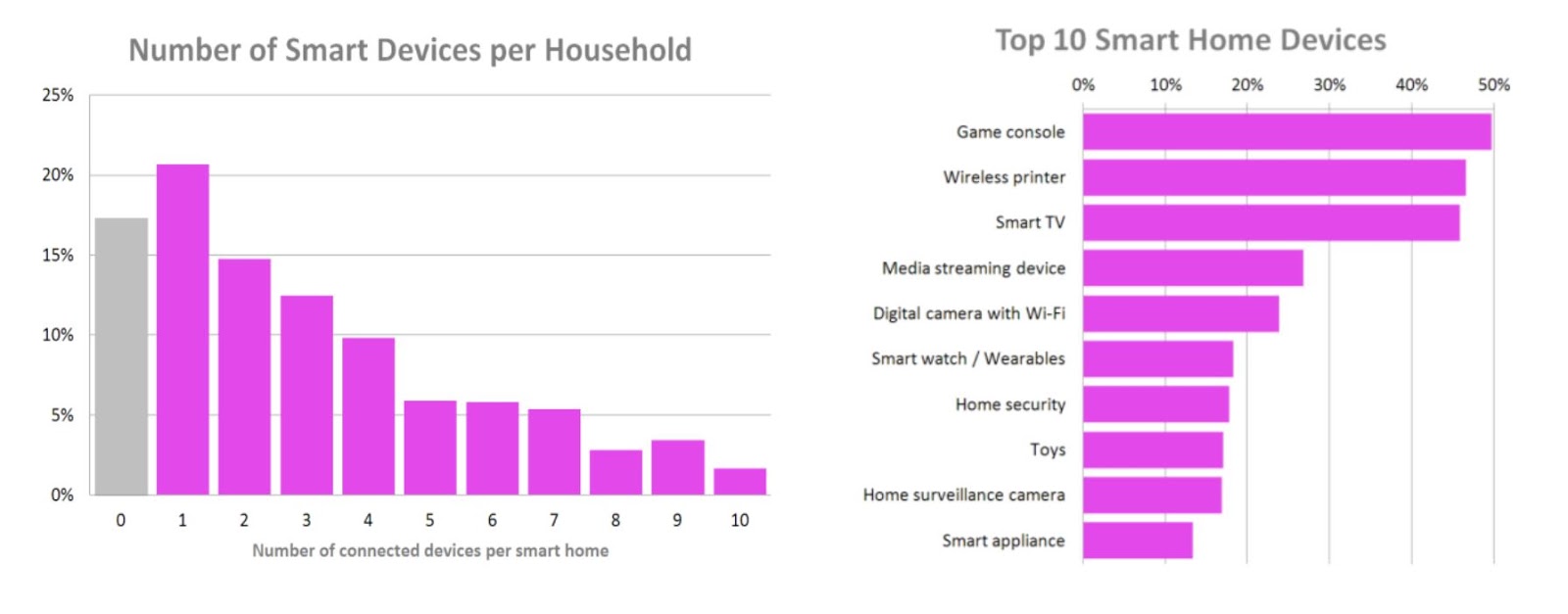 |
| Digital device adoption in the smart home. Source: prpl Foundation Smart Home Security Report |
The prpl Foundation has teamed up with the Continental Automated Buildings Association (CABA) on together on research projects to improve standards in smart home security.
The Foundation is an open-source, community-driven, collaborative group with a focus on enabling next-generation datacentre-to-device portable software and virtualized architectures, based around the MIPS architecture.
The Foundation is an open-source, community-driven, collaborative group with a focus on enabling next-generation datacentre-to-device portable software and virtualized architectures, based around the MIPS architecture.
“prpl’s alliance with CABA is an incredibly important step in the advancement of smart home technology,” said Art Swift, president of the prpl Foundation. “By collaborating with CABA’s wealth of smart home security experts and members, we will work together to provide high quality research and guidance that will push IoT industry standards to make sure that consumers are kept safe as connected device usage in their homes grows.”
Prpl’s recent Smart Home Security Report found that the smart home is already here(see graphic above) and device adoption in certain cases has reached a tipping point despite it being insecure. By aligning itself with CABA, an organization that is supported by an international membership of nearly 350 companies and 25,000+ industry professionals, the two organizations will progress security developments within smart home technologies.
“We are delighted to enter this alliance with the prpl Foundation as a demonstration of our commitment to developing industry standards and protocols across industry initiatives,” said Ron Zimmer, president and CEO of CABA. “We look forward to participating in prpl’s vibrant, open-source communities, in particular the security working group, and collaborating on future smart home projects.”
The prpl Foundation promotes the use of open source software to better security and interoperability of the Internet of Things (IoT). It has created a comprehensive framework for Securing Critical Areas of Embedded Computing, a peer-reviewed, actionable guide that has been put in to practice with a successful proof of concept.
“IoT security is not a problem that is going to be fixed by one single entity, it will take the industry at large to get involved to create communities and advance our knowledge of the subject matter,” said Swift. “Prpl is pleased to be working with CABA and welcomes the opportunity to work with others to promote better standards for IoT and making the connected world more secure for consumers.”
Prpl’s recent Smart Home Security Report found that the smart home is already here(see graphic above) and device adoption in certain cases has reached a tipping point despite it being insecure. By aligning itself with CABA, an organization that is supported by an international membership of nearly 350 companies and 25,000+ industry professionals, the two organizations will progress security developments within smart home technologies.
“We are delighted to enter this alliance with the prpl Foundation as a demonstration of our commitment to developing industry standards and protocols across industry initiatives,” said Ron Zimmer, president and CEO of CABA. “We look forward to participating in prpl’s vibrant, open-source communities, in particular the security working group, and collaborating on future smart home projects.”
The prpl Foundation promotes the use of open source software to better security and interoperability of the Internet of Things (IoT). It has created a comprehensive framework for Securing Critical Areas of Embedded Computing, a peer-reviewed, actionable guide that has been put in to practice with a successful proof of concept.
“IoT security is not a problem that is going to be fixed by one single entity, it will take the industry at large to get involved to create communities and advance our knowledge of the subject matter,” said Swift. “Prpl is pleased to be working with CABA and welcomes the opportunity to work with others to promote better standards for IoT and making the connected world more secure for consumers.”
Tuesday, November 22, 2016
Shuffling code to foil cyber attacks
By Nick Flaherty www.flaherty.co.uk
Researchers in the US have developed a new program that tries to preempt cyber attacks by allowing programs to continuously scramble their code as they run, effectively closing the window of opportunity for an attack.
"Shuffler makes it nearly impossible to turn a bug into a functioning attack, defending software developers from their mistakes," said David Williams-King, a graduate student at Columbia Engineering. "Attackers are unable to figure out the program's layout if the code keeps changing."
Even after repeated debugging, software typically contains up to 50 errors per 1,000 lines of code, each a potential avenue for attack. Though security defenses are constantly evolving, attackers are quick to find new ways in.
Shuffler was developed to deflect this latter style of code-reuse attack. It takes ASLR's code-scrambling approach to the extreme by randomizing small blocks of code every 20 to 50 milliseconds, imposing a severe deadline on would-be attackers. Until now, shifting around running code as a security measure was thought to be technically impractical because existing solutions require specialized hardware or software.
"By the time the server returns the information the attacker needs, it is already invalid --Shuffler has already relocated the respective code snippets to different memory locations," said study coauthor Vasileios Kemerlis, a computer science professor at Brown University.
Designed to be user-friendly, Shuffler runs alongside the code it defends, without modifications to program compilers or the computer's operating system. It even randomizes itself to defend against possible bugs in its own code.
The researchers say Shuffler runs faster and requires fewer system changes than similar continuous-randomization software such TASR and Remix, developed at MIT Lincoln Labs and Florida State University respectively.
As an invitation to other researchers to try and break Shuffler, Williams-King is currently running the software on his personal website. (He can check that the code is shuffling and whether anyone has attacked the site by reviewing the program's logs).
On computation-heavy workloads, Shuffler slows programs by 15 percent on average, but at larger scales--a webserver running on 12 CPU cores, for example--the drop in performance is negligible, the researchers say.
This versatility means that software distributors as well as security-conscious individuals could be potential end users. "It's the first system that is trying to be a serious defense that people can use, right now," said Williams-King.
Shuffler needs a few last improvements before it is made public. The researchers say they want to make it easier to use on software they haven't yet tested. They also want to improve Shuffler's ability to defend against exploits that take advantage of server-crashes.
"Billions of lines of vulnerable code are out there," said the study's senior author, Junfeng Yang, a computer science professor at Columbia Engineering and member of the Data Science Institute. "Rather than finding every bug or rewriting all billions of lines of code in safer languages, Shuffler instantly lets us build a stronger defense."
Researchers in the US have developed a new program that tries to preempt cyber attacks by allowing programs to continuously scramble their code as they run, effectively closing the window of opportunity for an attack.
"Shuffler makes it nearly impossible to turn a bug into a functioning attack, defending software developers from their mistakes," said David Williams-King, a graduate student at Columbia Engineering. "Attackers are unable to figure out the program's layout if the code keeps changing."
Even after repeated debugging, software typically contains up to 50 errors per 1,000 lines of code, each a potential avenue for attack. Though security defenses are constantly evolving, attackers are quick to find new ways in.
- Samsung's IoT module taps SiLabs' Gecko technology...
- Consultancy launches IoT security evaluation service...
- Prpl Foundation creates IoT security group for MIP...
Shuffler was developed to deflect this latter style of code-reuse attack. It takes ASLR's code-scrambling approach to the extreme by randomizing small blocks of code every 20 to 50 milliseconds, imposing a severe deadline on would-be attackers. Until now, shifting around running code as a security measure was thought to be technically impractical because existing solutions require specialized hardware or software.
"By the time the server returns the information the attacker needs, it is already invalid --Shuffler has already relocated the respective code snippets to different memory locations," said study coauthor Vasileios Kemerlis, a computer science professor at Brown University.
Designed to be user-friendly, Shuffler runs alongside the code it defends, without modifications to program compilers or the computer's operating system. It even randomizes itself to defend against possible bugs in its own code.
The researchers say Shuffler runs faster and requires fewer system changes than similar continuous-randomization software such TASR and Remix, developed at MIT Lincoln Labs and Florida State University respectively.
As an invitation to other researchers to try and break Shuffler, Williams-King is currently running the software on his personal website. (He can check that the code is shuffling and whether anyone has attacked the site by reviewing the program's logs).
On computation-heavy workloads, Shuffler slows programs by 15 percent on average, but at larger scales--a webserver running on 12 CPU cores, for example--the drop in performance is negligible, the researchers say.
This versatility means that software distributors as well as security-conscious individuals could be potential end users. "It's the first system that is trying to be a serious defense that people can use, right now," said Williams-King.
Shuffler needs a few last improvements before it is made public. The researchers say they want to make it easier to use on software they haven't yet tested. They also want to improve Shuffler's ability to defend against exploits that take advantage of server-crashes.
"Billions of lines of vulnerable code are out there," said the study's senior author, Junfeng Yang, a computer science professor at Columbia Engineering and member of the Data Science Institute. "Rather than finding every bug or rewriting all billions of lines of code in safer languages, Shuffler instantly lets us build a stronger defense."
Tuesday, November 08, 2016
Power news this week
Power News from EETimes Europe
 . Solar socket sticks to window to provide power
 . Hearables boom prompts Varta IPO
 . Panasonic starts mass production of high speed GaN gate drivers
TECHNOLOGIES TO WATCH
 . Steel-brass battery aims for smart homes
 . Researchers fireproof lithium-ion batteries
 . Researchers produce first 3D printed permanent magnets
NEW PRODUCTS
- Hybrid polymer capacitors boost endurance with low leakage current
- AEC-Q200 flyback transformer targets high temperature automotive and industrial applications
- Next generation power distribution architecture replaces high-current relays and fuses
INTERVIEWS
LATEST PRODUCTS
LATEST PRODUCTS
- Motor control chip adds power for smart industry and consumer designs
- Compact, low loss EMC filters for high current photovoltaic applications
- 650VDC cartridge fuse boosts over-current protection
- Configurable fanless power supply with medical approvals.
- 11mm high LED drivers fit tight spaces for cabinet lighting
- Murata Power Solutions: Partial discharge characteristics of different transformer insulation systems in DC-DC converters
- The promise and challenges of LED lighting: a practical guide
- SiLabs: CMOS isolated gate drivers enhance power supplies
- Linear Technology: How the Internet of Things Can Take Advantage of Wireless Charging & Energy Harvesting


ON Semiconductor expands support for IoT with modular development platform
By Nick Flaherty www.flaherty.co.uk

ON Semiconductor has launched a modular IoT Development Kit (IDK) that provides engineers with all of the hardware and software building blocks needed to speed the evaluation, design and implementation of medical, home, and industrial IoT applications.
ON Semiconductor has launched a modular IoT Development Kit (IDK) that provides engineers with all of the hardware and software building blocks needed to speed the evaluation, design and implementation of medical, home, and industrial IoT applications.
The kit combines power-efficient devices for smart and connected IoT designs that includes sensors, power management, connectivity, processors and actuators. By combining these with a comprehensive software framework, the IDK offers a modular, easy to use and compact platform that provides developers with access to everything they need to rapidly develop cloud-based IoT designs.
The ON Semiconductor IDK incorporates a variety of module options for sensing, wired and wireless connectivity and actuation. Its software development framework encompasses an embedded operating system (ARM mbed OS), drivers, APIs for hardware shields, a graphical user interface (GUI), and sample applications code. Built-in support for cloud software enables the platform to deliver data into the cloud for value added services such as analytics. The extensible modular architecture includes a variety of industry-standard interfaces such as Arduino and Pmod, allowing the integration of existing and future modules from both ON Semiconductor and third parties.
“ON Semiconductor offers a one stop shop of leadership semiconductor elements for industrial, medical and home IoT applications. By providing a single, modular, extensible platform that combines hardware, software and support for integrating third parties, the new IDK allows engineers to quickly and easily harness the power of ON Semiconductor solutions and significantly simplify the prototyping of cloud-based applications,” said Wiren Perera, IoT Strategist for ON Semiconductor.
The IDK is capable of supporting numerous application areas, including industrial automation, intelligent lighting, building automation, smart cities and a wide range of medical monitoring designs.
The IoT Development Kit will be available through distribution partners.
“ON Semiconductor offers a one stop shop of leadership semiconductor elements for industrial, medical and home IoT applications. By providing a single, modular, extensible platform that combines hardware, software and support for integrating third parties, the new IDK allows engineers to quickly and easily harness the power of ON Semiconductor solutions and significantly simplify the prototyping of cloud-based applications,” said Wiren Perera, IoT Strategist for ON Semiconductor.
The IDK is capable of supporting numerous application areas, including industrial automation, intelligent lighting, building automation, smart cities and a wide range of medical monitoring designs.
The IoT Development Kit will be available through distribution partners.
Tuesday, November 01, 2016
Power news this week
Power News from EETimes Europe
 . Panasonic boost from Tesla solar roof and powerwall
 . Battery storage project funding booms as smart grid schemes hit
 . Daimler to establish global battery production network
 . EPC & Taiwan designers JJPlus collaborate on GaN for wireless charging
TECHNOLOGIES TO WATCH
 . Trilayer electrode structure boosts lithium silicon battery capacity by a third . Researchers produce first 3D printed permanent magnets . Researchers fireproof lithium-ion batteries
 . Power core module integrates FPGA and hybrid drive stage for electric aircraft
NEW PRODUCTS
 . First digital multiphase PWM controllers with AVSBus and synthetic current control
 . Single chip power protection and control for USB Type-C
 . Intelligent battery charger for automotive and industrial applications fits into IP21 DC-DC converter package
INTERVIEWS
- Synthetic current control drives efficiency in IoT infrastructure
- Power Trends: On Semi aims for Infineon with Fairchild deal
- Power Trends: industry voices
- Semtech delivers public wireless charging with LinkCharge CT
- Constant current power supplies for energy storage systems
- LED triac analyzer provides an alternative for LED dimming and control
Subscribe to:
Posts (Atom)