All the latest quantum computer articles

See the latest stories on quantum computing from eeNews Europe
Showing posts with label consumer. Show all posts

Wednesday, February 24, 2016

Atmel launches new TinyAVR in a bid to protect product line in Microchip acquistion

By Nick Flaherty www.flaherty.co.uk

Atmel has launched what it says is the world’s highest performing, low power, 8-bit MCUs with 1kB Flash memory. 

The new ATtiny102/104 MCUs runs up to 12MIPS and integrate features previously only available in larger more expensive MCUs, aiming at smaller applications including logic replacement and the latest cost-optimised applications in the consumer, industrial and home automation markets.

The move appears to be an attempt to protect the AVR product line with the impending acquisition by Microchip. Microchip's PIC range of 8bit microcontrollers is also popular in the the same markets and it is distinctly possible that the AVR range will become a victim of the merging of the product lines. A spokesperson for Atmel declined to comment on the future of the line as the acquisition has not been completed.   

The majority of today’s 8-bit market growth is coming from applications that previously only required discrete components. With many of these new applications requiring simple intelligent functions including timing, motor control or on/off functionality, 8-bit MCUs are becoming an essential feature for the personal healthcare, small kitchen appliance and consumer markets, says Atmel. 

As a result the ATtiny102/104 AVRs integrate features such as self-programming for firmware upgrades; non-volatile data storage; accurate internal oscillator to provide more reliable motor control; high-speed serial communication with USART; operating voltages ranging from 1.8V to 5.5V, 10-bit ADC with internal voltage references; and sleep currents at less than 100nA in power down mode with SRAM retention.

“Atmel has already sold more units of its 8-bit AVR core-based MCUs than the 7.4 billion people on Earth,” said Oyvind Strom, Sr. Director of MCUs at Atmel. “We continue to expand our AVR portfolio with the new ATtiny102/104 8-bit MCUs. These are the first two devices in our new tinyAVR portfolio that are packed with features optimized for tiny, compact MCU systems such as LED lighting, fan control and other small applications.”

Key Features for Atmel's 8-bit tinyAVR MCUs
  • 1kB Flash / 32bytes SRAM
  • 8- and 14-pin packages down to 2mm x 3mm in size
  • Up to 12 MIPS at 12MHz
  • Self-programmable Flash
  • Accurate (±3%) Internal oscillator
  • Multiple calibrated internal voltage references (1.1V, 2.2V, 4.3V)
  • 10-bytes Unique ID (serial number)
  • USART
  • 10 bit ADC and analog comparator
  • 1.8V to 5.5V voltage range
  • -40°C to +105°C  and -40°C to +125°C temperature ranges


Development Kits and Ecosystem

To accelerate the design process, Atmel offers a low-cost Xplained Nano evaluation kit available for only $4.44 USD in the Atmel Store. The new kit includes a board with an ATtiny104, embedded programmer, access to all I/O, one push button and one LED. The ATtiny102/104 are supported by Atmel’s development ecosystem, including Atmel Studio 7, the integrated development environment (IDE) for developing and debugging both Cortex-M and AVR applications. 


Engineering samples are available today with mass production samples scheduled for May 2016.  


Thursday, February 18, 2016

Renesas expands its Synergy platform for IoT with ARM Cortex-M0+ controller family

By Nick Flaherty www.flaherty.co.uk

Renesas, the world's largest supplier of industrial microcontrollers, has expanded its Synergy Platform with a new family of devices based around the ARM Cortex-M0+ to accelerate time to market, reduce total cost of ownership and remove many of the obstacles engineers face when designing devices for the Internet of Things (IoT). 

The expansion includes the launch of the S124 Group of Synergy Microcontrollers (MCU) with ultra-low power operating characteristics and precise analogue signal acquisition and generation for sensor applications. An updated version of the Synergy Software Package (SSP) and the e2 studio Integrated Solution Development Environment (ISDE) tool supports the new devices with optimisations for the ThreadX real time operating system. 

The S124 family is based on Renesas’ proprietary ultra-low power technology consuming just 70.3 µA per MHz of MCU clock speed for extremely long battery life in low power and battery-powered portable applications. These MCUs carry advanced analogue signal capabilities with 14bit ADC, 12bit DAC and low power comparators. User interface applications are supported with more than 30 channels of capacitive touch sensing inputs. Connectivity includes USB-FS and CAN interfaces, plus safety and security are assisted with on-chip support for SRAM parity checking, a NIST-compliant True Random Number Generator (TRNG), and AES-256 cryptography with chaining. 

The MCU packages are as small as 4 mm x 4 mm for space-constrained end-products such as smart edge-node IoT sensors, home appliance control, and point-of-sale terminals. 

“The Synergy Platform continues to grow in value to both developers and their end-customers,” said Mark Rootz, Marketing Director of Renesas’ Internet of Things Business Unit, Renesas Electronics America. “This new S124 Synergy MCU Group is another example of platform growth that brings ARM Cortex-M0+ based MCUs to the lower end of the application spectrum while remaining completely scalable and compatible with the companion Cortex-M4 based Synergy MCUs. Software support for these new S124 MCUs is there by expansion of the SSP enabling customers to quickly and easily migrate between all Synergy MCU groups as their needs change and still be able to re-use existing application code. We continue to evolve all elements of the Synergy Platform and build value as demonstrated here with new MCUs, new software, plus ever-growing tool and partner support for the platform.”

Peripherals for the S124 microcontrollers for IoT applications from Renesas 
Development support for the new S124 MCUs and the DK-S124 development kit is provided in SSP version 1.1.0 and e2 studio version 5.0. The SSP v1.1.0 has specific optimizations for the ThreadX real-time operating system (RTOS) and the USBX communication stack to work efficiently within the S124 MCU’s smaller memory sizes.

SSP v1.1.0 also includes enhancements for IPv6 networking and services for connected devices, BSD-compatible socket layer support, support for SSI audio and CAN communications, plus several additions to the Application Framework.

e2 studio v5.0 is now built upon the latest updated eclipse v4.5 (Mars release) plus it includes many new features to enhance automated guidance for starting new Synergy Platform projects such as presenting all building blocks of a project in a graphical stack representation for simplification of workflow and providing complete visibility into overall memory usage at a glance.

The platform expansion also includes five new Verified Software Add-ons (VSA) for home and industrial automation including Echonet, CANopen, and BACnet, plus secure communications, and cloud services. The US-based VSA products are now available on the Synergy Gallery – Cypherbridge Systems SDKPac for Synergy secure IoT and web connectivity including SSL/TLS, Icon Labs for security services including firewall and secure boot, and Skkynet for secure real-time data connectivity, on premise or cloud-based (SaaS).

The S124 controllers are now in mass production status and will be available through Renesas sales channels in April 2016, along with their development kits. An early preview of SSP v1.1.0 and e2 studio v5.0 will be available on the Synergy Gallery at end of February 2016 with final released versions available in April 2016.

This means three Synergy MCUs Groups in the Synergy MCU Family have reached mass production status – the S124, S3A7, and S7G2 families – representing 30 individual Synergy MCU part numbers in a wide variety of memory and package sizes ranging from 128 KB to 4 MB of flash memory. More MCU Groups are on the way, as well as new qualified SSP software capabilities, tools, kits, solutions, and verified partners. 


Wednesday, June 02, 2010

Hewlett-Packard Maintains MEMS Dominance in 2009


Print heads still drive MEMS manufacturing but cell phone accelerometers are catching up
By Nick Flaherty www.flaherty.co.uk

It's always good to have pre-conceptions challenged, and this one is big - that HP is the leading manufacturer of Microelectromechanical (MEMS) sensors among semiconductor Integrated Device Manufacturers (IDM) and fabless firms, according to the latest figures from market researchers iSuppli.
“While sales of Hewlett-Packard’s inkjet printers fell 12 percent in 2009, the top player was able to cushion the blow through its large installed base, whose use of disposable printheads or replacement ink cartridges continues to provide significant revenues,” said Jérémie Bouchaud, principal analyst at iSuppli. “More than half of Hewlett-Packard’s MEMS revenue is fabless, and the company outsources the fabrication of a large portion of its printheads to STMicroelectronics. The seismic-grade accelerometers introduced by the company at the end of 2009 have not yet started contributing to its MEMS revenue, iSuppli research shows.”

In second place and mirroring its runner-up position in 2008 was Texas Instruments.
“Despite losing several hundred million dollars in MEMS since 2006, Texas Instruments benefited in 2009 from the revenue that MEMS in pico-projectors started to bring in,” Bouchaud said. “Furthermore, the MEMS in DLP chipsets produced by Texas Instruments for use in rear-projection TVs did better than expected, thanks to Mitsubishi Corp.’s continuing investment in laser rear-projection technology utilizing DLP.”
Likewise unchanged in their 2009 positions from the year before were the companies in third and fourth place: Bosch and Canon. Bosch, at No. 3, saw its overall MEMS revenue dip by 3 percent and its automotive MEMS revenue decline by 17 percent. However, consumer electronics revenue from the company’s Bosch Sensortec branch rose almost fourfold last year. Holding down the No. 4 spot was Canon, which gained MEMS share in the inkjet printhead segment, although its shipments remained flat.
Other companies in the IDM and fabless category that performed well included Epson, which achieved a 12 percent increase in revenue thanks to its booming quartz MEMS gyroscope business; and STMicroelectronics, which holds more than 40 percent of the accelerometer market for cell phones.
IDMs—i.e., semiconductor suppliers that conduct their manufacturing in-house—accounted for a greater share of MEMS revenue—roughly 77 percent, compared 23 percent for fabless manufacturers. However, the market share of fabless firms—i.e., semiconductor companies that outsource their manufacturing—is set to increase during the next five years because of the growing trend in the industry to use external foundries for semiconductor production.
Taken together, MEMS revenue for the Top 10 IDMs and fabless manufacturers amounted to $5.7 billion in 2009, down 8.8 percent from the year before. The decline was less than expected, mainly because of the impressive recovery of sensor production, especially in the automotive sector, during the last four months of 2009.

For more information, see iSuppli’s new report MEMS: Where's the Money and Who's Making it?

Reblog this post [with Zemanta]

Friday, May 14, 2010

World's Smallest Flash Microcontroller Package for Silicon Dust

Ultra-small packaging expands design options for applications in consumer, lighting and industrial control markets
 
By Nick Flaherty www.flaherty.co.uk

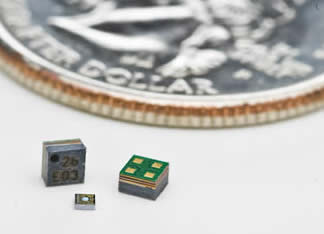
Just look at the size of this! Atmel has launched the world's smallest flash AVR microcontroller package, putting 12MIPS of processing for 50c in a mere 4 square millimetres, driving the trend to 'silicon dust' - processors so small they start to sit almost anywhere from connectors to leads to clothing.
The Atmel ATtiny4, ATtiny5, ATtiny9 and ATtiny10 AVR microcontroller (MCU) come in an ultra-small 8-pad UDFN package, with a dimension of only 2mm x 2mm x 0.6mm, and weighing less than 8 mg to reduce the package size as much as 55 percent compared to the market's smallest package offering available today. These products target applications in the consumer electronics, lighting, and industrial control markets. The new devices are well suited for lightweight and small form factor consumer applications, such as cell phones, toys, tooth brushes and other personal care and portable electronic products.
The smaller, lighter, faster and low-power microcontrollers from the Atmel ATtiny4/5/9/10 family also make it possible to integrate a powerful AVR MCU in some of the smallest designs. These designs may include the inside of electrical leads and miniature connectors, printer heads, and other applications such as inside clothing fabrics, plastic cover sheets or shells.
"This new package offering will strengthen Atmel's leadership in the microcontroller market," said Ingar Fredriksen, AVR Product Marketing Director. "In addition to being 55 percent smaller than any other 6-/8-pin Flash microcontroller in the market, the ATtiny4, ATtiny5, ATtiny9 and ATtiny10 devices deliver six times higher processing speed than the closest competitor."
This family is based on Atmel's patented low-power picoPower technology which enables any AVR microcontroller to operate at the industry's lowest power consumption at 650 nA, with a RTC running, and less than 100 nA in power down. These products also contain a rich feature set to execute code up to 12 MIPS at 12 MHz.
The Atmel ATtiny4, ATtiny5, ATtiny9 and ATtiny10 are available now. Volume pricing start at $0.52 USD for 10k quantities.
Reblog this post [with Zemanta]

Tuesday, April 27, 2010

Audium Semiconductor assets bought by NXT (UK Technology Startups)

Audium Semiconductor assets bought by NXT (UK Technology Startups)

Amplifier chip startup Audium Semiconductor in Bristol  has closed and its assets have been bought by flat panel speaker maker NXT. The company raised $8.5m in September 2007 for its untra low power amplifier but failed to raise a second round of venture capital.

Sunday, March 14, 2010

SiBEAM raises $36.5m for next round of high data rate wirelessHD

Cisco Joins Panasonic & Samsung to Accelerate Consumer Adoption

The most advanced millimetre wave startup, SiBEAM, has raised $36.5m in its D round of funding to accelerate the consumer adoption of its 60GHz short range wireless technology.
All of SiBEAM’s original investors contributed to this round including U.S. Ventures Partners (USVP) and New Enterprise Associates (NEA), joined by new partners in SiBEAM’s success, Lux Capital and Hatteras Funds. Best Buy and Cisco have also contributed strategic equity investments to support SiBEAM’s growth as well as fund future projects for personal computing and mobile devices.
"SiBEAM continues to deliver on its promise to bring high-quality, lossless wireless high definition capabilities to the A/V home entertainment market. Their team has executed well on its plans and has brought in nearly all leading CE manufacturers as customers through its work with the growing WirelessHD Consortium,” said Adam Grosser, General Partner at Foundation Capital which led the round. “This market adoption further supports our confidence in SiBEAM’s technology and the team’s capabilities to drive and solidify the company’s leadership in the exciting and high-growth wireless connectivity market.”
SiBEAM’s second generation 60GHz chipset with its OmniLink60 Technology was brought into mass production earlier this year for A/V receivers, home theater-in-a-box systems, Blu-ray players, set-top boxes, media center PCs, and consumer laptops.
“This round of financing is a significant milestone for SiBEAM as it demonstrates the continued growth of our business and potential for significant investment return even in a challenging economy. With these funds, we can grow our business toward profitability in the burgeoning wireless A/V market,” said John LeMoncheck, President and CEO of SiBEAM. “SiBEAM continues to receive extensive interest from CE and PC manufacturers worldwide that are eager to integrate simple, cost effective and high quality wireless streaming capability into their products.”
Reblog this post [with Zemanta]

Monday, January 25, 2010

Blu-Ray and Network Connectivity Finally Start Encroaching on DVD

High-volume shipments of Blu-ray players, most of which feature network connectivity, are finally making inroads into the broader disc player and recorder market, says market researcher In-Stat. By 2013, Blu-ray player shipments will still lag slightly behind the 90 million DVD player unit shipments. However, higher average selling prices will put Blu-ray player revenue at more than 4 times as large as DVD player revenue.
“In North America, significant price drops of Blu-ray players drove unit shipments to triple in 2009,” says Michelle Abraham, In-Stat analyst. “The cost differential between standard definition DVD and Blu-ray is becoming much smaller and new features such as IP/network connectivity are becoming increasingly important. Blu-ray is finally starting to make significant advances market.”
Recent research by In-Stat found the following:
  • Shipments of network-enabled Blu-ray players/recorders will approach 80 million units by 2013.
  • 18% of US survey respondents with at least some interest in purchasing a Blu-ray player cited cost as a barrier.
  • Japan dominates the market for Blu-ray recorders. Europe is the largest revenue market for Blu-ray players.
  • The key semiconductor providers supporting the Blu-ray and DVD player/recorder market include Broadcom, NEC, MediaTek, Sunplus and Zoran.
The research, “Worldwide Blu-ray and DVD Player/Recorder Market” (#IN1004547ME), covers the worldwide market for DVD players and recorders.
Reblog this post [with Zemanta]

Friday, January 22, 2010

French focus on 3D packaging for consumer and wireless applications


Leti and R3Logic to Combine Expertise in Three-Year Lab Agreement 


French research lab Leti is teaming up with R3Logic, a leading US 3D IC EDA company to combine their expertise in 3D silicon integration and packaging in France to build 3D IC designs and methodologies for consumer and wireless applications.
3D ICs enable dramatically improved performances at a much lower cost than new, leading-edge CMOS technologies. The creation of these new ICs depends on the availability of new methodologies and skills that require a deep understanding of the overall semiconductor supply chain, including EDA, design technology and fabrication technology. This three-year Leti-R3Logic common lab is aimed at developing 3D-design solutions to accelerate developments in 3D chip-package co-design, including TSV placement and short-loop floor planning, allowing management of all aspects of the design flow in an integrated fashion. “With R3Logic’s presence in Grenoble and Leti’s leading design-and-process-technology research infrastructure, we have the full range of competencies of the ideal ecosystem working together,” said Laurent Malier, CEO of Leti. “We are confident this joint lab will accelerate the adoption of 3D-IC technologies by the semiconductor industry, which will better align its fabrication process, and by the mobile- and consumer-device industries, which will develop more-competitive products.”
“Being closer to world-leading design and technology teams will allow us to accelerate the adoption of our EDA tools,” said Lisa McIlrath, CEO of R3Logic, which opened an R&D centre in Grenoble last year. “We are collaborating with Leti for three reasons: their research and technology expertise will help us accelerate development of our tools, their business model allows us to better protect our IP, and finally, their immersion in a complete ecosystem that concentrates in the same region the full spectrum from R&D in advanced concepts to major global providers of mobile and consumer applications.”
As a major player in the MINATEC excellence centre, Leti operates 8,000-m² state-of-the-art clean rooms, on a 24/7 schedule, on 200mm and 300mm wafer standards. With 1,200 employees, Leti trains more than 150 Ph.D. students and hosts 200 assignees from partner companies and owns more than 1,400 patent families.  R3Logic, founded in 2000 in Massachusetts, specializes in the design of 3D integrated circuits and has developed a unique set of patented EDA tools for 3D integrated circuit design. R3Logic has created a new R&D centre in Grenoble, France, to develop and enhance its design tools for 3D heterogeneous system and system-in-package design. This center is part of a newly created French subsidiary, R3Logic-France, which when fully staffed over the next two years will employ over 20 engineers. The centre will also work in close collaboration with STMicroelectronics.
Reblog this post [with Zemanta]

Monday, October 05, 2009

True wireless speakers emerge with Audium


The main problem with "wireless" speakers is that they aren't - you end up replacing the speaker cable with a power cable, which can give you some advantages but really isn't the point.
Now, a Bristol startup aims to provide true wireless speakers with an audio amplifier that uses just 5% of the power of traditional amplifiers.
Audium Semiconductor has developed an amplifier architecture that can run for nearly a year off 4 C size batteries, with the first device, the AS1001, aimed squarely at wireless speakers. The architecture uses patented techniques to minise both fiexed power losses and output dependent variable power lossses with a low switch rate in the modulation.
"Traditionally audio amplifiers have only reached quoted efficiency figures at maximum output, which is like building a city car that's only efficeint at 200mph," said Huw Davies, chief commercial officer at Audium.
Altough 4 C sized batteries are still quite large, there is plenty of space in traditional speakers, giving them the flexibility to be placed anywhere in the house. With surround sound speakers there is a different challenge, as these are already small and adding the batteries would double the size of the units, but there are design tradeoffs there where styling will make a key difference. The rear surroundsound speakers also only account for 4 to 5% of the sound, so could use less batteries.
The company has rasied $8.5m for the design and development of the chip in 0.18um 30V digital technology at TSMC, and is planning a stereo device for wireless MP3 docking stations, and then looking at the automotive market.

Wednesday, September 30, 2009

HD video broadcast network launched by Akamai

In a move that has big implications for the developers of equipment that receives multimedia - whether tethered or portable - Akamai Technologies has launched the first platform to deliver HD video online to viewers using Adobe Flash technology, Microsoft Silverlight, and to the iPhone, at broadcast scale. The Akamai HD Network is the only solution that supports live and on-demand HD streaming with a highly-personalized and interactive online experience that matches and complements HD television.
As a first-of-its-kind streaming platform, the Akamai HD Network is designed as one, comprehensive HD network reaching multiple playback environments and devices, including Flash, Silverlight, and the iPhone. Using its globally-distributed EdgePlatform of more than 50,000 servers, the Akamai HD Network enables content providers to deliver more HD content than previously possible – due to its wide-scale distribution in 70 countries and increased throughputs in more than 900 networks.
This means that Silverlight and Flash will be a key element of any embedded multimedia software design.

The Akamai HD Network uses:
· Adaptive Bitrate Streaming - Unique network and player streaming process that is designed to enable uninterrupted playback at HD bitrates that seamlessly adjusts to fluctuations in available bandwidth to provide the best quality possible for each user
· Instant Response – Immediate response to viewer interactions with the video player, including sub-second time-shifting (such as pause, rewind, seek and play commands) video startup times, and seamless stream switching
· HD Video Player – Open, standards-based video player for faster time to market
· HD Player Authentication - Authenticates player for all three environments ensuring only authorized players access content

“Seeing is believing,” said Paul Sagan, President and CEO, Akamai. “With the Akamai HD Network, we are revolutionizing the way content traverses the Internet with a new approach to bringing an HDTV-like experience online. We’re entering a different online world, where many content owners and publishers need to deliver HD-quality video to a much wider online audience, with a higher level of interactivity for consumers. Delivering ‘web-quality’ content to ‘web-sized’ audiences is one thing, but delivering HD-quality content to broadcast-scale audiences is another.”
Two key trends have made it necessary to now evolve how streaming media is delivered on the Internet. First, online audiences have grown to broadcast scale. Second, those viewers are demanding higher quality content. Studies show that when higher quality video content is offered, viewer engagement time increases. Supporting this level of traffic requires a global network that can manage millions of simultaneous users streaming very high bitrate content. The Akamai HD Network was designed for large-scale broadcasters and film distributors looking to increase audience engagement and to expand revenues by complementing traditional mediums, such as TV and DVD, with the Internet.
The Akamai HD Network offers adaptive bitrate streaming capabilities across playback formats that are specifically optimized to work with Akamai’s HD EdgePlatform for the fastest and most consistent video bitrate switching - enabling an instant and uninterrupted viewing experience for consumers even at the highest bitrates. Leveraging Akamai’s entire HTTP footprint, video over Akamai’s HD Network is delivered from servers closer to audiences around the world. As a result, Akamai can more tightly control the amount of time the player needs to buffer before switching streams. The shorter the buffer, the faster the stream can adapt and respond to changing end-user conditions. The result is intended to create a seamless HD quality video experience – with little to no buffering.
“We are excited to see Akamai’s commitment to HTTP adaptive streaming as the future of online video delivery, as we have worked closely over the past year to build a robust end-to-end media delivery platform with IIS Smooth Streaming and Silverlight,” said Steve Sklepowich, director for Silverlight at Microsoft Corp. “Together, we’ve proven that these true HD experiences can dramatically increase online viewing times for broadcasters. In addition, Microsoft’s ability to deliver live and on-demand protected streams with Smooth Streaming and Silverlight, along with enhanced interactive experiences, such as multiple camera angles, alternate language tracks and in-stream data feeds, have raised the bar for online delivery using HTTP.”

Wednesday, September 16, 2009

Low power USB development kit from TI at $49

With a low power digital signal processor, Texas Instruments has managed to develop a development kit in a USB stick which drops the cost of a full-featured emulator and integrated development platform down to $49. This enables rapid creation of DSP applications including portable audio players, voice recorders, IP phones, portable medical devices, biometric USB keys, software defined radios (SDRs), hands-free headsets and metering applications. At this extremely low price point, it is the industry’s lowest cost DSP tool, making development accessible to existing and potential customers, hobbyists, researchers and students.
The TMS320VC5505 eZdsp USB stick development tool simplifies development by providing integrated features such as an on-board XDS100 emulator and on-board audio codec and connectors. Taking advantage of the energy efficient C5505 DSP, the eZdsp requires no other components or cables allowing the entire development tool to be powered by the USB port. Designers simply plug into the USB port of any laptop or workstation for hassle-free development and a simple out-of-the-box experience.
It is based on the C5505 processor, the industry’s lowest power 16-bit DSP with active power consuming less than 0.15 mW/MHz and standby power less than 0.15 mW. An on-board audio codec and connectors allow developers to evaluate many features of the C5505 processor and quickly optimize complex DSP algorithms in terms of performance and power consumption across a variety of design scenarios, and an extension connector allows developers to design and directly connect to daughter cards suitable for their application.
The C5505 eZdsp USB stick development tool is available now $49, which includes a full XDS100 emulator and a target version of the CCStudio v.4 software. Special incentives are available for educators, university students and developers actively participating in TI’s online community.

Reblog this post [with Zemanta]

Tuesday, August 25, 2009

Jukebox player startup thriving


Nice to see startups thriving. Martin Brennan, covered in my story in Electronics Weekly back in September 2007 is doing well with his JB7 jukebox that uses an innovative, simple interface to access thousands of CDs on a simple unit. The reviews are good and full page ads are appearing, so things are going well.

Reblog this post [with Zemanta]

Wednesday, August 19, 2009

Silicon microphone moves to Bosch

Akustica, developer of silicon MEMS (micro electro-mechanical systems) microphones for the consumer electronics market has been bought by Robert Bosch North America. Terms of the agreement will not be disclosed.
Akustica, which was founded in 2001, is based in Pittsburgh, Pennsylvania and develops and sells digital and analogue micro electromechanical microphones using standard CMOS silicon technology. This approach allows the integration of transducer elements and associated integrated circuits on a single Silicon chip. Bosch is the world leader in MEMS sensors and, with this acquisition, further strengthens its position in this market.
“The strategic acquisition of Akustica with their outstanding application of sophisticated MEMS technology complements our growing semiconductor business and ideally complements our ongoing MEMS activities” said Dr. Stefan Kampmann, executive vice president, Bosch Automotive Electronics. “We look forward to working together with the Akustica team to continue to develop this important business area.”

To date Akustica, which developed and sold the world’s first digital MEMS microphone, has sold over 5 million microphones in the global market. All of the company’s 36 associates will be employed by Bosch.
According to Joseph A. Jacobson, president and chief executive officer, Akustica, Inc., “We are excited to join the market leader in MEMS sensors and be a part of Bosch's expansion in commercialization of consumer MEMS products. The strength of our combined technology, manufacturing capability, and talent will allow us to continue delivering innovative and differentiating sensor product solutions.”

Comment: However, this looks more like the inability of Akustica to raise more money in the current financial climate and not enough income to go it alone despite big early plans.

Reblog this post [with Zemanta]

Wednesday, June 10, 2009

Touch screen chip maker licenses ARM M0

Melfas, a Korean chipmaker, has licensed ARM's Coretex M-0 32bit core to upgrade from its 8bit 8051 core in a capacitive-sensing touch input chip.
Melfas has many years’ expertise in designing turnkey touch screen module solutions including controller IC, circuitry, driver software, and patterned ITO panel with window lens and test system. It has shipped over 40 million controller ICs since 2006. According to market research firm, DisplaySearch, the total touch screen module market will grow from $3.6 billion in 2008 to $9 billion by 2015, with a CAGR of 14 per cent.
"Our engineers were already familiar with the Keil software development tools, which support both 8051 and ARM Cortex-M0 processor-based devices," said D.J. Min, VP Engineering, Melfas. "We were able to quickly and easily evaluate the new processor using our existing 8051 code base. The results demonstrated that we could halve the flash memory requirement using the Cortex-M0 processor, and reduce the MHz requirement by 5x, saving power.”

The deal is a good one for ARM as it drives high volume royalties.
“The use of touch screen controllers in products ranging from mobile phones, personal media players, digital cameras, navigation devices, to home appliances is rapidly increasing. The Cortex-M0 processor’s energy efficiency and small size make it particularly suited for these applications,” said Eric Schorn, VP marketing, Processor Division, ARM. “The agreement with Melfas is a further endorsement of the Cortex-M family of low power processors and ARM physical IP, and demonstrates ARM’s low power leadership.”

The Cortex-M0 processor is the lowest power and smallest 32-bit ARM processor. It offers an optimal blend of ultra low-power, energy efficiency and low gate count, with binary upwards compatibility with the higher performance ARM Cortex-M3. This makes it an ideal next step for embedded applications that outgrow legacy 8-bit microcontrollers, skipping the need for 16-bit devices.
Based in Seoul, Korea, Melfas was set up in 2000 with a mission to make electronics friendly and smart. Melfas developed its first semiconductor fingerprint sensor in 2003 and its first touch sensor chip in 2005, and early this year announced it had shipped 40 million touch sensor chips.

Thursday, June 04, 2009

Intel buys Wind River

Intel is making a serious play into the truly embedded market with a $884m deal to buy real time operating system (RTOS) company Wind River Systems.
The board of directors of Wind River has unanimously approved the transaction which is expected to close this summer and then Wind River will report into Intel's Software and Services Group, headed by Renee James.
This is a key part of Intel's strategy to grow its processor and software presence outside the traditional PC and server market segments into embedded systems and mobile handheld devices, and Wind River is already a close partner with Intel, making use of its hardware virtualisation technology.
Wind River will become a wholly owned subsidiary of Intel and continue with its current business model.
"This acquisition will bring us complementary, market-leading software assets and an incredibly talented group of people to help us continue to grow our embedded systems and mobile device capabilities," said James at Intel. "Wind River has thousands of customers in a wide range of markets, and now both companies will be better positioned to meet growth opportunities in these areas."
"As a wholly owned subsidiary, Wind River will more tightly align its software expertise to Intel's platforms to speed the pace of progress and software innovation," said Ken Klein, Wind River Chairman, president and CEO. "We remain committed to continuing to provide leading solutions across multiple hardware architectures and delivering the same world-class support to which our customers have grown accustomed."
The acquisition will deliver to Intel robust software capabilities in embedded systems and mobile devices, from in-car "info-tainment" systems and other automotive areas, networking equipment, aerospace and defence to energy and thousands of other devices.

Wednesday, June 03, 2009

Android moves into home equipment

MIPS Technologies has ported Google's Android operating system to its processor cores, aiming to drive the software, and Web applications, into more areas such as digital TV and set top boxes.
With Android and the open source development community around it, developers can easily and quickly create new applications and OEMs can leverage the growing set of applications for their devices, says MIPS. With the MIPS ecosystem around Android, OEMs will be able to quickly optimize Android for their specific platforms.
"In the future, almost every consumer device will be connected to the Internet and its wide array of content," said Rich Wawrzyniak, senior analyst for ASIC and SoC at Semico Research Corporation. "Leveraging Android to quickly and easily bring new and innovative applications and user interfaces to devices beyond the mobile phone is a very appealing proposition for consumers. Android also removes applications from their ties to specific hardware systems and opens the market for companies like MIPS Technologies to move into new market segments. I can understand why MIPS’ partners and licensees are excited about Android on MIPS. It is a potential game changer."

MIPS Technologies is establishing development tools and system integration partnerships with service providers to help its licensees with porting, integration, and testing. Partnerships initially include those with Embedded Alley and Viosoft.
Embedded Alley, a leading provider of embedded Linux solutions, is offering support for SoC implementations from MIPS Technologies’ licensees. The Embedded Alley Development System for Android-based Devices includes processor and board support as well as a version of the Android Dalvik virtual machine (VM) optimized for the MIPS instruction set and CPU cores; extending the Android bionic library, linker and other software infrastructure for the MIPS architecture; and providing integration and testing board support industry-specific device drivers, CODECs and other middleware. Embedded Alley is already enabling Android on devices built with the Alchemy Processor family from RMI—providing an Android-ready Linux kernel for RMI Au1250 and the Embedded Alley Development System for Alchemy reference platforms.
“Embedded Alley and MIPS Technologies have been working closely to deliver value to our mutual customers,” said Matthew Locke, COO, Embedded Alley. “Following the success of Android in the mobile phone market, many companies have been looking at the potential of Android beyond mobile handsets, but it just wasn’t clear how to make Android a reality for other types of devices. Embedded Alley, together with MIPS -- a strong leader in the digital home marketplace -- has determined what it will take, and we are making it happen. We are enabling OEMs and developers to create new Android-based designs."

Viosoft Corporation is a key partner for MIPS based software development tools. Viosoft’s Arriba tools deliver comprehensive support for single and multi-core platforms. The tools support Android, and are available today.
“The MIPS architecture has consistently delivered high-performance Linux platforms with low power consumption, making it ideal for VM-based environments such as Android,” said Art Lee, vice president of business development, Viosoft Corporation. “To enable the porting, debugging and deployment of the Android platform on MIPS, Viosoft provides a set of unique and very powerful tools that dramatically reduce development time, risk and costs. Working closely with MIPS Technologies, we are focused on helping OEMs quickly and easily bring their Android platforms to market.”

Wednesday, May 13, 2009

USB3.0 test chip from TI

Texas Instruments has developed a new 5Gbit/s transceiver test chip designed to the USB3.0 specification version 1.0 as part of the SuperSpeed USB promoters group. The new transceiver is capable of driving and receiving signals over 4m USB3.0 cables to ensure data integrity. This transceiver will be demonstrated at the USB Developers Conference in Tokyo, Japan on May 21-22.
The new SuperSpeed USB transceiver, with intellectual property (IP) for a digital controller from design tool vendor Synopsys, tested successfully at the USB-IF SuperSpeed Peripheral Interoperability Lab.
“Demonstrating interoperability between Synopsys’ DesignWare SuperSpeed USB digital controller and TI’s USB transceiver gives designers confidence that the IP functions successfully in a real-world system environment,” said John Koeter, vice president of marketing for the Solutions Group at Synopsys. “Synopsys and TI are working together to help advance new technology into the market quickly, while minimizing risk and speeding time-to-market.”


The test chip includes an integrated spread spectrum PLL, support for multiple input reference frequencies: 20 MHz, 25 MHz, 30 MHz and 40 MHz, PIPE3 and ULPI compliant interfaces and programmable transmitter pre-emphasis. These save system cost by eliminating the need for an external spread spectrum clocking device and give interoperability across a wide selection of ASIC / FPGA platforms eases designs by allowing designers to work with the same USB device, regardless of the processor platform.

The first of TI's SuperSpeed USB family of devices, the TUSB1310, SuperSpeed USB transceiver, will sample by the end of the year with volume production in the first quarter of 2010


USB3.0


The most obvious change in SuperSpeed USB versus USB 2.0 high-speed is the over 10X speed increase from 480 Mbps to 5 Gbps. There are many applications for which the USB connection is becoming the bottleneck and, as with the introduction of USB 2.0 high-speed, SuperSpeed USB will inspire the creative minds in the industry to develop new, emerging applications and end-equipment that will benefit from the higher performance. The 5Gbit/s data rate should provide headroom for the next 5 years.

In addition to the increase in speed, the physical layer electrical signaling has changed from the simple two-wire system to a dual-simplex data path. This is done over a completely different set of connections than the existing USB 2.0 two-wire interface, which remains untouched. In addition, it was mandatory that the any changes in the electrical signaling scheme NOT drive the need for a new forma factor plug or receptacle on the host, and if possible, on the peripheral as well. In order to minimize the risk, the promoters group determined that creating the new signaling scheme to be very similar to PCI Express could meet the goals. This also allows the connection to retain sideband functionality without additional wires and allow for receiver termination for connect/disconnect detection.

One of the other key changes was to focus on improving the power efficiency of the bus. This is ideal for extending the battery life for portable devices, whether hosts (notebook PCs) or peripherals. The specification defines excellent power characteristics, especially for idle links. Both Upstream and Downstream ports can initiate lower power states of the link. There is also local power management control using multiple link power states defined to further improve the power use efficiency. In addition, another power saving method was to eliminate all polling of devices.

Tuesday, January 08, 2008

Pansonic shows 150in plasma screen

It's the Consumer Electronics Show again, and this year Panasonic is pushing the size of its HD plasma screen to 150inches! It is also likely to be selling fro roughly the same price (£50,000) as last year's 103in version. But this is going to need some high class content, or be viewed from quite a long way away!

Wednesday, January 02, 2008

Handheld projectors start emerging


The problem of displaying information from ever smaller devices has been a major headache fro several years. Micromachined technology such as Texas Instruments' Digital Light Processor (DLP) have driven down the size of projectors to just-about-handheld (see previous stories) and now a new venture is tackling the same market.
Microvision of Redmond, Washington has developed a prototype of a truly handheld, battery powered projector (right) for mobile phones and personal media players that goes on show at the CES consumer electronics show next week (Jan 7th), although production is planned for the end of the year.
Code-named SHOW, Microvision's pico projector uses a single micromachined mirror (rather than TI's array of mirrors) and laser scanning to get the size down to 7mm thick and keep the power down. The images projected can range anywhere from 12 inches (30 cm) to 100 inches (2.5 m) in size depending upon the projection distance and are always in focus. The production version of the device is expected to offer approximately 2.5 hours of continuous battery life, sufficient to watch a full-length movie without a need for recharging.
Microvision says that SHOW can project a widescreen, WVGA (848 X 480 pixels), DVD quality image, compared to other miniature projectors that typically only offer QVGA resolution (320 x 240 pixels). The technology is already being used for a head-up display in development for cars.
"While mobile multi-media subscription services are on the rise, handset manufacturers, content providers and service providers view tiny cell phone displays as a barrier to stronger consumer adoption of their products and services,” said Alexander Tokman, President and Chief Executive Officer of Microvision. "SHOW is a significant milestone for Microvision and is proof that our technology is maturing according to plan and is close to being market-ready. Microvision's low-profile and low-power design, supported by leading supply chain partners, is very attractive to numerous mobile handset device manufactures, carriers and content providers. We believe that this milestone is meaningful not only for our company but for the industry at large," he said.

Wednesday, December 19, 2007

Shake up in the set top box business

Philips has sold its set top box and connectivity business to Pace Micro Technology of the UK in a move that will help Pace achieve the scale that it needs to compete effectively in global markets. The company has been struggling in recent years, although it has a stream of contracts from the US.
The deal also includes the connectivity business, and Pace has been a leader in this area aiming to integrate the connectivity around the home into the set top box to help maintain margins and prevent the business moving to low cost Chinese suppliers.
Philips agreed in principle to divest the STB and CS businesses to Pace in exchange for 70 million Pace shares. The proposed transaction is subject to approvals from Pace shareholders, the relevant regulatory authorities and Philips' workers council. After completion, Philips will become a 23% shareholder in the combined business, representing a market value of around £60m.
The outcome of the transaction will result in a combination of strengths of two leading players in the industry, creating one of the largest set-top-box players in the world at a time when the shift from analogue to digital TV is rapidly increasing. Commenting on the sale, Philippe Alcaras, Business Unit leader Philips Home Networks said: "We feel that the rapidly changing dynamics of the markets in which the STB and CS businesses operate will inevitably culminate in further industry consolidation. By striking a deal with Pace now, we gain the first-mover advantage and it shows Philips' determination to secure a leading role for our businesses, and make them even more relevant to our customers and technology partners."
The two businesses had estimated sales of EUR 425 million in 2007 and employed 335 people, predominantly based in France, who would transfer to Pace as part of the transaction. The remainder of Home Networks, Home Communications, which includes Internet Telephony and Home Telephony (DECT), will become part of the Peripherals & Accessories unit within Philips' Consumer Lifestyle sector.