All the latest quantum computer articles

See the latest stories on quantum computing from eeNews Europe
Showing posts with label SATA. Show all posts

Tuesday, May 10, 2011

VIA Labs links USB3.0 to SATA

V bridge controller provides more flexibility for embedded designs
By Nick Flaherty www.flaherty.co.uk

Embedded chip developer VIA Labs has had its VL701 Low-Power USB 3.0 to SATA Bridge Controller certified by the USB Implementers Forum (USB-IF) as adhering to strict power-consumption criteria for bus-powered devices. VIA Labs is currently the first and only company to achieve USB-IF Bus-Powered certification using a traditional hard disk drive, which draws more power than flash-based devices.
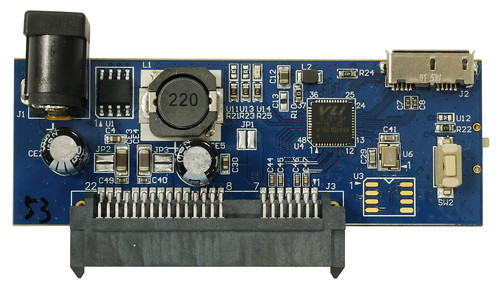
The comprehensive suite of tests conducted as part of the USB-IF Compliance and Certification Program ensures that certified products are interoperable with existing USB devices while also offering all the speed and power enhancements of the USB 3.0 specification.
With the industry's first fully-integrated 5V switching regulator, the VL701 is a highly integrated single chip solution that allows users to connect any SATA hard disk drive (HDD), solid state drive (SSD), or optical disc drive (ODD) to their PC via USB 3.0. With data transfer rates of up to 5Gbps, data stored on SATA devices can be effortlessly transferred to a PC in a fraction of the time it would usually take compared to USB 2.0 or Firewire.
Cal-Comp Electronics and Communications, a leading Electronics Manufacturing Services (EMS) and Original Design Manufacturer (ODM) that contracts with many name-brand customers worldwide, adopted and integrated the USB-IF Certified VL701 it into its upcoming USB 3.0 external storage products.
“The VL701 is an advanced, highly-integrated USB 3.0 to SATA Bridge that lets users experience the benefits of USB 3.0 using hard drives, optical drives, and even SSDs,” said David Hsu, Associate Vice President, VIA Labs, Inc. “The low power aspect is compelling for both end-users and manufacturers by enabling lower operating temperatures and longer battery life without sacrificing performance.”
Enhanced by Zemanta

Wednesday, May 12, 2010

ACAL samples next generation 2.5in solid state drives (SSDs) for embedded


  • Over 2x faster Read/Write transfer rates than previous Wester Digital drives
  • Speed Assurance for consistent performance across the life-time of the drive
  • Support for advanced features: TRIM, NCQ and SMART
  • 5 year warranty and Western Digital FIT Lab certified
  • Available in 32GB, 64GB and 128GB capacities

ACAL Technology is sampling the latest generation of 2.5 inch SATA Solid State Drives (SSD) from Western Digital which more than doubles the read/write transfer rates of the previous generation combined with drive endurance and consistently high sequential write speeds. The N1x series of SSDs is based on Single-Level Cell (SLC) media for write-intensive, embedded OEM applications with up to 24/7 operation.
It features a native SATA 3.0 Gigabit per second (Gb/s) interface which delivers target read speeds of up to 240 megabytes per second (Mb/s) and write transfer rates of up to 140Mb/s. The drives are available with capacities of 32, 64 and 128GB. In addition to patented and patent-pending Western Digital technologies, the drives support Native Command Queueing (NCQ), SMART and Windows 7 TRIM commands. Based on proven Western Digital technology, the SSDs have a high tolerance to shock or vibration and can operate across a temperature range of 0 to 70 degrees Centigrade.
“The new single-level cell N1x SSDs complement Western Digital’s recent Multi-Level Cell (MLC) WD SiliconEdge Blue devices," said Richard Pollard, European Product Manager at ACAL Technology. "The combination of these two technologies means that OEMs across the cost/performance spectrum can access SSDs featuring Western Digital’s innovative Speed Assurance technology. This eliminates the need for an external ‘wiper’ utility and ensures that the drives operate at consistently high speed, regardless of the amount of stored data and with no degradation over the life of the drive.”
 The applications which would benefit most from the N1xx’s speed and longevity include database or multimedia servers, digital graphics rendering, NAS server and storage arrays, storage appliances and video on demand as well as telecom and wireless networking infrastructure. 
Samples of the N1xx SSDs are available now, from ACAL Technology, on a sale or return basis at http://www.acaltechnology.com/uk/wd1
Reblog this post [with Zemanta]

Monday, December 21, 2009

Western Digital and NEC collaborate on USB3.0

New Driver for SuperSpeed Connectivity for SCSI Hard Drives With Advanced Features

Western Digital and NEC Electronics are collaborating to promote the new SuperSpeed Universal Serial Bus (USB) 3.0 standard in storage devices supporting data transfer rates of up to 5 gigabits per second (Gbps), 10 times faster than the previous high-speed USB 2.0 transfer speeds.
The companies plan to develop a USB Attached SCSI Protocol (UASP) driver to deliver hard drives with very high performance, mass-storage capacity. UASP is a new industry-standard, high-performance mass-storage protocol being developed for SuperSpeed USB 3.0 to overcome the performance boundaries of the Bulk Only Transfer (BOT) protocol, which has been used for traditional USB 2.0 speeds. The new UASP driver will be used with NEC Electronics’ USB 3.0 xHCI (eXtensible Host Controller Interface) host controller (part number µPD720200), which appeared on the market as the world’s first USB 3.0 host controller in June 2009.
Key features of the new UASP driver
(1) Support for the UASP mass-storage protocol
(2) Data transfer rate is enhanced by 30 percent, with optimized power efficiency and smooth interoperability, compared to the existing BOT protocol
(3) NEC Electronics’ license program is available for any LSI (large scale integration) vendors who develop UASP-based LSI devices

“The wide adoption of external storage, for both expanding and backing up internal computer storage, highlights the need for faster interface transfer rates. The USB 3.0 interface offers a significant advance in data transfer speed,” said Robert Caddy, Jr., vice president of engineering for WD’s Branded Products Group. “We are pleased to collaborate with NEC Electronics as a leading supplier of USB host devices in the introduction of USB 3.0 technology to the storage market.”

“Partnering with WD enables us to combine our USB transfer technology with WD’s data storage technology and provide added value to our customers,” said Masao Hirasawa, deputy general manager, Home Multimedia Division, NEC Electronics Corporation. “Starting with the new HDDs, WD and NEC Electronics are working together as the industrial leaders to expand USB 3.0 marketplace offerings with the highest quality and performance solutions while speeding time to market.”

Reblog this post [with Zemanta]

Monday, September 28, 2009

SATA flash drives move to 62GBytes for embedded


Toshiba Electronics Europe (TEE) has moved to 32nm NAND flash technology for a series of solid state drive (SSD) modules, increasing the capacity and lowering the cost for embedded systems. The SG2 modules come in two types, one based on the new low-profile mini-SATA (mSATA) interface standard and the other a Half-Slim type, which uses a SATA connector. The drives are available in 30GB and 62GB modules. Volume production will start in October.
The two types of modules, each smaller than a business card, provide greater design flexibility and save space and cost compared to SSDs with hard disk drive form factors and cases. The 62GB module is only one seventh the volume and one eighth the weight of a 2.5-inch form factor SSD, and consumes half the power. With interface speeds up to 3Gbit/s, a maximum sequential read speed of 180MByte/s and a maximum sequential write speed of 70MByte/s,the modules will help bring the performance advantages of SSDs to notebooks, portable electronics and embedded systems. An advanced controller features a translation mode, which enables any drive configuration, and the drive supports 28-bit LBA (Logical Block Address) mode commands and 48-bit LBA mode commands. Multi-word DMA, Ultra-DMA modes and Advanced PIO commands are supported. The drives have an optional capability for secure Full Disk Encryption (FDE) backup that prevents unauthorized data access.
Embedded designers can either use the newer mobile mSATA interface where power is a key requirement, or existing, lower cost SATA.
The mSATA modules use the popular SATA interface in a small form factor module measuring 1.18 in. x 0.19 in. x 2 in. (30mm x 4.75mm x 50.95mm) that connects to the system board using a low profile SATA connector. Adaptive Power Mode and SATA Device Initiated Power Management typically reduce power consumption to less than half of the Read power level when the device is in idle, standby or sleep mode.
The Half-Slim SATA II modules feature a SATA connector, measure 1.18 in. x 0.19 in. x 2 in. (54mm x 4 mm x 39mm). The Half-Slim SATA II modules have the same SATA connector used on 2.5-inch HDD and SDD form factors. Thus, this smaller form factor can easily be used in applications designed to use 2.5-inch storage form factors. The Half Slim is also compliant to JEDEC SFF 8156.