All the latest quantum computer articles

See the latest stories on quantum computing from eeNews Europe

Thursday, August 24, 2017

Integrating Raspberry Pi boards into enterprise IoT

By Nick Flaherty www.flaherty.co.uk

Indian software developer 42gears has introduced support for the low cost Raspberry Pi boards so that they can be used in enterprise IoT systems.

Through the EMM platform, companies can manage IoT deployments that include sensors and small handheld devices connected to Raspberry Pi Gateway.

This is a key addition to the operating systems supported by 42Gears, as Raspberry Pi gateway is now being widely by businesses. The SureMDM software helps to remotely manage deployed IoT devices controlled by Raspberry Pi and perform functions such as creating directories on the devices, moving and transferring files between directories.

"The IoT ecosystem is growing rapidly and can contain a huge number of connected devices used for various purposes," said Prakash Gupta, CTO at 42Gears. "Raspberry Pi devices are being utilized extensively in various industry verticals such as logistics, transport, energy management, and advertising. SureMDM offers a viable solution for all these businesses that need to manage sensors and small handheld devices. SureMDM can be beneficial to organizations in their Data Mining efforts. Data gathered in SureMDM through these IoT devices can be used in healthcare monitoring, environmental sensing, machine health monitoring and has many other applications."

Currently SureMDM supports Ubuntu Mate, Snappy Ubuntu Core and Raspbian on Raspberry Pi. Support for Windows 10 IoT core is under development and will be available soon.

42gears has a close relationship with Test and Verification Solutions in Bristol and recently set up a UK office in Manchester.

Related stories:

Tuesday, August 22, 2017

Qualcomm details 10nm 48 core ARM chip for datacentre servers

By Nick Flaherty www.flaherty.co.uk

Qualcomm has shown details of its 10nm, 48 core ARM chip  at the Hot Chips conference this week, its first device for datacentre servers.

The Centriq 2400 SoC using the custom Falkor 64bit ARMv8 core with a 4-issue, 8-dispatch heterogeneous pipeline. This is designed to optimise performance per unit of power, with variable length pipelines that are tuned per function for maximum throughput.

Falkor’s out-of-order and rename resources are sized to prevent instruction retirement from being in the performance-critical path, allowing unbridled usage of the multiple execution engines. Other performance-critical elements of the micro-architecture, such as branch prediction algorithms and the cache hierarchy, are state-of-the-art for today’s server class processors. 

A range of power management techniques were designed into the core, including such mechanisms as independent p-state control for each of the CPUs and L2, with entry to and exit from low-power states controlled by hardware state machines for ultra-fast state transitions, and hardware state retention for power-collapsed sleep states with ultra-fast recovery.

The Falkor core duplex includes two custom Falkor CPUs, a shared L2 cache and a shared bus interface to the Qualcomm System Bus (QSB) ring interconnect. This modular building block serves as the foundation for the 48 core Centriq 2400 SoC design.

The shift from the private datacenter infrastructure to cloud computing services continues to accelerate. According to a recent IDC Cloud Server Forecast, more than 50 percent of servers sold by 2020 will be deployed for cloud computing services, and the processors that power those servers need to be optimized to address the demand for scalable performance with unique characteristics for cloud software and services.

Five years ago, the Qualcomm Datacenter Technologies team began to map out the strategy to enter the datacentre market. The key design point for the chip roadmap was to deliver 'right-sized' devices optimized for throughput performance and efficiency for emerging multi-core cloud workloads. Cloud services need to perform well in highly-loaded and multi-tenant environments, and the hardware platform needs to maximise aggregate compute performance while improving the cloud operator’s operational costs, largely driven by the cost of power and cooling.
To meet the demand for larger instruction footprints, falkor uses a new split instruction cache comprised of a single-cycle, low-power 24KB L0 I-cache complementing its 64KB L1 I-cache. The two caches are managed exclusively to provide a total of 88KB of low-latency I-cache. The core supports a 32KB L1 D-cache with a 3-cycle load-use latency. The L1 D-cache is augmented by a sophisticated multi-level hardware prefetch engine that dynamically adapts to system conditions.

The 48 Falkor CPUs are connected by a high-bandwidth and low-latency ring interconnect extending out to its large L3 cache and multiple memory controllers with new shared resource management techniques such as L3 Quality of Service (QoS) extensions and effective memory bandwidth enhancement via in-line and transparent memory compression. 

The Centriq SoC also supports the most robust form in the industry for secure boot: an on-die hardware-based immutable root of trust that authenticates firmware before the first line of firmware is ever executed. It also supports virtualised workloads with the full suite of ARM Execution Levels (EL0-EL3) and TrustZone secure execution environment, using the ARMv8 instruction extensions to accelerate cryptographic transform and secure hash operations needed for efficient performance when running networking security protocols such as https. The SoC also provides the RAS mechanisms needed to keep a datacentre running, such as fault isolation, reporting, and handling techniques.

The Centriq 2400 processor series is now sampling to key customers and is expected to be commercially available in the second half of 2017.

www.qualcomm.com

Poll shows medical devices pose major IoT security threat

By Nick Flaherty www.flaherty.co.uk

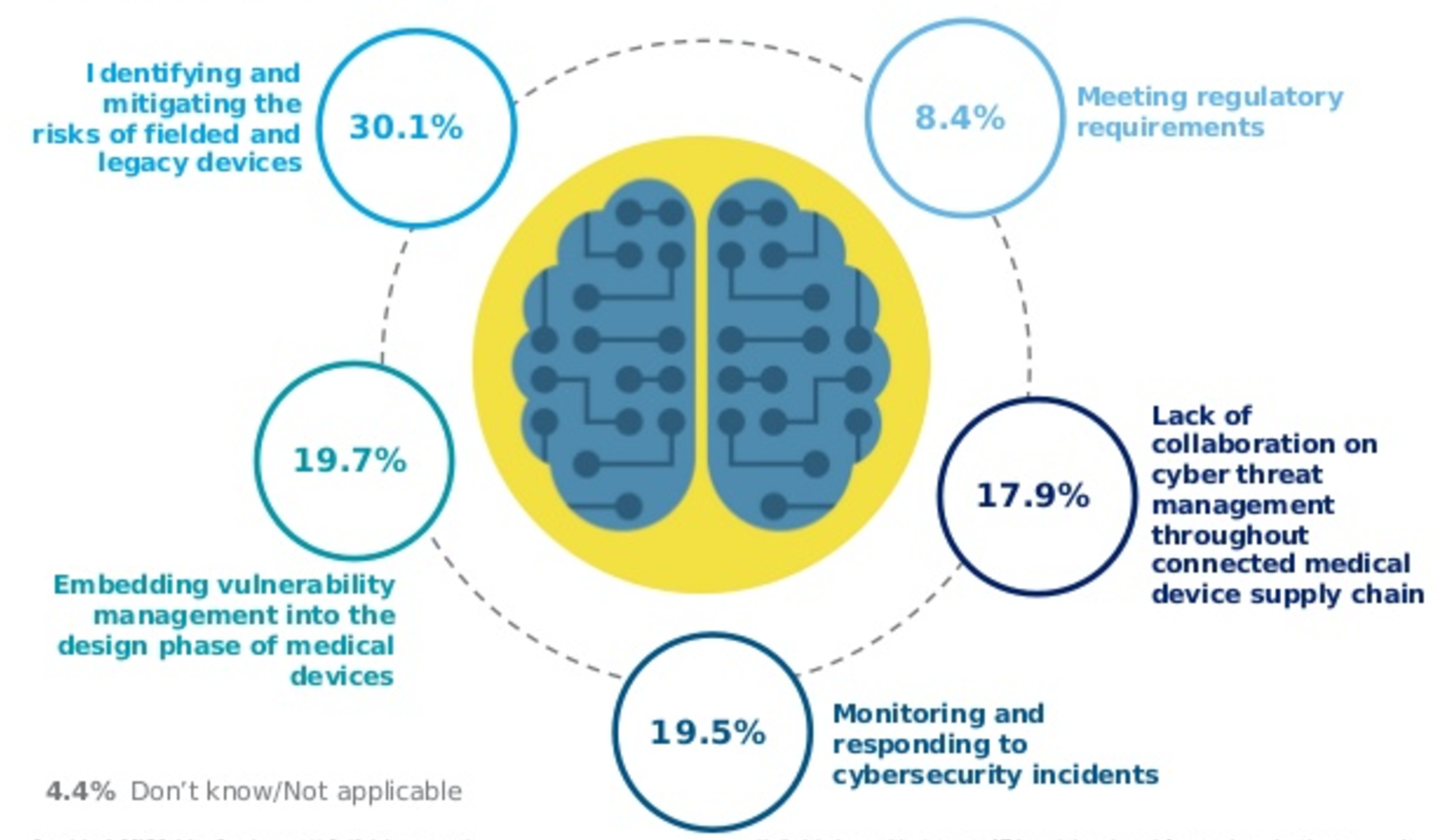
A survey of professionals working with connected medical devices in the Internet of Things has seen over a third (35%) experiencing security breaches in the last year.

The survey by Deloitte highlights that identifying and mitigating the risks of fielded and legacy connected devices presents the industry's biggest cybersecurity challenge according to respondents (above at 30.1%).

"It's not surprising that managing cyber risks of existing IoT medical devices is the top concern facing manufacturers, providers, and regulators," said Russell Jones, Deloitte Risk and Financial Advisory partner at Deloitte & Touche. "Legacy devices can have outdated operating systems and may be on hospital networks without proper security controls. Connected device cybersecurity can start in the early stages of new device development, and should extend throughout the product's entire lifecycle; but even this can lead to a more challenging procurement process. There is no magic bullet solution."

Additional cybersecurity challenges that connected medical devices presented to respondents included embedding vulnerability management into the design phase of medical devices (19.7%), monitoring and responding to cybersecurity incidents (19.5 percent), and lack of collaboration on cyber threat management throughout the connected medical device supply chain (17.9%).

"Collaboration between providers, manufacturers, and suppliers is key when it comes to bridging the gaps in medical device cybersecurity," said Jones. "This is a problem that requires the industry as a whole to come together and create a safe space where feedback and information can be shared freely."

Beyond cybersecurity risk management itself, there are post-incident risk management efforts to attend to as well. Few respondents (18.6%) say their organizations are "very prepared" to address litigation, internal investigations or regulatory matters related to medical device cybersecurity incidents in the next 12 months.

"As regulatory, litigation, and internal investigation activities start to focus on post-market cybersecurity management, leading organizations are taking a more forensic approach to discerning the timeline and size of cyber incidents so the impact to intellectual property, client data and other areas can be addressed more quickly," said Scott Read, Risk and Financial Advisory principal at Deloitte Transactions and Business Analytics. "Forensic analyses responding to regulator, litigant, or whistleblower concerns may even help predict the next moves of cyberattackers."

More than 370 professionals whose organizations operate in the medical device/IoT ecosystem responded to poll questions during the Deloitte Dbriefs webcast, "Medical devices and the Internet of Things: A three-layer defense against cyber threats," on May 23, 2017. Respondent organizations include medical device or component manufacturers (i.e., implantables, diagnostic devices, capital equipment; 31 percent); health care IT organizations (i.e., mobile app/software developers; 22 percent); medical device users (i.e., health care providers, device monitoring; 36 percent); and regulators (10 percent).


Monday, August 21, 2017

Power news this week

By Nick Flaherty www.flaherty.co.uk


POWER NEWS FROM EENEWS EUROPE

. Startup plans world’s largest data centre in Norway

. Microsemi to develop 1.7 kV and 3.3 kV SiC MOSFETS and Diodes


. €7m Australian project to develop large perovskite solar panels

TECHNOLOGIES TO WATCH
. Low power boost from ultrathin materials


. 'Biobatteries' use salt water


. Safer flexible lithium polymer batteries with freezing

NEW POWER PRODUCTS
. 60W USB Type-C power supply is plug-and-go


. Hornet DC-DC converter family targets harsh industrial and environmental designs


. Radiation hardened isolated DC-DC converter for space applications


. CMOS LDO voltage regulators drive up to 420mA for mobile designs

TECHNICAL PAPERS
. Managing the successful adoption of new low-voltage memory ICs

. Interference free cabling

. Synopsys: Saving Power in a UFS Implementation Leveraging MIPI M-PHY and UniPro

Bluetooth chip drives direct connection to hearing aids

By Nick Flaherty www.flaherty.co.uk

New chip technology is enabling a higher performance Bluetooth hearing aid.

Swiss developer Sonova is using the SWORD chip for a hearing aid under its Phonak brand.  The Bluetooth 4.2 implementation took $25m and three years to develop and supports wireless stream for up to 80 minutes from a lithium ion battery.

Neighbour Swatch has also been working on similar ultra low power Bluetooth technology: 
The SWORD chip in a chip scale package (above)  has been used for the Phonak Audéo B-Direct hearing aid that directly connects to any Bluetooth enabled cell phone or TV. This uses a dedicated operating system called AutoSense OS. The hearing aid connect to both Apple iOS10 and Android 6.0 phones.

All new products will be available in the US by the end of August with Europe and other countries worldwide from September 2017 onward.

“For 70 years, Phonak has continued to develop life-changing solutions that break down barriers,” says Thomas Lang, Senior Vice President of Phonak Marketing. “With the Audéo B-Direct, we’re now breaking barriers to accessibility and connectivity. Audéo B-Direct also works similar to a wireless headset. We’re giving more hearing aid wearers access to proven Belong technology without limiting them to a single cell phone, manufacturer, or operating system. This is a true game-changer for our industry.”

The Audéo B-Direct provides hands-free voice calling as hearing aid wearers can answer or reject a phone call by simply pressing the push button on their hearing aid. The ringing of the phone is heard through the hearing aids and once the call is accepted, the conversation is instantly streamed. The wearer’s voice is picked up by the hearing aid’s intelligent microphone network and transmitted to the other caller similar to a wireless headset. All this is done without the hearing aid wearer ever having to physically touch the phone.

Phonak has also launched a hearing aid with Biometric Calibration. Each ear is unique and each ear hears differently. Identifying over 1,600 data points, the Phonak proprietary 3D modelling software calculates the unique calibration settings for each Virto B hearing aid. The result is a 2 dB improvement in directionality leading to better hearing performance1. Virto B comes in a full product family launch. The new CROS B Custom for single sided deafness is also introduced to be compatible with Virto B.


  • Swiss software developer Fennex is taking a similar approach with an app that turns Apple's Airpod Bluetooth wireless earphones into hearing aids. The app allows the user to control volume, the focus of the conversation, balance, compression to amplify or limit low/loud sounds, keeping or removing high or low-frequency sounds, and an equalizer to adapt treble, mid and bass sounds.


www.phonakpro.com

Related stories:

Bare metal hypervisor is key to Security 3.0 for AI

By Nick Flaherty www.flaherty.co.uk

Tokyo-based software developer Seltech has started demonstrations of its hypervisor-based security system for the Internet of Things.

Bare metal hypervisors are increasingly key to the next generation of security for IoT and AI systems, which the company calls Security 3.0, as it starts development of artificial intelligence (AI) algorithms for IoT sensors and licenses its technology to third parties.

It has developed FOXvisor which supports a range of operating systems on ARM, MIPS and Intel processor cores to provide low level security. This lightweight hypervisor uses less than 1% of the CPU cycles and has a small kernel of just 32Kbytes, reducing the threat envelope. No OS modification is needed and there are no kernel dependencies. 

This bare metal hypervisor is at a lower level than other virtualisation or real time operating system implementations, although many RTOS suppliers now offer such kernels and these are gaining traction in IoT designs.
“As the market swiftly shifts to IoT and AI, we are entering into an environment in which security issues must constantly be handled properly,” said Shoi Egawa, CEO. “Seltech is a strong advocate of Security 3.0, and we shall continue to have a heavy focus on the necessity and importance of IoT security, ensuring that IoT/AI cannot be taken over.”

Back in November Seltech signed a partnership deal with Seattle-based Sequitur Labs to cooperate on developing and deploying security technology for embedded systems and Internet of Things

As part of the agreement, Sequitur will integrate CoreTEE—a Trusted Execution Environment (TEE) for devices built on ARM Cortex-A—with FOXvisor. This initially supports NXP/Qualcomm’s i.MX6 SoC, including the quad core SABRE platform targeted at automotive entertainment, as well as the other i.MX SoCs. Additionally, the two companies will also collaborate on market development activities and custom solution development.

CoreTEE already supports TrustZone implementations on a number of Cortex-A platforms including Microchip’s SMART | A5D2 and A5D4, NXP’s QorIQ LS1 family, as well as i.MX6 and i.MX7 platforms. “Our agreement with Seltech draws on complementary capabilities of each company,” said Philip Attfield, CEO of Sequitur Labs. “Combining our solutions with FOXvisor allows any device maker to quickly implement a scalable security strategy.

“We are very pleased to collaborate with Sequitur Labs who support the CoreTEE solution on to the Starter Kit. Seltech will address secure application development for automotive, industrial automation, medical, POS, and home automation applications," said Egawa. "CoreTEE will compliment Seltech's OS independent FOXvisor and help system integrators to build secure system applications."

www.seltech.j/en

Related stories:


Saturday, August 19, 2017

Zingbox raises $22m to automate IoT security with AI

By Nick Flaherty www.flaherty.co.uk

Stanford spin-out ZingBox has raised $22m to roll out its artificial intelligence software to identify attacks and take the tech out of IoT security. 

The funding, the company's second round, was led by Dell Technologies Capital and Triventures.

Zingbox claims its IoT Guardian software is the industry’s only IoT security solution based on device personalities. It uses machine learning algorithms to discover and assess the baseline normal behaviour of an IoT node, detect anomalous activities and provide real-time protection across an organization’s entire IoT footprint. The patent-pending system has a model of each IoT device’s 'personality', analysing communication to and from every device, watching constantly for deviations in behaviour and providing alerts for any suspicious behaviour.

“Dell Technologies Capital invests in innovative founders and companies that can use our technical resources and unique go-to-market channels to bring their breakthrough technology to customers around the globe,” said Raman Khanna, managing director of Dell Technologies Capital. “As more and more hospitals, retailers and businesses deploy IoT solutions, security is top of mind and ZingBox’s machine-learning approach to IoT security helps them address this fundamental challenge.”

“The company brings the right solution at the right time for healthcare organisations that need real time visibility and cyber protection to optimise operations and provide uninterrupted, quality patient care,” said Dr. Peter Fitzgerald, Co-Founder & Managing Partner of Triventures. “ZingBox’s deep and unique understanding of IoT and medical device behaviour delivered in a seamless SaaS solution will be a gamechanger for its customers.”

www.zingbox.com

Friday, August 18, 2017

MIPS wins Mediatek LTE modem chip slot

By Nick Flaherty www.flaherty.co.uk

MediaTek is using the multi-threaded MIPS I-class processor cores from Imagination Technologies for its latest LTE cellular modem chips. The first device from MediaTek featuring MIPS technology is the new flagship MT6799 Helio X30 processor which uses MIPS in its Cat-10 LTE modem. 

The relationship with MediaTek takes MIPS into high-volume smartphone modems, and demonstrates the performance and efficiency advantages MIPS multi-threading technology can provide in many real-time, power sensitive applications such as LTE, artificial intelligence and the Internet of Things (IoT) as the technology moves  into industrial designs.

The MIPS I-class CPU is a key component of the integrated 4G LTE Advanced modem which features 3x carrier aggregation downstream to support 450Mbit/s data rates and 2x carrier aggregation upstream to support 150Mbit/s. The MIPS multi-threading capability enables the MIPS CPU to do more work every clock cycle. This can be particularly advantageous in balancing power, performance and cost, and can boost real-time responsiveness and performance where multiple latency-sensitive tasks must be handled simultaneously.

“With their powerful multi-threading capability, MIPS CPUs offer a combination of efficiency and high throughput for LTE modems that contributes significantly to system performance,” said TL Lee, general manager of the Wireless Communications division at MediaTek.

While this is a boost in the battle against ARM, it comes against the backdrop of the MIPS division being up for sale, as is the rest of Imagination Technologies, so the new owner of the MIPS technology has yet to be determined.

Related stories:

Thursday, August 17, 2017

First flexible 2.4GHz antenna designed specifically for metal surfaces

By Nick Flaherty www.flaherty.co.uk


Laird has developed a flexible 2.4GHz antenna designed to be used directly on metal surfaces without detuning, boosting the performance of IoT applications. A higher performance antenna provides longer range or longer battery life.

The patented mFlexPIFA antenna is just 2mm thick and aimed at wirelessly connecting everything from household appliances and automated equipment to medical devices and millions of other items. It is based on a Planer Inverted-F Antenna (PIFA) structure comprised of a mylar antenna element with a foam core, resulting in a low profile, flexible antenna.

The mFlexPIFA antenna can be mounted in a wide range of embedded and external applications with metal surfaces and enclosures. It is available in a 2.4 GHz version for Wi-Fi, Bluetooth, Zigbee, Thread, and general ISM applications. It is also certified for use in selected Laird Bluetooth and Wi-Fi modules.

The key is that the antenna can be placed directly onto metal surfaces without detuning the antenna, which until now has been a major challenge for product designers and OEMs. It also can be used on concave or convex curved metal surfaces to provide greater flexibility in design.

“Products with a lot of integrated metal and metal enclosures have historically provided significant challenges for antenna implementation, and Laird has solved this problem with the mFlexPIFA,” said Scott Lordo, Laird’s senior vice president and general manager. “Typically, placing an antenna near metal surfaces will detune the antenna, but the mFlexPIFA addresses this critical technical challenge.

“The mFlexPIFA joins our family of antenna solutions that are engineered to provide unmatched quality and flexibility, and solve real-world antenna design challenges, especially in products that will become a part of the Internet of Things,” he said, adding that Laird is a trusted source for wireless design, and provides custom antenna design services, product development, and on-site EMC certification and testing.

For more information about Laird’s mFlexPIFA, click here

Related stories:

Multicore Atom edge devices boost IoT performance

By Nick Flaherty www.flaherty.co.uk

Super Micro Computer has launched a full suite of all-in-one systems for the growing Embedded Appliance, Intelligent Datacentre and Network Edge markets with long lifetime support. 

The compact systems and motherboards are designed around the new Intel Atom C3000 (Denverton) SoC feature lower thermal and power requirements and can improve performance by 2.5X compared to the previous generation for IoT designs.

Supermicro's A2 series motherboards feature 2 to 16 Atom cores, up to 128GB ECC memory, quad 10G SFP+ or RJ45 ports and up to 7 years long life. The  A2SDi series motherboards are optimised for low-power servers, storage appliances, or web hosting applications and are integrated with Intel QuickAssist technology (QAT) for network security appliances. These new low power full-featured motherboards extend Supermicro's embedded Server Building Blocks for transportation and communications infrastructure, retail applications, digital signage, industrial automation, digital security and surveillance, cloud and cold storage, medical imaging and network/security appliances.

"Our new Atom C3000 solutions can deliver 2.5X more performance to the Edge, which helps increase overall enterprise efficiency and drives improved competitiveness and productivity," said Charles Liang, President and CEO of Supermicro. "As the embedded server market continues to evolve, Supermicro has become the solution provider of choice with enterprise-class engineering, manufacturing and support expertise in this area."

The motherboards are in the Flex and mini-ITX form factors with additional building blocks for a wide range of edge applications including vCPE, NFV, SDN and SD-WAN. The boards support up to 6-cores in the Atom C3958 with quad 10G and up to 128GB memory on the A2SDV-16C-TLN5F.
  
For system form factors, solutions range from a 16W 1U box and compact 25W 1U rackmount to a 9W mini-tower and even a 3U MicroCloud system designed for entry-level dedicated hosting and memory caching applications.

Designers can choose between AC or DC power supplies and fan-less options. Networking and storage expansion capabilities with mini-PCIE and M.2 sockets make it easy to scale application hosting and storage.

www.supermicro.com/Atom

Related stories:

Wednesday, August 16, 2017

Modelling tool for rolling out edge computing infrastructure

By Nick Flaherty www.flaherty.co.uk


Schneider Electric has developed a software tool that empowers partners to rapidly and accurately plan and design integrated, customised and highly reliable edge solutions. 

The APC Local Edge Configurator features an intuitive, easy-to-use interface, enabling partners to design a comprehensive, validated edge architecture, including rack, single-phase uninterruptible power supply (UPS), security, power distribution and software, in a plug-and-play model. This helps them provide redundancy and physical security with speed, agility and simplicity.

The growth of big data, the Internet of Things (IoT) and the explosion of data-intensive applications increases the need for real-time data processing, high bandwidth transmission and significantly reduced latency traditional data centres are unable to support. This necessitates the use of distributed IT environments at the network edge. Once relegated to disorganised, insecure wiring closets, these deployments are becoming highly critical, requiring more availability, security, redundancy and resiliency at the access layer than ever before. As a result, specifying, building and ensuring system component compatibility within these systems is becoming expensive and time-consuming for channel organisations.

"In response to a growing need for real-time access to information, edge computing is revolutionising the way in which data can be collected, processed and shared. As a result, edge deployments are becoming mission critical, and ensuring compatibility and validation of systems components is increasingly complex for the channel," said Shannon Sbar, Vice President, North America Channels for the APC power brand owned by Schneider Electric. "APC Local Edge Configurator delivers Certainty in a Connected World by eliminating these obstacles, empowering partners to easily build, test and ship fully integrated solutions, delivering the power and value channel partners need to remain competitive, and maximising the business opportunity around edge."

The online tool  draws from a comprehensive, automatically updating library of all currently available APC physical infrastructure solutions, as well as leading storage, networking, converged and hyperconverged systems from Cisco, Nutanix, Dell EMC and others.

The final physical architectures can be shipped as individual components or a fully integrated system when designed with the Cisco-certified APC NetShelter SX with Shock Packaging or built from the Micro Data Centre Xpress system. These latter options enable system integrator partners to limit the time and costs necessary for full manual integration and provide an easily installable product for customers.


Securing 3D printers with gold nanorods

By Nick Flaherty www.flaherty.co.uk

Researchers from the Georgia Institute of Technology and Rutgers University have developed a three-layer system to verify that components produced with 3D printing have not been compromised. 

The system uses acoustic and other physical techniques to confirm that the printer is operating as expected, and nondestructive inspection techniques to verify the correct location of tiny gold nanorods buried in the parts. The key is that the technique is independent of printer firmware and software in the controlling computer which may itself have been compromised.

"These 3-D printed components will be going into people, aircraft and critical infrastructure systems," said Raheem Beyah, the Motorola Foundation Professor and associate chair in Georgia Tech's School of Electrical and Computer Engineering. "Malicious software installed in the printer or control computer could compromise the production process. We need to make sure that these components are produced to specification and not affected by malicious actors or unscrupulous producers."

The technique uses acoustic measurement of the 3-D printer in operation. When compared to a reference recording of a correct print, this acoustic monitoring -- done with an inexpensive microphone and filtering software -- can detect changes in the printer's sound that may indicate installation of malicious software.

It also uses physical tracking of printer components. To create the desired object, the printer's extruder and other components should follow a consistent mechanical path that can be observed with inexpensive sensors. Variations from the expected path could indicate an attack.

The detection of the nanorods in the finished components is the third element. This uses Raman Spectroscopy and computed tomography (CT) to detect the location of gold nanorods that had been mixed with the filament material used in the 3-D printer. Variations from the expected location of those particles could indicate a quality problem with the component. The variations could result from malicious activity, or from efforts to conserve printer materials. This uses similar techniques to medical imaging, and the gold contrast materials were tested to make sure they wouldn't compromise the structural integrity of the printed components.

The researchers tested their technique on three different types of 3- printers and a computer numerical control (CNC) machine using a polyethylene tibial knee prosthesis as a test case. Beyond detecting malicious activity or quality problems, the technique could stop inadvertent production problems, reducing materials waste.

"Our focus now will be on testing the resilience of this technology and its resistance to intrusion and malicious attacks," said Javanmard.

Among the challenges ahead will be obtaining good acoustic data in the noisy environments in which 3-D printers typically operate. In the research reported by the researchers, operation of other 3-D printers near the one being observed cut the accuracy significantly, but Beyah believes that challenge can be addressed with additional signal processing. The technique will also be applied to additional types of printers, and to different materials.

With the capabilities of 3-D printers growing and their cost declining, Beyah believes the use of additive manufacturing techniques will continue to expand. The validation and intrusion detection system will therefore become more critical.

"The idea that additive manufacturing processes could be compromised to intentionally hurt someone hasn't really been considered with some of these applications," he said. "There is a good bit of room to improve the security of 3-D printers, and we think that will start with applications that are closest to humans, such as implants and medical devices."

Growth in security for Industry 4.0 is still slow says report

By Nick Flaherty www.flaherty.co.uk

Consideration of security for the next generation of industrial systems is still slow, says a new report.

GrammaTech commissioned the report from VDC detailing the growing concerns in cyber-physical manufacturing systems within today’s smart factories. The report, “Industry 4.0: Secure by Design,” summarizes the results from surveying over 500 engineers to find that for Industry 4.0 to succeed, smart factories must be made secure by design, meaning security concerns should guide decisions from the earliest stages and through the full system development lifecycle.

According to 46% of developers surveyed by VDC, cyber security concerns are very or extremely important on their current project, up from 37% two years ago.

IoT is opening up a broad range of new business opportunities and solutions like the smart factory. Unfortunately, the introduction of connectivity can unearth new vulnerabilities and magnify any existing software quality issues.

One of VDC’s recommendations is a testing regimen including dynamic testing and static analysis to provide greater assurance that vulnerabilities are discovered and fixed. This can help embedded development teams secure their devices and accelerate their time-to-market in industry 4.0, as well as industries such as medical devices, aerospace, and transportation where software capabilities are key drivers of innovation and competitive advantage.

“Based on our research, action to prevent or mitigate vulnerabilities is not rising in parallel with the increasing awareness of the impact of security failures,” said André Girard, Senior Analyst at VDC. “Embedded engineers surveyed report that over 24% of their projects have no security actions taken.”

"The results found by VDC agree with what we see with our customers,” said Mark Hermeling, Senior Director of Product Marketing at GrammaTech. “GrammaTech has been promoting a security-first design approach that leverages automated software tools as much as possible. Advanced static analysis, for example, plays an important role in a secure design lifecycle.”

“Increasing the use of automated testing tools, starting in the early stages of software design can help their engineering teams prevent many common coding errors and security weaknesses,” said Girard. “The low existing use-rates of static analysis and binary analysis — tools that can help in the code acceptance process — suggests many Industrial Automation & Control engineering teams are not yet following best practices for third-party code use.”


Customised robotic OS and SDK aims to simplify system development

By Nick Flaherty www.flaherty.co.uk

Vincross has launched a six-legged, all-terrain, highly maneuverable robot using its proprietary operating system called MIND.

The HEXA robot and its complete software developer kit (SDK) are available for backing on Kickstarter to simplify the development of robotic systems.

The MIND SDK and easy-to-follow documentation allows developers to create Skills that control HEXA’s movements. MIND also comes with a 3D Simulator where users build robot functionality with the click of a mouse. HEXA’s easy-to-use App provides access to user-created Skills and allows the operator to remotely control the robot.

“We all have this dream of what robots should be, of robots interacting with and helping humans on a daily basis. But the reality is, robots have a long way to go. To date, the industry has focused on single use robots for industrial labs or household cleaning purposes or robots for children. There hasn’t been a single robot or platform built for the masses – especially for those developers and innovators eager to create on robots,” said Tianqi Sun, founder and CEO of Vincross. “Our robotics ecosystem represents a breakthrough, where people can now build, learn and accelerate innovation in the field of robotics, ultimately turning society’s vision of robots into reality.”

“The single biggest impediment to technologies like robotics and AI is that talented developers don’t have ready access to the full technology stack required to engineer new products. These new technologies require full integration between hardware, the OS and product application design,” said Jenny Lee, Managing Director at GGV Capital. “With the launch of HEXA, Vincross is filling a palpable gap in the market for individuals who want to break into the booming robotics revolution. Tech enthusiasts, developers and innovators now have a comprehensive platform with Vincross’ hardware and software to teach themselves how to enable their vision.”

HEXA can nimbly handle different environments and terrains and the compact, lightweight body makes it convenient to fit into daily life. The camera includes night vision and allows it to interact with and learn from the world around it. Other sensors include two three-axis accelerometers for balance, a built-in distance measuring sensor and an infrared transmitter.

The MIND OS is based on the Linux kernel and is optimised for robots. It integrates various libraries and drivers to easily control the robot hardware and network. With MIND, individuals can integrate voice interaction and third-party device interaction with a mobile phone or IoT home appliances.
The SDK is powered by Golang and can seamlessly integrate third-party libraries, such as ROS and OpenCV. With a highly abstracted toolkit, there’s no need to know underlying hardware and complex mechanics, which means individuals are free to focus on building software applications that bring ideas to life.

www.kickstarter.com/projects/1090670314/hexa-programmable-highly-maneuverable-robot


Tuesday, August 15, 2017

Broadcom bids to dominate 802.11ax

By Nick Flaherty www.flaherty.co.uk

Broadcom aims to dominate the market for 802.11ax with three new devices covering residential and enterprise routers and smartphones.

The Max WiFi devices enable up to four times faster download speeds, six times faster upload speeds, four times better coverage, and seven times better battery life than 802.11ac. The chips are designed to kick-start an ecosystem of Wi-Fi routers, residential gateways, enterprise access points, and client devices.

Max WiFi supports delivery of simultaneous video, voice, data and IoT services with an architecture that is optimised for internet upload and cloud storage. Broadcom expects a typical family of four expected to have an average of 50 connected devices by 2022, with the amount of media content exchanged among mobile devices through the cloud increasing exponentially. 

“The 802.11ax Wi-Fi protocol is significant for users as it functions in the critical 2.4 GHz and 5 GHz bands and adds OFDMA while retaining backward compatibility with legacy protocols," said Andrew Zignani, Senior Analyst at ABI Research. "The Wi-Fi device and traffic explosion, higher density Wi-Fi deployments, growing use of outdoor Wi-Fi, and the need to support a great variety of different device types will require more efficient Wi-Fi implementations that can help to deliver richer experiences for enterprise and consumer applications that are hungry for bandwidth.”

Broadcom’s ecosystem of Max WiFi products includes BCM43684, BCM43694 and BCM4375.

The BCM43684 is a chip targeted for the residential Wi-Fi market while the BCM43694 is optimized for use in enterprise access points with support for 4 streams of 802.11ax over a 4.8 Gbps PHY and e
160 MHz Channel Bandwidth.

The BCM4375 is a smartphone combo chip that supports two 2 streams of 802.11ax with Bluetooth 5.0+ including Low-Energy Long Range (LELR) and Real Simultaneous Dual-Band (RSDB) operation. This has a 1.429 Gbps PHY Rate and uses 1024 QAM modulation with multi-user MIMO, although technical details are not yet publicly available.

Broadcom is sampling the chips to early access partners in retail, enterprise and smartphone, service provider, and carrier segments, including Asustek, Arris, D-link, Netgear and TP-link.
“Advancement in the WLAN standards are critical to keep pace with the reliable delivery of quadruple play services to an increasing number of wireless connected devices in the home," said Larry Robinson, President of ARRIS CPE Products which develops TV set top boxes and routers. "The 6th generation WLAN standard, 802.11ax, adopts many of the established technologies from cellular standard such as LTE enabling true “carrier grade” Wi-Fi. This will allow service providers to provide their subscribers a best in class wireless experience that matches the WAN speeds provided by state of the art xDSL, DOCSIS and PON technologies. ARRIS is partnering with Broadcom to bring 802.11ax technology to the latest generation of Telco and Cable operator gateways.”

“D-LINK is working aggressively with Broadcom to bring the advances of 802.11ax technology to our customers. With the 6th generation of Wi-Fi, users can expect to connect more devices with better reliability and faster speeds,” said Anny Wei, CEO of D-LINK.

www.maxwifi.org

Cypress adds iCloud support for IoT designs

By Nick Flaherty www.flaherty.co.uk


Cypress Semiconductor has updated its development platform for the IoT to add iCloud remote access support for Wi-Fi-based accessories using Apple's HomeKit.

The Wireless Internet Connectivity for Embedded Devices (WICED) Studio platform (acquired from Broadcom) API can now be linked to the Cypress CYW43907 Wi-Fi controller to create hub-independent platforms that connect directly to Siri voice control and the Apple Home app remotely. 

“Emerging smart home applications are providing some of the most tangible improvements to our everyday lives, not only giving us the convenience of controlling our lighting, appliances and thermostats remotely, but the ability to manage their usage and power consumption profiles more efficiently—which is a win-win for the environment and consumer pocketbooks,” said Brian Bedrosian, Vice President of Marketing for the IoT Business Unit at Cypress. 

“Our new WICED Studio development platform lets OEMs bring HomeKit support to their smart home products, enabling Siri control and convenient control using an iPhone, iPad or Apple Watch.” For example, the WICED platform is used in Leviton Manufacturing' Decora Smart family of lighting switches and dimmers with HomeKit support.

Using Cypress’ WICED development platform and ultra-low power CYW20719 Bluetooth/BLE MCU, developers can integrate HomeKit support into products such as smart lighting devices, leverage Siri voice control and connect to the Apple Home app seamlessly.

WICED Studio provides a single development environment for multiple wireless technologies, including Cypress’ Wi-Fi, Bluetooth and combo solutions, with an easy-to-use application programming interface in the world’s most integrated and interoperable wireless SDK. The kit includes the market’s most broadly deployed and rigorously tested Wi-Fi and Bluetooth protocol stacks, and it offers simplified application programming interfaces that free developers from needing to learn about complex wireless technologies. The SDK also supports Cypress’ high-performance 802.11ac Wi-Fi solutions that use high-speed transmissions to enable IoT devices with faster downloads and better range, as well as lower power consumption by quickly exploiting deep sleep modes.

The CYW43907 SoC integrates dual-band IEEE 802.11b/g/n Wi-Fi with a 320MHz ARM Cortex-R4 RISC processor and 2 MB of SRAM to run applications and manage IoT protocols. The SoC’s power management unit simplifies power topologies and optimising energy consumption. The WICED SDK provides code examples, tools and development support for the CYW43907.

The WICED Studio SDK enables cloud connectivity in minutes with its libraries that uniquely integrate popular cloud services such as iCloud, Amazon Web Services, IBM Bluemix, Alibaba Cloud, and Microsoft Azure, along with services from private cloud partners and China’s Weibo social media platform. It has a single installer package for multiple wireless technologies with an Eclipse-based Integrated Development Environment (IDE) that runs on multiple operating systems, including Windows, MacOS and Linux.

A key factor is that the SDK is microcontroller (MCU)-agnostic and provides ready support for a variety of third-party MCUs to address the needs of complex IoT applications. The platform also enables cost efficient solutions for simple IoT applications by integrating MCU functionality into the connectivity device. Wi-Fi and Bluetooth protocol stacks can run transparently on a host MCU or in embedded mode, allowing for flexible platform architectures with common firmware.

Developers can access the WICED Studio platform, ecosystem and community at http://www.cypress.com/wicedcommunity


Monday, August 14, 2017

Power news this week

By Nick Flaherty www.flaherty.co.uk

POWER NEWS from eeNews 
. Perovskite stacked solar cell beats silicon efficiency for the first time


. £1.5m UK project for hybrid high frequency response power system


. Nissan sells off battery business to Chinese investor

TECHNOLOGIES TO WATCH
. Hydrogen power for DC power grid


. Solid polymer rechargeable alkaline battery could take on lithium ion


. Consortium sets up battery gigafactory 'foundries'

NEW POWER PRODUCTS
. AirFuel demo sends 33W of wireless power

. Flexible buck converter extends battery life of USB Type-C PD devices

. First programmable USB Type-C switch for manufacturing and test


TECHNICAL PAPERS
. Managing the successful adoption of new low-voltage memory ICs


. CUI: Medical Design Standards for Power Supplies to IEC-60601-1


. Spin Transfer: Advanced MRAM Technology

Multi-Band LTE/Wi-Fi/GNSS antenna with centimetre profile for IoT

By Nick Flaherty www.flaherty.co.uk

PCTEL has launched a multi-band LTE/Wi-Fi/GNSS antenna with a sub-inch profile for IoT, precision agriculture and public safety applications. 

The rugged antenna combines PCTEL’s high rejection multi-GNSS (Global Navigation Satellite System) technology for precision timing and location tracking with high performance multi-band data connectivity. 

“Complex, high performance antennas are critical for modern public safety communications, as well as for commercial applications such as mobile asset management. However, vehicles and autonomous systems have limited space for antenna installation. PCTEL’s sub-inch antenna addresses these space limitations while delivering high performance multi-band coverage,” said Rishi Bharadwaj, Senior Vice President and General Manager of PCTEL's Connected Solutions group. 

“PCTEL also offers external and embedded antenna system design services for customers with more severe antenna size constraints or other specialized requirements,” he said.

The ruggedized ultra-low profile housing is less than 25mm and the GNSMB-COV supports multi-band LTE MIMO and dual-band 2.4/5 GHz Wi-Fi for data connectivity, as well as GPS, GLONASS, BeiDou, and Galileo GNSS satellite technologies. All GNSS elements feature PCTEL’s proprietary high rejection technology to ensure reliable satellite connectivity in the presence of LTE signals or other interference. The antenna has been fully tested for use in extreme environments and on heavy agricultural equipment.

www.pctel.com

Microchip launches In-Circuit Debugger with wider voltage range and higher speed

By Nick Flaherty www.flaherty.co.uk

Microchip has launched an in-circuit programming and debugging development tool for its PIC microcontroller and dsPIC digital signal controller portfolios. The MPLAB ICD 4 includes all the features of the MPLAB ICD 3 debugger while adding increased speed through a faster processor and increased RAM.

The MPLAB ICD 4’s significant improvement in speed is accomplished through a 32bit MCU running at 300 MHz. This, combined with an increased buffer memory of 2 MB, results in a product that is up to twice as fast as its predecessor.

The puck-shaped debugger is housed in a durable, black case with a brushed aluminium top and is accented with an LED light strip to indicate debugging status. The tool has a wider target voltage range, from 1.20 to 5.5 V, as well as an optional 1 Amp of power when using an external power supply.

There is a selectable pull-up/pull-down option to the target interface and a configurable interface speed for optimised programming and debugging as well as support for JTAG debug.

The MPLAB ICD 4 supports all PIC microcontrollers and dsPIC digital signal controllers in Microchip’s portfolio through the MPLAB X Integrated Development Environment (IDE). This simplifies the design process for customers when they choose to migrate from one PIC MCU to another to meet the needs of their application.

www.microchip.com

Related stories:

Kalray uses massively-parallel processor for 'Just a bunch of flash' JBOF arrays

By Nick Flaherty www.flaherty.co.uk

French massively parallel chip designer Kalray has developed a controller for  the next generation of data centre storage servers.

Available in the autumn, the KTC40 includes a PCIe board based on Kalray's MPPA2 manycore processor, as well as the all important complete software stack. This supports both NVMe-oF (embedded non-volatile memories over fabrics) and Ethernet JBOF (Just a Bunch Of Flash) to improve the density of SSDs. 

Using JBOF eliminates the need for costly and power hungry dual x86 controller and the associated DDR memory, reducing the cost of JBOFs by 65% and increasing SSD density within the JBOF by 60%. This gives an overall reduction in power consumption of 65%1. 

"We are excited to offer this unique solution to our data centre customers," said Eric Baissus, CEO at Kalray. "KTC40 will give our customers a new range of possibilities for optimizing their JBOF. This means increased SSD density, as well as big savings in both the cost of the JBOF itself and in terms of significant reductions in power consumption within the JBOF. We are confident that this will be a leading solution in the new era of Ethernet-compatible JBOFs."

www.kalrayinc.com

Related stories: