All the latest quantum computer articles

See the latest stories on quantum computing from eeNews Europe

Friday, March 02, 2018

First NB-IoT module certified for use in hazardous environments

By Nick Flaherty www.flaherty.co.uk

The SARA-N2 NB-IoT module series from u-blox is entering initial production. In addition to being certified for use in Europe, Asia and Australia, the module has received ATEX certification for deployment in hazardous environments, expanding the scope of the Internet of Things (IoT) to new industrial applications.

"At u-blox, we've been closely involved in the development of NB-IoT since its inception," said Samuele Falcomer, Product Manager, Product Center Cellular at u-blox. "In 2016, we sent the first pre-standard message over a NB-IoT network and then went on to launch the world's first NB-IoT module. Now, our u-blox SARA-N2 NB-IoT module series is in production, including the world's first ATEX-certified NB-IoT module."

u-blox sees NB-IoT is establishing itself as the technology of choice for many industrial IoT applications including metering and sensor applications. This is driven in part by the technology's low power requirements, which let end devices run for years - sometimes more than a decade - on a single battery, minimizing the need for maintenance. The indoor and underground signal penetration and wide-reaching coverage enable IoT applications in otherwise challenging locations such as in cellars, deep underground, or in remote areas.

The SARA-N211 product variant, which targets the European market with support of Bands 8 and 20, is the first NB-IoT module to receive ATEX-certification for use in hazardous and potentially explosive environments often encountered in the oil and gas industries, in chemical plants and in mining applications, further extending the reach of NB-IoT. ATEX pre-certification saves end-device makers time and resources by assuring compliance, while simultaneously speeding up testing and simplifying end device certification. Importantly, it minimizes the risk of last-minute changes to the module to meet ATEX demands.

www.u-blox.com

MicroTCA Chassis optimised for FPGAs

By Nick Flaherty www.flaherty.co.uk

VadaTech has launched a 2U MicroTCA chassis that provides eight extended-size/full-size and/or mid-size AMC slots that can accept any AMC.1, AMC.2, AMC.3 and/or AMC.4 modules and is optimsed for FPGA modules. 

The VT882 provides TCLKA, TCLKB, TCLKC and TCLKD clock lines as well as FLCLKA to each slot in addition to the JTAG signals. It also contains capability for full redundancy by having a redundant MCH, Power Modules, as well as redundant Cooling Units for high availability. The option for a redundant/non-redundant clock is per MTCA specification.

To achieve this, the chassis has high-speed routing on 26 layers (40G capable) and high-speed MTCA connectors (12.5 GHz). Pairs of modules have ports 2-15 and 17-20 routed locally (not via a switch), making the chassis suitable for housing FPGA modules communicating over low-latency protocol such as Aurora. Ports 0 and 1 are routed to GbE switches as normal, supporting control plane resource management.

The chassis has a JTAG Switch Module (JSM) slot per MTCA specification. This JSM provides transparent communication between the front JTAG port and the selected AMC device. This can be used with the Ethernet Virtual Probe capabilities of VadaTech’s 3rd generation MCH, the UTC004. Virtual Probe services are available to provide JTAG via Ethernet for Xilinx FPGAs. 

This allows for standard development tools such as Xilinx iMPACT / ChipScope to treat the MCH/JSM combination as if it was a standard JTAG probe, removing the need to attach JTAG probes directly to each FPGA.

VadaTech

mbed tests out alpha of simplified desktop development tool

By Nick Flaherty www.flaherty.co.uk

Web-based development tool and operating system maker mbed is working on a desktop tool that supports application development, build, debug, that will provide a greater level of integration with its web services. It is now looking for developers for a closed alpha test.


Mbed Studio is targeting application development, bringing together the command line tools and utilities into an environment that allows developers to get up and running quickly with a single installer. mbed currently provides desktop command line tools and utilities such as pyOCD and Mbed CLI, which are often used to build custom environments, or for CI, but mbed Studio is intended for users who are looking for a simple way to program and debug.

For the more detailed embedded development challenges, which require powerful debug capabilities, developers can still can work with Mbed OS in Keil uVision or IAR Embedded Workbench via the exporters.

mbed Studio is based around Eclipse as the C/C++ Development Tooling gives a good level of functionality for microcontroller development out of the box. Mbed OS tooling has been added with a focus on the UI around the idea of an active project, so that build, run, debug and other actions are all carried out against the active project. This is quite different to the way that Eclipse typically works, but the developerrs say it offers a more consistent development experience with the other mbed tools.  Eclipse can be confusing when it comes to configuration menus, and so the team populate as much as possible behind the scenes so that developers don't need to go menu diving.

It combines Eclipse, GCC, pyOCD and GDB, along with the tooling that is included with Mbed OS, such as build.py. There are also tools for version control, and will be focused on developing this area further. During the alpha, they plan to gather as much feedback from you as possible on how the integration of these tools matches your own development workflow. mbed will also add tight integration to the Online Compiler and Mbed website.

 If you’d like to volunteer as an alpha tester for Mbed Studio, please register your interest at os.mbed.com/studio. If you would be happy to provide feedback, ideas and most importantly, a bit of time to test Mbed Studio, then you can sign up here. Once the release is ready, they will let you know and you will be able to download, install and test out Mbed Studio.


Software defined signal splitters with USB interface

By Nick Flaherty www.flaherty.co.uk

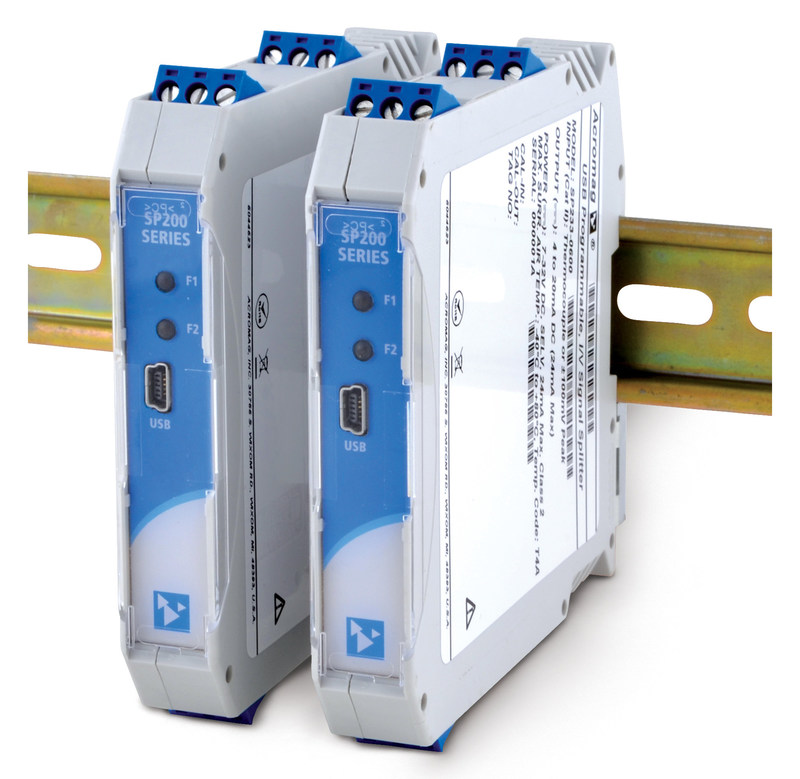
Acromag has launched a range of signal splitters for industrial designs with a simple USB interface that can be configred via software.

The SP230 series of isolated signal splitters/duplicators are designed for easier installation and setup. Four models, covering a broad range of sensor signals, provide dual 4-20mA outputs proportional to a single current, voltage or temperature input. 

A USB connection to a Windows PC or Android device enables simple, precise configuration of I/O ranges and a variety of operational settings with free software. The two-wire instruments include plug-in terminal blocks to install quickly and can acquire power from either output loop. Sink or source output wiring connections are supported.
 

A ruggedised design operates reliably from -40 to 80°C with high immunity to electrical noise and surge protection. UL/cUL Class 1 Division 2, ATEX Zone 2 and IECex hazardous location approvals are pending. Prices start at just $250.

SP230 Process Loop Signal Splitters


"The combination of software-guided setup, two-wire loop-powered installation, and removable wiring terminal blocks, make SP230s the most convenient solution for signal splitting/duplicating applications. A variety of models to support a spectrum of input, output, and power requirements [means engineers] can confidently standardizs on this series for future signal conditioning projects," said Robert Greenfield, Acromag's Business Development Manager.

A common USB port enables software configuration without costly proprietary adapters. Software menus let developers quickly set I/O ranges and select options DIP switches cannot support. Each output can use a different input scaling range.


Thursday, March 01, 2018

congatec moves into hypervisor software

By Nick Flaherty www.flaherty.co.uk

We have long pointed out the importance of hypervisor software for embedded systems.

German board and module maker congatec's puchase of hypervisor developer Real-Time Systems (RTS) highlights this for IoT development and the next phase of automation equipment known as Industry 4.0.

Headquartered in Ravensburg, Germany, RTS is a leading provider of hypervisor software for real-time applications in the embedded market.

"The congatec strategy is to simplify the use of embedded computing technologies," said Jason Carlson, CEO of congatec. "As the connected IIoT and Industry 4.0 world is getting more and more complex, one of the most important strategic levers to meet this objective is to invest in software." 

RTS will become a wholly owned subsidiary of congatec and will continue to operate independently, providing software to run on any x86 hardware, but now with worldwide sales and technical support teams.

However this may be an issue for other board makers (and their customers) that use the hypervisor and also compete with congatec.

"If customers need a hypervisor with the best possible real-time performance, easy installation and configuration for any x86 multicore platform, supporting all popular real-time as well as general purpose operating systems, then the RTS Hypervisor from Real-Time Systems is the preferred choice," said Gerd Lammers, CEO at Real-Time Systems. "Our RTS Hypervisor therefore fits perfectly into congatec's strategy of simplifying the use of embedded technology under very demanding circumstances. We are confident that our customers will benefit from our joined forces as it gives us the chance to grow faster, extend our offerings to new markets and improve our services on a global base."

Real-Time Systems' customers are OEMs from markets such as robotics, automation, mechanical engineering, medical technology or test and measurement systems. New markets further arise from the increasing real-time requirements of IIoT and Industry 4.0 applications as well as real-time broadcasting and streaming. Other customers are embedded computer technology manufacturers who qualify the platforms they develop as ODMs for OEMs for the RTS Hypervisor.

"We are investing in the sustainable growth of Real-Time Systems. For instance, we want to extend the functionalities of the RTS Hypervisor in order to open up new markets in the field of transportation. All RTS customers will benefit from these investments; this is because the RTS Hypervisor is independent of any RTOS and GPOS, which gives us the chance to set new standards. The explicit goal is therefore to continue to attract embedded computer manufacturers as customers and to maintain existing customers in this segment," said Gerhard Edi, CTO at congatec. "We will take all necessary organizational measures to achieve these goals. Discussions with these customers have already been initiated in connection with this acquisition announcement."


Related stories:

Top stories on the Embedded blog in February

By Nick Flaherty www.flaherty.co.uk

It has been refreshing to see more focus on embedded designs last month, perhaps as a reaction to the hype of the Internet of Things or indication that more work is happening behind the scenes. The top story on the new JEDEC SD card format was surprising but welcome - ARM's AI (ie machine learnign and neural network) processing blocks less so. Tiny high performance amplifiers and ThreadX on the new RISC-V cores is definitely more embedded, while security worries around SCADA networks being hacked to mine the Monero cryptocurrency also showed up.
 

EntryPageviews
230
217
198
188
185
170
156
151
140
133

Wednesday, February 28, 2018

Avast taps into phones to mine Monero coins as it moves into IoT hardware

By Nick Flaherty www.flaherty.co.uk

Anti-virus developer Avast is tapping into visitor’s phones at Mobile World Congress in Barcelona this year to highlight the vulnerability of devices to mining cryptocurrencies. Nearly 60,00 devices in the city are potentially vulnerable.

It is also planning to launch its own hardware hub to protect smart home networks, and was using this as an example of how cryptojacking works.

Initial research by Avast shows that an army of more than 15,800 devices would be needed to mine $1,000 in Monero coins over the four days of the congress. Smartphones and IoT devices, like smart TVs or webcams or thermostats, often have very low computation power, which is bad for mining. For this reason, cybercriminals are looking to attack devices at a mass scale to maximize profit. Mining on IoT devices remains largely invisible to the consumer; unlike a PC, it’s not as noticeable when an IoT device heats up or loses performance.

“Until recently, cybercriminals were focused on spreading malware to turn PCs into crypto-mining machines, but now we are also seeing an uptick in attacks targeting IoT devices and smartphones,” said Gagan Singh, Senior Vice President and General Manager, Mobile, at Avast. “According to current data from Shodan.io, 58,031 smart devices in Barcelona are vulnerable. If each of these devices were recruited to a botnet to mine Monero at Mobile World Congress, cybercriminals could earn the approximate equivalent of $3,600, or €3,000. The costs involved in mining are so high that profit from cryptocurrency mining is very low, encouraging cybercriminals to not attack tens of thousands but millions of devices.”

Last year the first IoT botnet appeared, a new version of the Mirai botnet emerged to mine cryptocurrencies. Since then, the risk of cybercriminals taking control of IoT devices to profit from cryptocurrency mining has increased.

The demonstration of mining was to highlight its new tool called Smart Life to address IoT security threats that will also come with a smart hub device. This uses machine learning to identify and block threats and is delivered through a Software-as-a-Service (SaaS) model to service providers and customers.

“It has been five years now since the first well-publicized hack of a baby monitor in Texas. Since then, IoT devices have transformed our homes and workplaces, but the security of these connected devices has not been significantly improved and users are still at risk. We increasingly expect convenience and enjoyment from smart devices like smart speakers, smart doorbells or IP cameras, but with this rapid adoption comes a real urgency to address the complex challenge of protecting them,” said Gagan Singh, Senior Vice President and General Manager of Mobile at Avast.

“With over 400 million active users worldwide at Avast, we get unparalleled insights into how IoT devices work which feed our cloud-based machine learning engine to identify and quickly block anomalies, botnets and other threats to IoT devices. When developing the Smart Life platform to harness the power of this technology, our focus was on delivering a security service that is easy for people to use to secure all of their IoT devices and networks,” he said.

Many smart devices can be compromised, including thermostats, streaming boxes, webcams and digital personal assistants. One of the more common types of attack is when cybercriminals hack thousands of IoT devices in unsuspecting households to create botnets to perform attacks on others.

One of Avast’s initial offerings based on the Smart Life platform, Avast Smart Home Security, will provide protection and visibility into what is happening on their home network. Key features include the detection of privacy threats, botnets and malware as well as safe browsing and prevention of Distributed Denial of Service (DDoS) attacks.

For example if a smart heating thermostat is turned on at an unusual time and is transmitting data in high volume to an unknown location, then Avast can instantly take action to shut down the attack and alert the family to the activity. This will be available later this year through a mobile app along with a hub that connects to the home network.

www.avast.com

Related stories:

Trinamic to build motion control chips with RISC-V core

By Nick Flaherty www.flaherty.co.uk

Eating into the MIPS business, embedded motor and motion control chip maker Trinamic has selected the Bk3 processor from Czech designer Codasip for its next designs. The Bk3 is based on the open source RISC-V architecture.

German Trinamic’s products serve multiple markets including laboratory and factory automation, semiconductor manufacturing, textiles, robotics, ATMs, and vending machines – wherever reliable positioning is required such as 3D printing, medical pumps, and security cameras.

“We chose RISC-V as the microcontroller platform for our future motion control product families. The open source character of the instruction set ensures the longevity our customers require,” stated Jonas P. Proeger, Marketing Director of Trinamic. “After investigating alternatives, we determined that Codasip’s Bk3 offered the ideal combination of performance and power efficiency that our applications demand. Backed by best-in-class development tools and the RISC-V ecosystem, the Bk3 is perfect for our future processing needs”.

The Codasip Bk3 processor, based on the RISC-V open instruction set architecture (ISA) definition, features a single 3-stage in-order execution processor pipeline and offers optional caches, IEEE 1149.1 debug, and industry standard bus interfaces. Further, the Bk3 – like all Codasip RISC-V implementations – is fully configurable and extensible, offering great advantage over traditional, fixed-configuration processor IP cores.

www.trinamic.com and www.codasip.com

Tuesday, February 27, 2018

Kerlink and Semtech test out non-GPS location technology in Mexico

By Nick Flaherty www.flaherty.co.uk

IoT network provider Kerlink is working with LoRa chip supplier Semtech to test out urban non-GPS location technology in  Aguascalientes City, Mexico.

Live tests in the demonstration show promising results with CEP 95 (circular error probable with 95 percent probability) around 80m for moving objects, such as vehicles, in class A type of communication while in urban environments that can create communication multipath challenges, resulting from radio reflection generated by buildings.

Land-based geolocation using the LoRaWAN open protocol uses a different technology than GPS, eliminating the requirement for costly and power-hungry data processing. Gartner forecasts that a third of the world’s 15 billion connected devices will be critically dependent on geodata by the end of 2020.

The Mexican project is the first demonstration of Kerlink’s end-to-end network environment, which combines the Wirnet iBTS 915 MHz gateways, the Wanesy Management Center, which is the company’s core network management suite, and the Wanesy Geolocation, its new geolocation solver. The experiment with Semtech provides large-scale field-testing opportunities to demonstrate the benefits of geolocation and to show the impact of the quality of coverage on accuracy, when the number of gateways and location of installation points is varied in a dense urban setting.

“Geolocation is simple to deploy and operate because each end-device can be natively located without the need to add a costly GPS module inside it,” said Yannick Delibie, Kerlink CTIO. “This dramatically optimizes power consumption and reduces device hardware costs. No additional hardware is required, assuming that gateways are geolocation-ready."

Semtech, whose LoRa devices and wireless radio frequency technology transceivers are central to the implementation of LoRaWAN networks around the world, actively collaborated with Kerlink on equipment installation in Aguascalientes City, a metropolitan area of about 1 million population.

“Optimal location of the gateways is crucial for delivering an optimized, fine time stamp for real-time tracking,” said Marc Pegulu, vice president and general manager of Semtech’s Wireless and Sensing Product Group. “Kerlink’s Wirnet iBTS Compact, based on Semtech’s industrial-grade reference design, offers improved gateway clock synchronization for its embedded GPS to further improve geolocation accuracy, especially in a dense urban area.”

The urban environment will also help the teams to further evaluate network and gateway-deployment geometry, which plays a significant role in geolocation performance. All of these findings will help Kerlink continuously optimize the network design and deployment it offers customers through its professional services, including geolocation services.

”The global performance of the accuracy is continuously progressing by leveraging environment learning and intelligent algorithms,” Delibie said. “The infrastructure set-up is an alive technical ecosystem of partners delivering the entire value chain with a tremendous improvement in the quality of service able to support an increasing number of concrete use cases.”
Semtech and Kerlink are among the founding members of the LoRa AllianceTM, which recently published a white paper on geolocation using Semtech’s LoRa technology.

NXP launches i.MX IoT-on-a-Chip for Edge Computing

By Nick Flaherty www.flaherty.co.uk

NXP has developed an IoT-on-a-chip device that compbines an ARM-based i.MX applications processor, Wi-Fi and Bluetooth into small footprint with security and connectivity.

IoT-on-a-Chip brings together the pre-integrated features from NXP’s i.MX applications processor family and Wi-Fi/Bluetooth solutions for consumer and industrial developers to quickly build compact IoT products. It uses an Arm Cortex-A7 applications processor with dual-band 802.11ac Wi-Fi and Bluetooth 4.2 as a reference Wi-Fi certified module with proven Wi-Fi/BT software stacks.
The i.MX applications processors provide advanced security implementation for secure boot, tamper detection and response, and high throughput cryptography, and the IoT-on-a-chip can be expanded with its custom inter-chip interface to include a secure element without increasing the package footprint
The 14mm x 14mm x 2.7mm solution includes applications processor and Wi-Fi/BT in a single footprint and the package design allows DDR memory direct connect via pass-through board layout simplifies PCB design and provides additional space savings.

Different levels of i.MX performance in the same 14x14 body size, using the same inter-chip interface. Footprint compatible top-modules provide a range of Wi-Fi/BT options suited to your application.

“Representing a major step in the evolution from on-board offerings to the future vision of IoT-on-a-Chip, our highly integrated solution completely demystifies the Internet of Things,” said Martyn Humphries, vice president of i.MX applications processors for industrial and consumer markets with NXP. “NXP’s forward-looking design approach will provide customers with far greater efficiencies across their systems, allowing them to accelerate their time to market for products – at no additional cost.”


NXP’s first IoT-on-a-Chip product, based on the i.MX 6ULL applications processor, will be available in late 2018. i.MX 7 and i.MX 8 processor configurations will be available in 2019.

Monday, February 26, 2018

Power news this week

By Nick Flaherty www.flaherty.co.uk


POWER NEWS

ADLINK demos first true fog computing

By Nick Flaherty www.flaherty.co.uk

ADLINK Technology is set to demonstrate true Fog Computing for the first time later this week. 

The system includes not only device monitoring, but also the management of the orchestration of embedded devices, all the edge of the Internet of Things (IoT).

The demonstration is based on ADLINK’s prototype open source Fog Computing platform (code-named fog∅5) that provides the end-to- end virtualization of compute, storage and
communication resources from Cloud services to connected embedded devices. 

ADLINK will also demonstrate its implementation of SGeT’s Universal IoT Connector (UIC) specification as a plug-in to the fog05 platform. Together, fog05 and SGeT/UIC go well beyond providing standard device connectivity to bring true Fog Computing to embedded computing.


“We’re very pleased to be able to demonstrate true Fog Computing,” said Angelo Corsaro, CTO of ADLINK. “Also our developments in UIC connectivity and XRCE data communications give our embedded computing customers a good view of the future and thus opportunities to plan for their next-generation IoT solutions. For ADLINK, Edge Computing is connected-embedded- computing, so pioneering seamless connectivity solutions from Cloud Services to Fog Nodes to embedded systems (also known as Fog Computing) is a strategic priority for us.”

www.adlinktech.com