| Entry | Pageviews | |||||||||
|---|---|---|---|---|---|---|---|---|---|---|
167
| ||||||||||
163
| ||||||||||
159
| ||||||||||
1 Feb 2019
|
143
| |||||||||
131
| ||||||||||
109
| ||||||||||
26 Feb 2019
|
108
| |||||||||
103
| ||||||||||
5 Feb 2019
|
102
|

Monday, March 04, 2019


Friday, March 01, 2019
congatec puts consumer Whisky Lake quad core processors on embedded cards
By Nick Flaherty www.flaherty.co.uk
congatec has launched what it believes to be the world's first embedded form factors with consumer versions of Intel's 8th Generation Intel Core Mobile processors (codenamed Whiskey Lake).
Compared to embedded variants, consumer-grade processors mainly lack long-term availability support - which is often not the top priority in the embedded high-performance race. OEM customers who are content with this but need a rugged embedded form factor can use these hybrid embedded 3.5 inch SBCs, Thin Mini-ITX motherboards, and COM Express Type 6 modules as they combine the benefits of consumer-grade processors with those of rugged embedded boards and modules. Even vendors who want to use embedded variants in series production benefit from these boards because thanks to the identical APIs provided by the embedded board vendors, they can test their applications on appropriate platforms far earlier than before.
The conga-JC370 3.5 inch SBCs, conga-IC370 Thin Mini-ITX motherboards and conga-TC370 COM Express Type 6 modules all come with the 1.8 GHz quad-core Intel Core i7-8565U Mobile processor that impresses with a performance increase of up to 40% compared to previous U-Series processors enabled by a leap from 2 to 4 cores along with the improved microarchitecture. The memory is designed to match this performance boost: Two DDR4 SODIMM sockets with up to 2400 MT/s are available for a total of up to 64GB.
congatec has launched what it believes to be the world's first embedded form factors with consumer versions of Intel's 8th Generation Intel Core Mobile processors (codenamed Whiskey Lake).
The COM Express Type 6 Compact modules, 3.5 inch SBCs, and Thin Mini-ITX motherboards are all equipped with consumer-grade 1.8GHz Intel Core i7-8565U Mobile processors. OEM customers get early access to the new high-end processor technology and benefit from first-to-market strategies. Industrial end-customers profit from an instant application performance boost of up to 40% compared to previous U-Series processors - enabled by 4 instead of 2 cores plus an overall improved microarchitecture.
"One of our main goals is to simplify the use of embedded computer technology as much as possible for our customers. That's why we offer our embedded Computer-on-Modules, 3.5 inch SBCs and Thin Mini-ITX motherboards now also as consumer-grade BGA variants featuring 8th Generation Intel Core processors," said Christian Eder, Director of Marketing at congatec
"One of our main goals is to simplify the use of embedded computer technology as much as possible for our customers. That's why we offer our embedded Computer-on-Modules, 3.5 inch SBCs and Thin Mini-ITX motherboards now also as consumer-grade BGA variants featuring 8th Generation Intel Core processors," said Christian Eder, Director of Marketing at congatec
"This helps OEMs who want to deploy the latest processor technologies as fast as possible - especially at the mobile high-performance level where life cycles are shorter, and where OEMs are searching for complementary embedded computing platforms, for example to enable closed loop manufacturing with the latest performance classes. Our new embedded boards cater exactly for this need," he said.
Compared to embedded variants, consumer-grade processors mainly lack long-term availability support - which is often not the top priority in the embedded high-performance race. OEM customers who are content with this but need a rugged embedded form factor can use these hybrid embedded 3.5 inch SBCs, Thin Mini-ITX motherboards, and COM Express Type 6 modules as they combine the benefits of consumer-grade processors with those of rugged embedded boards and modules. Even vendors who want to use embedded variants in series production benefit from these boards because thanks to the identical APIs provided by the embedded board vendors, they can test their applications on appropriate platforms far earlier than before.
The conga-JC370 3.5 inch SBCs, conga-IC370 Thin Mini-ITX motherboards and conga-TC370 COM Express Type 6 modules all come with the 1.8 GHz quad-core Intel Core i7-8565U Mobile processor that impresses with a performance increase of up to 40% compared to previous U-Series processors enabled by a leap from 2 to 4 cores along with the improved microarchitecture. The memory is designed to match this performance boost: Two DDR4 SODIMM sockets with up to 2400 MT/s are available for a total of up to 64GB.
For the first time, USB 3.1 Gen2 is now supported natively. This USB SuperSpeed+ interface is capable of transferring up to 10 Gbps, which makes it possible to transfer even uncompressed UHD video from a camera to a monitor. The new 3.5 inch SBC provides this performance via a USB-C connector that also supports 1x DisplayPort++ and power supply for peripheral devices, thereby enabling monitor connection with a single cable for video, touch and power. The COM Express modules support the same feature set on carrier boards. Further interfaces depend on the form factor but all support a total of 3 independent 60Hz UHD displays with up to 4096x2304 pixels as well as up to 2x Gigabit Ethernet (1x with TSN support). The new boards and modules offers all this and many more interfaces with an economical 15W TDP, which is scalable from 10W (800 MHz) to 25W (up to 4.6 GHz in Turbo Boost mode).
Thursday, February 28, 2019
Intel partners to reduce firmware attack surface
By Nick Flaherty www.flaherty.co.uk
Intel is working with US startup Eclypsium to reduce the vulnerability of firmware throughout an organisation, including its cloud links. This pairs security capabilities built into Intel silicon with advanced defences against firmware threats.
Intel Security Essentials provide a built-in foundation for improved security features and are available across Intel processor lines. The Eclypsium Platform, now generally available, builds upon Intel’s foundation by analyzing the system configuration and ensuring the latest firmware is deployed. With Eclypsium, the end user can see the status of their firmware patch levels, gain visibility into firmware misconfigurations, and validate the integrity of Intel systems as part of the supply chain, even through the cloud.
eclypsium.com
Intel is working with US startup Eclypsium to reduce the vulnerability of firmware throughout an organisation, including its cloud links. This pairs security capabilities built into Intel silicon with advanced defences against firmware threats.
Intel Security Essentials provide a built-in foundation for improved security features and are available across Intel processor lines. The Eclypsium Platform, now generally available, builds upon Intel’s foundation by analyzing the system configuration and ensuring the latest firmware is deployed. With Eclypsium, the end user can see the status of their firmware patch levels, gain visibility into firmware misconfigurations, and validate the integrity of Intel systems as part of the supply chain, even through the cloud.
This can also help protect against 'Evil Maid' attacks against devices such as laptops or phones that are left unattended, for example in a hotel room or at an airport. This uses a USB-stick to compromise the firmware with a fake password prompt identical to the original. Once the password is input, the compromised firmware sends the password to the attacker and removes itself after a reboot. However, this nodes need the hacker to return to the device a second time to steal the now-accessible data.
“With security features built into the hardware, Intel delivers a ‘chain of trust’ rooted in silicon that makes the device and extended network more trustworthy and secure,” said Yuriy Bulygin, CEO of Eclypsium. “We are pleased to be working with them to extend that chain of trust for the firmware layer, and therefore across the supply chain, while enabling leading hardware OEMs to deliver the right patches and more secure hardware configurations to the market.”
“Security sensitive organizations need to be able to inspect these low-level technologies to look for signs of malicious activity,” said Window Snyder, Chief Software Security Officer and General Manager, Platform Security Division at Intel.
As well as protection against Evil Maid attacks, Intel and Eclypsium are demonstrating a number of use cases:
- Firmware Visibility and Patch Management - Visibility of firmware versions across hardware components and centralised patch updates.
- Protection From Supply Chain Attacks – Find firmware that has been compromised in the hardware supply chain even before deployment.
- Protecting Cloud Infrastructure – Help protect cloud and bare-metal infrastructure from implants at the firmware level or software-level attacks that can spread to the firmware.
- Verifying Device Integrity After Infection - Bring firmware security into the workflow to help ensure devices are clean at the firmware level before re-imaging.
eclypsium.com
Wednesday, February 27, 2019
Murata teams with eSoftThings on pan-European IoT network
By Nick Flaherty www.flaherty.co.uk
Murata and eSoftThings have teamed up on a hardware and platform for secure end-to-end IoT designed for the European market and compliant with European regulations,
This combines Murata’s communications modules and sensor technologies with the eSoftLink IoT platform (which leverages AI to provide end users with predictive consumption information), providing a seamless private and secure IoT package. This allows customers to start benefitting from the value-add of IoT in their operations.
This combines Murata’s communications modules and sensor technologies with the eSoftLink IoT platform (which leverages AI to provide end users with predictive consumption information), providing a seamless private and secure IoT package. This allows customers to start benefitting from the value-add of IoT in their operations.
Actively deployed for Direct Energie, a major European energy utility now integrated with Total, eSoftLink supports billions of messages a day and allows real time asset management, messaging and configuration. The system uses eSoftThings’ custom hardware – featuring Murata’s compact 1DX Wi-Fi module – to assure stable, low-power connectivity across all deployments.
“We wanted to provide our customers with a unique service option to enable constantly updated energy consumption information and innovative services,” commented Louis Duperry, Head of Innovation at Direct Energie. “The eSoftLink solution, using advanced Murata communications technology, has allowed us to do precisely that. Our customers follow their consumption in real time, and are empowered to adapt their usage for environmental and economic reasons. Initial analysis shows that 60% of our customers utilising the solution have reduced their energy usage already.”
“Murata’s breadth of available hardware solutions, including connectivity modules and sensors, makes it the ideal partner to provide our customers, such as Direct Energie, with quality hardware IoT solutions adapted to their specific requirements,” commented Kimmo Vuorinen PhD, President of eSoftThings. “Combined with Murata’s communication modules and sensor offerings, eSoftLink represents a straightforward, versatile solution to support customers implementing new IoT developments or retrofitting existing infrastructure, thereby realising the full power of the IoT.”
www.esoftthings.com/en/esoftlink-private-iot-platform-with-artificial-intelligence-for-predictive-maintenance-in-real-time/
Related stories:
ARM in key China IoT deal
By Nick Flaherty www.flaherty.co.uk
Arm has signed a deal with China Unicom that will drive IoT adoption, bringing together the Pelion Device Management, Arm Mbed OS and China Unicom IoT platform.

“We are very pleased to reach the partnership with Arm, together to provide the fast-expanding market with a better, safer IoT solution," said Chen Xiaotian, General Manager of China Unicom IoT Limited, “China Unicom IoT has made efforts to be the driver of the IoT era. Facing the ever-increasing number of devices, we believe that our collaborations with Arm will help our clients to efficiently grow their businesses, provide better service experiences and earn higher investment return. Furthermore, we will build the whole IoT ecosystem together, facilitating IoT upgrades and service transformation.”
Arm has signed a deal with China Unicom that will drive IoT adoption, bringing together the Pelion Device Management, Arm Mbed OS and China Unicom IoT platform.
“We are very pleased to reach the partnership with Arm, together to provide the fast-expanding market with a better, safer IoT solution," said Chen Xiaotian, General Manager of China Unicom IoT Limited, “China Unicom IoT has made efforts to be the driver of the IoT era. Facing the ever-increasing number of devices, we believe that our collaborations with Arm will help our clients to efficiently grow their businesses, provide better service experiences and earn higher investment return. Furthermore, we will build the whole IoT ecosystem together, facilitating IoT upgrades and service transformation.”
The newly launched China Unicom IoT Platform brings a robust “edge-to-cloud” ecosystem, and securely connects 100 million devices across China. The solution provides device-to-data security and device management by building on top of Arm's Pelion Device Management service that can manage any device type and being tightly integrated with Mbed OS.
The deal allows Chinese enterprises and foreign companies operating in China to deploy and manage IoT applications at scale across verticals, including smart utility, smart cities, smart logistics and more.
“IoT presents a significant opportunity for enterprises, but requires solutions that are easy to implement, secure and can manage devices over their entire lifecycle,“ said Dipesh Patel, president, IoT Services Group, Arm. “With China Unicom licensing Pelion Device Management and using Mbed OS, we are together bringing tremendous scale and simplicity in enabling the secure development and management of IoT devices so that enterprises can obtain value from their deployments.”
Pelion Device Management allows organizations to securely and efficiently onboard, manage and update various types of IoT devices (from ultra-constrained to large gateways), throughout the device lifecycle. Pelion Device Management also provides enterprises with the flexibility to deploy in the public or private cloud, on-prem or in hybrid environments.
Mbed OS integrates all the essential components and mainstream standards necessary in the IoT, providing rich types of connectivity functions. The next release of Mbed OS next month will be one of the first IoT OS’s to have out-of-the-box compliance with PSA Certified Level 1 and PSA functional API Certification with support for multiple semiconductor vendor hardware, including Cypress, Nuvoton, NXP Semiconductors and ST.
“The IoT market in China continues to grow at a rapid pace, with cellular IoT connections growing from 560 million in 2018 to 1.5 billion by 2022,” said Sam Lucero, senior principal analyst, IoT, IHS Markit. “This growth presents a tremendous opportunity for partnerships, like this one between Arm and China Unicom, to bring new solutions to market that attempt to address the need for simple and secure enterprise deployment and management of IoT devices.”
Related stories:
Bluetooth 5.1 chips with Arm M33 core
By Nick Flaherty www.flaherty.co.uk
Dialog Semiconductor has launched its latest wafer scale multicore Bluetooth low energy devices.
Dialog Semiconductor has launched its latest wafer scale multicore Bluetooth low energy devices.
The SmartBond DA1469x family of four devices includes the first wireless microcontroller in production with a dedicated application processor based on the ARM Cortex-M33 processor. The M33 offers developers greater processing power for more intensive applications, such as high-end fitness trackers, advanced smart home devices and virtual reality game controllers.
The DA1469x integrated radio offers double the range compared to its predecessor together with an ARM Cortex-M0+ based software-programmable packet engine that implements protocols and provides full flexibility for wireless communication.
On the connectivity front, an emerging application is for manufacturers to deploy accurate positioning through the Angle of Arrival and Angle of Departure features of the newly introduced Bluetooth 5.1 standard. With its world-class radio front end performance and configurable protocol engine, the DA1469x complies with this new version of the standard and opens new opportunities for devices that require accurate indoor positioning such as building access and remote keyless entry systems.
To enhance the sensing functionality of the DA1469x, the M33 application processor and M0+ protocol engine is complemented with a Sensor Node Controller (SNC), which is based on a programmable micro-DSP that runs autonomously and independently processes data from the sensors connected to its digital and analog interfaces, waking the application processor only when needed. In addition to this power-saving feature, a state-of-the-art Power Management Unit (PMU) provides best-in-class power management by controlling the different processing cores and only activating them as needed.
The devices provide up to 144 DMIPS of performance with 512 kBytes of RAM, memory protection, a floating-point unit, a dedicated crypto engine to enable end-to-end security and expandable memories, ensuring a wide range of advanced smart device applications can be implemented using the chipset family and supporting a range of key value-add interfaces to extend functionality even further.
The PMU also provides three regulated power rails and one LDO output to supply external system components, removing the requirement of a separate power management IC (PMIC). Additionally, the DA169x product family come equipped with a range of key value-add interfaces including a display driver, an audio interface, USB, a high-accuracy ADC, a haptic driver capable of driving both ERM and LRA motors as well as a programmable stepping motor controller.
“The demands of today’s connected consumer are expanding with each new product cycle,” said Sean McGrath, Senior VP & GM of Dialog Semiconductor’s Connectivity Business Group. “Our SmartBond wireless microcontrollers are recognized in the market as being designed not only to meet the needs of today’s users, but to anticipate where the market is heading and offer development opportunities for our customers for their next product cycles. With the DA1469x family, we have doubled the processing power, quadrupled available resources and doubled the battery lifetime compared to its predecessor, making it by far, one of the most advanced, feature-rich Bluetooth products we’ve developed to date.”
The DA1469x variants will start volume production in the first half of 2019. Samples and the SmartSnippets development kits are available at https://www.dialog-semiconductor.com/products/da1469x-product-family
Tuesday, February 26, 2019
Murata, Cypress and NXP team on mix-an-match IoT Wi-Fi tech
By Nick Flaherty www.flaherty.co.uk
Murata, Cypress Semiconductor and NXP Semiconductors have teamed up to provide IoT developers with mix-and-match wireless connectivity and processor modules that shorten development times.
The platform solutions give developers a broad range of scalable processing platforms including i.MX 6, i.MX 7 and i.MX 8 Series application processors and i.MX RT crossover processors. The Murata solutions provide devices with the flexibility of the easy-to-use M.2 connector.
Murata, Cypress Semiconductor and NXP Semiconductors have teamed up to provide IoT developers with mix-and-match wireless connectivity and processor modules that shorten development times.
The combined products pair Murata’s wireless modules, based on the Cypress Wi-Fi and Bluetooth combos, with a broad range of processors from the NXP i.MX series. The three have worked together for many years and understand the hardware and software requirements needed to support i.MX customers designing products ranging from battery-powered IoT devices up to industrial equipment and subsystems for connected cars. Murata worked closely with Cypress and NXP to ensure that each hardware platform and corresponding software is validated
“IoT customers still face significant design challenges in getting their connected products to market. This collaborative effort solves that challenge while enabling a broad range of new applications. Together with Cypress and NXP, we are providing out-of-box solutions with a wide range of i.MX processors and connectivity options to fit any IoT systems’ application requirements,” said Toshifumi Oida, Director, Communications Module Division at Murata.
“IoT customers still face significant design challenges in getting their connected products to market. This collaborative effort solves that challenge while enabling a broad range of new applications. Together with Cypress and NXP, we are providing out-of-box solutions with a wide range of i.MX processors and connectivity options to fit any IoT systems’ application requirements,” said Toshifumi Oida, Director, Communications Module Division at Murata.
The platform solutions give developers a broad range of scalable processing platforms including i.MX 6, i.MX 7 and i.MX 8 Series application processors and i.MX RT crossover processors. The Murata solutions provide devices with the flexibility of the easy-to-use M.2 connector.
The Wi-Fi/Bluetooth connectivity solutions include 1x1 802.11bgn, 802.11abgn and 802.11ac up to 2x2 802.11ac, as well as Bluetooth 5.0 support.
Developers have direct access to the necessary software in NXP’s Linux board support package and MCUXpresso SDK. The Wi-Fi evaluation kits will be available through NXP preferred partner Embedded Artists to support a diverse range of applications.
Michael Hogan, Senior Vice President of the IoT Compute and Wireless Business Unit at Cypress added, “In order to address the vast breadth of applications that make up the IoT, Cypress takes the approach of giving customers flexibility for processing options to pair with our Wi-Fi and Bluetooth combo solutions. We are giving developers of the diverse range of products served by the i.MX processor family the ability to provide the robust connectivity user experience that people expect, while cutting time to market.”
Martyn Humphries, Vice President and General Manager for i.MX applications processors at NXP concluded, “From our experience working with a vast customer base, we know a key pain point is Wi-Fi integration and certification. From a platform perspective, our collaboration with Murata and Cypress addresses this need, providing a simplified, system-level solution that is fully validated. Our partnership with Murata provides customers with a full range of Wi-Fi solutions with our i.MX evaluation kits for thousands of applications across Industrial, Automotive and IoT.”
ARC EM processor in full NB-IoT design
By Nick Flaherty www.flaherty.co.uk
Design tool supplier Synopsys has teamed up with Palma Ceia SemiDesign to develop a full hardware/software design for LTE Cat NB1/NB2 IoT.
The design combines Palma Ceia's RF transceiver IP with Synopsys' DesignWare ARC EM9D Processor IP to deliver a complete low-power NB-IoT IP solution for both standalone or embedded modems. The collaboration provides designers with a ready-to-use NB-IoT solution, conforming to the latest LTE Release 14 standard and proven in 40nm process technology.
"NB-IoT is enabling the next wave of IoT connected devices that require lower energy consumption and higher system capacity," said Kevin Walsh, vice president of strategic marketing at Palma Ceia. "By collaborating with Synopsys to deliver a complete, integrated NB-IoT solution consisting of our RF IP in Synopsys' NB-IoT platform, we are enabling the design community to accelerate the integration of NB-IoT into their SoCs with less risk."
The NB-IoT modem solution includes the ultra-low power ARC EM9D processor, which combines RISC and DSP capabilities for a flexible architecture that can be quickly adapted for rapidly changing wireless standards. The EM9D's zero-latency XY memory architecture takes advantage of instruction level parallelism and single-cycle 16+16 MAC operations to deliver power-efficient data processing. The ARC EM9D processor is supported by the MetaWare Toolkit, which includes a rich library of DSP functions, allowing software engineers to rapidly implement algorithms from standard DSP building blocks.
The Palma Ceia LTE Cat NB1/NB2 Release 14 RF transceiver performs across all possible frequency bands for NB-IoT, including high band (1695 MHz to 2200 MHz) and low band (699 MHz to 960 MHz). The wide range of operation supports any band required for regions controlled by different network operators. Palma Ceia's RF transceiver IP is fully characterized in 40-nm processes.
"Wireless standards are evolving rapidly, driving the need for complete solutions to meet current LTE requirements while adapting to future 5G standards," said John Koeter, vice president of marketing for IP at Synopsys. "The combination of our ARC EM9D processor with Palma Ceia's RF transceiver will enable designers to implement a complete, low-power NB-IoT solution, accelerating time to market and reducing cost and risk."
Synopsys' DesignWare ARC EM9D processor is available now from Synopsys
PCS's LTE Cat NB1/NB2 Release 14 RF transceiver is available now from Palma Ceia SemiDesign
X-Ware IoT platform gains first Arm Platform Security Architecture (PSA) certification
By Nick Flaherty www.flaherty.co.uk
The industrial-grade X-Ware IoT Platform from Express Logic has become an Arm PSA Certified product —currently the only such commercial product to earn this distinction.
PSA Certified is an IoT security evaluation scheme created by Arm to support customers in implementing the level of security needed for their devices. Its objective is to help build trust in the Internet of Things by making independent security testing the norm for IoT platforms. Express Logic worked with security evaluation lab BrightSight on the certification.
The X-Ware IoT Platform is built on the ThreadX RTOS, which has more than 6.2 billion deployments, and makes use of the small footprint and near wirespeed of Express Logic’s NetX Duo IPv4/IPv6 TCP/IP stack for IoT connectivity.
The X-Ware IoT Platform is built on the ThreadX RTOS, which has more than 6.2 billion deployments, and makes use of the small footprint and near wirespeed of Express Logic’s NetX Duo IPv4/IPv6 TCP/IP stack for IoT connectivity.
In addition to the Arm PSA certification, it has attained the highest levels of safety certifications including IEC 61508 SIL 4 (the highest, most dependable level as determined by IEC), IEC 62304 Class C, ISO 26262 ASIL D, EN 50128 SW-SIL 4, UL 60730-1 Annex H, CSA E60730-1 Annex H, IEC 60730-1 Annex H, IEC 60335-1 Annex R, and IEC 60335-1 Annex R, 1998. For those devices and applications that must do more than just connect to the IoT, the X-Ware IoT Platform offers the safety-certified FileX embedded FAT-32/exFAT file system, the GUIX GUI development and embedded runtime framework, and the USBX embedded host/device USB stack.
“Brightsight is excited to work with Express Logic on this PSA certification project,” said Dirk-Jan Out, CEO, Brightsight. “PSA Certified will improve the security of IoT devices and build a higher level of trust in the value chain. This trust is critical for the IoT to succeed. As one of the leading partners of PSA Certified, we are proud to be the security lab and advisory partner supporting Express Logic in its commitment to secure its products.”
Arm’s PSA helps make security implementation easier and more affordable for developers to design into IoT devices. Arm’s PSA provides guidance, documentation, and deliverables through every phase of development, enabling developers to get their products to market faster and more cost-effectively.
“The IoT presents ever-increasing opportunities and challenges, especially when it comes to secure connectivity,” said William Lamie, President, Express Logic. “The X-Ware IoT Platform provides Arm PSA embedded developers a rock-solid commercial connectivity solution to meet those safety and security requirements without compromise.”
Monday, February 25, 2019
Siemens' first smart home battery ... Solid state batteries on the Moon ... Record solar panel efficiency ... Solid state transformer tech for smart grids
By Nick Flaherty www.flaherty.co.uk
 . Siemens launches its first home smart battery
 . Japanese project to test solid state battery on the Moon
 . Shell buys out German smart storage pioneer sonnen
POWER TECH TO WATCH
 . Next generation solar modules set efficiency record at 29 percent
 . Smaller solid state transformer for DC smart grids
 . Powerline tech adds data to busbars
 . DC energy analyser crowdfunds development
 . Power chip enables ST's first multicore Linux IoT processor
 . 60kV, 1200W rack mount DC supplies aim at labs and manufacturing
TECHNICAL PAPERS
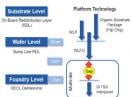 . Silicon Wafer Integrated Fan-out Technology (SWIFT) Packaging for Highly Integrated Products
 . The voltage rises
 . Key considerations when selecting a connector solution
. Siemens launches its first home smart battery . Japanese project to test solid state battery on the Moon . Shell buys out German smart storage pioneer sonnenPOWER TECH TO WATCH
. Next generation solar modules set efficiency record at 29 percent . Smaller solid state transformer for DC smart grids . Powerline tech adds data to busbars
NEW POWER PRODUCTS
. DC energy analyser crowdfunds development . Power chip enables ST's first multicore Linux IoT processor . 60kV, 1200W rack mount DC supplies aim at labs and manufacturingTECHNICAL PAPERS
. Silicon Wafer Integrated Fan-out Technology (SWIFT) Packaging for Highly Integrated Products . The voltage rises . Key considerations when selecting a connector solutionFirst System in Package for embedded Linux STM32MP1
By Nick Flaherty www.flaherty.co.uk
Octavo Systems has launched its first System-in-Package (SiP) product based on the new STM32MP1 embedded Linux microprocessor from STMicroelectronics.
Octavo Systems has launched its first System-in-Package (SiP) product based on the new STM32MP1 embedded Linux microprocessor from STMicroelectronics.
The OSD32MP1 allows users of the popular STM32 family to move to Linux without adding size or complexity to their design. Octavo has tightly integrated system building blocks to develop a device that is up to 64% smaller than an equivalent system made from discrete components. At only 18mm X 18mm the OSD32MP1 is the same size as the STM32MP1 but integrates:
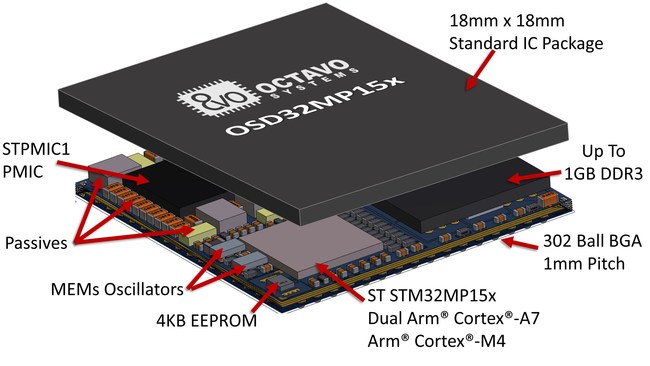 The OSD32MP1 integrates the STM32MP1, DDR, PMIC, EEPROM, Oscillators, and Passives into a single BGA package that is 18mm X 18mm.
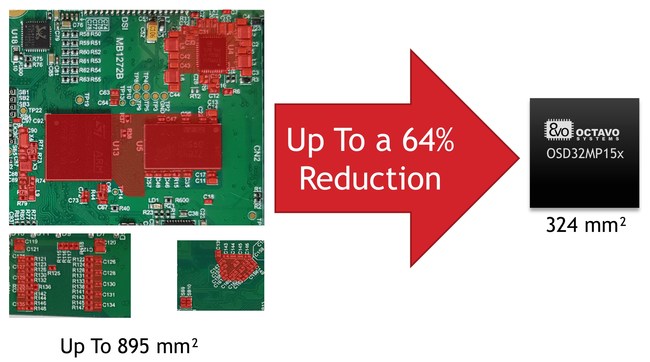 At only 18mm on a side, the OSD32MP1 packs an entire STM32MP1 system in a package the same size as the processor itself saving designers up to 64% in PCB area.
STMicroelectronics STM32MP1 microprocessor
STPMIC1 Power Management IC (PMIC)
Up to 1GB of DDR3 memory
4K non-volatile EEPROM
MEMs oscillators
Over 100 passives
The OSD32MP1 integrates the STM32MP1, DDR, PMIC, EEPROM, Oscillators, and Passives into a single BGA package that is 18mm X 18mm.At only 18mm on a side, the OSD32MP1 packs an entire STM32MP1 system in a package the same size as the processor itself saving designers up to 64% in PCB area.STMicroelectronics STM32MP1 microprocessor
STPMIC1 Power Management IC (PMIC)
Up to 1GB of DDR3 memory
4K non-volatile EEPROM
MEMs oscillators
Over 100 passives
The STM32MP1 contains two Arm Cortex-A7 microprocessors along with an Arm Cortex-M4 real time microcontroller, making it a great fit for remote sensors, HMI displays, motor control applications, medical systems, and IoT end points. The integration provided by the OSD32MP1 SiP makes the solution suitable for any application needing a versatile applications processor in a small package.
The SIP integration allows users to take advantage of a full microprocessor without the increase in complexity that typically comes from routing DDR and complex power management. The ability to reuse firmware and the elimination of complexity makes the OSD32MP1 the easiest path for designers to move from a microcontroller to Linux.
"The continued push of IoT and the demand for more data has required many applications to migrate from an existing microcontroller design to one based on a microprocessor running Linux. There are usually two major hurdles that prevent this from being an easy transition; porting their application, and complicated hardware designs," said Greg Sheridan, Marketing Manager at Octavo Systems. "Integrating the new STM32MP1 into the OSD32MP1 removes these roadblocks, greatly reducing the effort required to migrate from a microcontroller to a microprocessor running Linux."
Beyond simplifying the design process, the OSD32MP1 reduces the cost of PCBs by needing less pace and less complicated manufacturing processes, like Laser Vias or Via-in-Pad. The OSD32MP1 also simplifies the task of sourcing components by integrating over 100 devices from multiple vendors into a single component.
"Having ST ask us to be one of their partners at launch really validates our vision for the future of electronics design. Designers will demand more integrated solutions to start to develop their unique applications faster rather than spend time on tedious tasks that don't differentiate their product," adds Gene Frantz, CTO Octavo Systems. "System-in-Package is the solution to provide this tremendous level of integration."
Design resources for the OSD32MP1 are available today on the Octavo Systems website. Samples will be available in Q3 with full production scheduled for Q4. "Pricing is still being finalized and will be in-line with the cost of an equivalent system designed with discrete components," said Greg.
Wednesday, February 20, 2019
ST launches processor with linux distribution to speed IoT and smart industry designs
By Nick Flaherty www.flaherty.co.uk
STMicroelectronics has launched a multicore processor with ARM Cortex-A and -M cores and Linux support for Industrial, Consumer, Smart Home, Health and Wellness applications.
The STM32MP1 series supports OpenSTLinux as a mainlined, open-source Linux distribution to extend the STM32 family. With this combination of MPU and software, ST has assembled all the pieces to match the product supply requirements of many industrial and professional applications and the STM32MP1 is included in ST’s rolling 10-years longevity commitment.
“The STM32MP1 brings the strength of the STM32 experience to applications that need MPU compute and graphics support, combined with power efficient real-time control and high feature integration,” said Ricardo De Sa Earp, General Manager of STMicroelectronics’ Microcontroller Division. “Our commitment to consolidating open-source Linux software and microcontroller development support, combined with the longevity that consumer-oriented alternatives cannot equal, establish solid confidence in STM32MP1 for embedded MPU projects.”
STMicroelectronics has launched a multicore processor with ARM Cortex-A and -M cores and Linux support for Industrial, Consumer, Smart Home, Health and Wellness applications.
The STM32MP1 series supports OpenSTLinux as a mainlined, open-source Linux distribution to extend the STM32 family. With this combination of MPU and software, ST has assembled all the pieces to match the product supply requirements of many industrial and professional applications and the STM32MP1 is included in ST’s rolling 10-years longevity commitment.
The Cortex-A cores running Linux allows standard high level software such as graphics for user interfaces to be used, while the -M cores provide real time control and low power operation.
For example, by stopping Cortex-A7 execution and running only from the more efficient Cortex-M4, power can typically be reduced to 25%. From this mode, going to Standby further cuts power by 2.5k times – while still supporting the resumption of Linux execution in 1 to 3 seconds, depending on the application.
The STM32MP1 embeds a 3D Graphics Processor Unit (GPU) to support Human Machine Interface (HMI) displays. It also supports a wide range of external DDR SDRAM and Flash Memories. Moreover, the STM32MP1 embeds a large set of peripherals that can be seamlessly allocated either to Cortex-A / Linux or Cortex-M / Real-time activities. The STM32MP1 series are available in a range of BGA packages to support the lowest PCB cost structure and use the smallest board space.
The STM32MP1 series comprise dual Arm Cortex-A7 application processor cores running at 650MHz and a high-performance Arm Cortex-M4 microcontroller core running at 209MHz. The STM32MP1 supports cost-efficient and DDR SDRAMs, including DDR3, DDR3L, LPDDR2, LPDDR3 32/16-bit at 533MHz, which prevents performance bottlenecks and bandwidth issues on MPU systems. On top of this, the STM32MP1 supports a wide range of Flash products: eMMC, SD card, SLC NAND, SPI NAND and Quad-SPI NOR Flashes.
The 3D Graphics Processing Unit (GPU) provides for advanced HMI development, based on OpenGL® ES 2.0 interface and native support for Linux and various application frameworks, including Android Qt. The STM32MP1 supports 24-bit parallel RGB displays up to WXGA at 60fps and MIPI® DSI with 2 data lanes running at 1Gbps.
This 3D graphics processor will enable equipment such as industrial control panels to enhance user experiences. Brian Edmond, President of Crank Software, which produces the Storyboard™ user-interface tool suite, commented, “The STM32MP1 platform strengthens ST’s solution and aligns with Storyboard’s industry-leading scalability. The powerful 3D GPU from Vivante® lets Storyboard users create the rich graphical experiences needed in today's embedded markets."
In addition, ST has collaborated with Witekio for the Android porting to STM32MP1. “Witekio is proud to collaborate with STMicroelectronics for the Android porting on STM32MP1,” said Yannick Chammings, Chairman of Witekio. “As a System Software integrator, Witekio accompanies ST customers in their IoT innovative project by developing STM32MP1 Series based full software systems from Linux or Android customization, to Qt HMI development and cloud connectivity.”
In order to assure Customer code is fully trusted, the STM32MP1 Series embeds hardware security features that include TrustZone, cryptography, hash, Secure Boot, anti-tamper pins, and a real-time clock.
The STM32MP1 also leverages advanced IPs from STM32 MCUs. STM32MP1 has 37x communication interfaces, such as 3x USB2.0 including 2x High-Speed, 1x Gigabit Ethernet GMAC, 2x CAN FD and standard I²C, UARTs and SPIs. It also comes with a range of analog peripherals including 2x 16b ADCs, 2x 12b DACs and On-chip LDOs. The STM32MP1 supports 29x timers and 3x watchdogs. Depending on packages, it can also support up to 176 GPIOs.
ST completes the chipset with the STPMIC1, a dedicated Power-Management IC (PMIC) that integrates four DC/DC buck converters, six LDOs, a DC/DC boost converter, and USB VBUS and general-purpose power switches, creating a space and BOM savings to supply all required power rails for the STM32MP1 and for other components on the board. Using power-consumption optimization, the STPMIC1 is an ideal companion chip for the STM32MP1 Series in battery-powered applications.
To accelerate development, ST is demonstrating its commitment to software development with the release of OpenSTLinux Distribution as a mainlined open-source Linux distribution. OpenSTLinux has already been reviewed and accepted by the Linux community: Linux Foundation, Yocto project and Linaro. The distribution contains all the essential building blocks for running software on the application-processor cores.
The OpenSTLinux Distribution supports development on the STM32MP1’s Cortex-A7 cores and contains important elements that include Linux BSP, kernel, drivers, boot chain, and secure OS (OP-TEE: Trusted Execution Environment).
Three developer software packages let users select the support that best meet their needs:
Enhanced STM32Cube tools, specially upgraded from the STM32Cube package for Cortex-M microcontrollers, features all necessary characteristics – and more -- to accelerate microprocessor development using Arm Cortex-A-core MPUs. ST’s solution simplifies setting up MPU projects and configuring the on-chip resources.
STM32MP1 part numbers are in production now, priced starting at $4.84 for orders of 10,000 pieces. Other pricing options are available. Products will be available through distributors in March.
The OpenSTLinux Distribution supports development on the STM32MP1’s Cortex-A7 cores and contains important elements that include Linux BSP, kernel, drivers, boot chain, and secure OS (OP-TEE: Trusted Execution Environment).
Three developer software packages let users select the support that best meet their needs:
- Starter Package (STM32MP1Starter) to quickly and easily start with any STM32MP1 microprocessor device
- Developer Package (STM32MP1Dev) to add software on top of the STM32MP1 Embedded Software distribution
- Distribution Package (STM32MP1Distrib) to create a dedicated Linux distribution with its own Starter and Developer packages
Enhanced STM32Cube tools, specially upgraded from the STM32Cube package for Cortex-M microcontrollers, features all necessary characteristics – and more -- to accelerate microprocessor development using Arm Cortex-A-core MPUs. ST’s solution simplifies setting up MPU projects and configuring the on-chip resources.
STM32MP1 part numbers are in production now, priced starting at $4.84 for orders of 10,000 pieces. Other pricing options are available. Products will be available through distributors in March.
Two Evaluation boards (STM32MP157A-EV1 and STM32MP157C-EV1) and two Discovery kits (STM32MP157A-DK1 and STM32MP157C-DK2) will be available through Distributors channels in April.
www.st.com/stm32mp1
www.st.com/stm32mp1
Subscribe to:
Posts (Atom)