All the latest quantum computer articles

See the latest stories on quantum computing from eeNews Europe

Wednesday, September 29, 2010

Shipments of Silicon to Jump 23.6 Percent in 2010

By Nick Flaherty www.flaherty.co.uk
Global silicon shipments in terms of square inches will rise to record levels in 2010, according to semiconductor manufacturing market research firm iSuppli.
 
Shipments of silicon for semiconductor manufacturing in 2010 will grow by 23.6 percent year-over-year, reaching 8.9 billion total square inches, up from 7.2 billion square inches in 2009, iSuppli forecasts. By 2014, 12.4 billion total square inches of silicon will be shipped.
However, while this is good news for filling fabs, it doesn't necessarily follow through to the average selling price (ASP) and the health of the industry. There is a fine balance between demand for silicon and production - too much silicon, low prices; too much demand and not enough siliocn - high prices. 
“Following the recession of late 2008 and 2009, chip manufacturers spent the first half of 2010 striving to reverse the damage they had suffered,” said Len Jelinek, director and chief analyst for semiconductor manufacturing and supply at iSuppli. “Visibility in the second half of 2010 remains limited even as the all-important holiday season inches closer. The good news is that barring any new collapse, silicon suppliers will have sufficient orders on the books to carry them through the third and fourth quarters. And while growth in 2011 won’t match the high expansion rate seen in 2010, iSuppli anticipates that the semiconductor industry will require additional increases in silicon shipments of about 13 percent compared to 2010 shipment rates to meet the projected development.”
Outperforming the industry
The demand for silicon in 12-inch wafers continues to rise at a rate that will outperform the industry average for silicon through 2014. In order to maintain growth, however, silicon suppliers must continue to expand 12-inch wafer manufacturing.
Beyond 2010, iSuppli expects to see a greater emphasis on shifting to even more 12-inch wafer manufacturing. Specifically, mixed signal and other technologies will be moving to 12-inch wafers as a result of older 12-inch tools no longer being cost effective for the manufacturing of leading-edge technology products.
Over the next five years, the availability of additional mature manufacturing capacity and tools will accelerate the conversion to 12-inch wafer manufacturing for products such as analog and mixed signal devices.
Enhanced by Zemanta

Tuesday, September 28, 2010

Freescale to drive industrial connectivity with i.MX28 family of processors

Industrial-Focused Processors With On-Chip Connectivity and Analogue Features at Less Than 0.5 Watts

By Nick Flaherty www.flaherty.co.uk

Freescale Semiconductor has launched two new families of processors for low-power, cost-sensitive industrial applications. Consuming less than half a watt and priced starting at less than $6, these devices are aimed at a wide range of applications, including appliances, portable and diagnostic medical devices, energy distribution equipment, meters, human machine interfaces, motor control and industrial controllers. These applications can benefit from the processors’ on-chip connectivity and analogue features, which reduce system-level discrete components, power consumption, board size, development effort and system cost.
The MCF5441x ColdFire family provides customer benefits tailored for motor control, and the i.MX28x offers benefits for display applications. These two processor families introduce an embedded three-port Layer 2 switch that can replace up to $4 (USD) of external component cost. Applications such as elevator and assembly line controllers may use this feature to eliminate network equipment and reduce cable costs by daisy-chaining between Ethernet-connected nodes. In addition, both processor families integrate popular cores with dual 10/100 Ethernet ports containing IEEE 1588 hardware timestamp support for accurate clock synchronization of networked devices. These features are combined with many other industry-standard connectivity options, such as multiple UARTs, controller area network (CAN) controllers and USB interfaces to provide system design flexibility. “Industrial customers typically design systems without cooling fans,” said Bruno Baylac, Freescale’s director of global industrial segment marketing. “With all features running at maximum performance, the i.MX28x and MCF5441x families consume less than half a watt of power across the industrial temperature range of -40C to +85C. These highly integrated devices give design engineers a low-cost, ultra-low-power solution for a broad range of industrial designs.”

i.MX28x: Less than 0.5 watts powers 500 MIPS processors
The i.MX28x applications processor family is based on a 454 MHz (500 MIPS) ARM9 core and integrates a rich feature set including: an on-chip display controller with touchscreen for a rich user interface; a power management unit to power sequence the device and external components in the system; two USB modules with PHYs; analogue to digital converters (ADC); low-power modes for low standby current and secure boot.
The i.MX28x is suppported by Freescale’s i.MX28 evaluation kit, multimedia codecs and complete board support packages for Linux and Windows Embedded CE. In addition, integrated development environments and tool chains, industrial network protocols, additional operating systems, development boards and System on Modules are supported by a vast i.MX ecosystem. The i.MX28x is featured in Freescale’s recently announced Home Energy Gateway reference platform to support the growing smart energy market.

MCF5441x: Offering MCU peripherals with MPU performance
The MCF5441x ColdFire microprocessor family integrates a ColdFire V4 core that offers a high level of connectivity with up to 10 serial ports. Serial connectivity provides designers increased flexibility to meet current and future development needs.
These devices allow designers to reduce system costs with multiple analog peripherals built in to simplify system architecture. Analog features include high-speed precision pulse width modulators and dual high-speed ADCs.
The MCF5441x is supported with a powerful suite of enablement software developed by Freescale, including a board support package for Linux®, Freescale’s complimentary full-featured MQX™ 3.6 real-time operating system, and Eclipse™ based CodeWarrior 10.0 IDE. The MCF5441x Freescale Tower System for rapid prototyping completes the offering by providing nearly unlimited quick prototyping capabilities to help eliminate months of development time.
Availability and pricing
The MCF5441x ColdFire family suggested resale pricing starts at $4.99 in 10,000-unit quantities. Evaluation and demonstration systems for the MCF5441x family are available now. The TWR-MCF5441X 32-bit MPU module is available at a suggested resale price of $139. The TWR-MCF5441X-KIT is available at a suggested resale price of $259 www.freescale.com/MCF5441x.

The i.MX28x family suggested resale pricing starts at $5.27 in 10,000-unit quantities. Evaluation and demonstration systems for the i.MX28x family are available now. The MCIMX28EVK evaluation kit is available at a suggested resale price of $399, with the optional LCD module add-on for $199 www.freescale.com/imx28.

The MCF5441x and i.MX28x devices are part of the Freescale Product Longevity program, with 15 years of assured supply. For terms and conditions, please see: www.Freescale.com/productlongevity.

Adeneo Embedded

“Adeneo Embedded is very excited to extend its collaboration with Freescale Semiconductor to the new i.MX28 processor, through our support to device makers in the integration of Windows Embedded CE and Embedded Linux on i.MX based architectures,” said Yannick Chammings, CEO of Adeneo Embedded. “Our collaboration with Freescale for the distribution, maintenance and support of the i.MX28-based Home Energy Gateway reference design leverages further our expertise with i.MX architecture as well as our leading position helping OEMs from the industrial market releasing high performing product at most optimized cost and time-to-market.”
AllGo Systems
“The i.MX28 family of processors is a great follow-on series to the popular i.MX23 and i.MX25 family from Freescale. The integration of power management, dual USB ports, Ethernet and LCD controller make this a very interesting platform for consumer and industrial markets,” said K. Srinivasan, CEO, AllGo Systems. “AllGo plans to port Android to i.MX28 as well as offer our Smart Home Energy Gateway software on top of i.MX283 running Linux.” www.allgosystems.com
CodeSourcery
"CodeSourcery is pleased to provide professional C/C++ development tools for i.MX28 developers targeting bare-metal, RTOS and Linux platforms," said Mark Mitchell, chief sourcerer of CodeSourcery. "The debugger in Sourcery G++ fully supports popular low-cost JTAG emulators, and Sourcery G++ offers excellent source code development tools and build management for a simple yet powerful solution to development on Freescale's exciting new i.MX28 processor."
Innovate Solutions
“Innovate Software Solutions Pvt Ltd is excited to collaborate with Freescale on the i.MX28 processor family and is announcing its Swiftboard, a user-friendly, low-power and low cost development board,” said Manjunath P, managing director of Innovate Solutions. “Swiftboard’s flexible, open embedded, small, 10x12-cm form factor can be directly used for industrial or consumer product deployment. Enabled with multiple expansion and interface options Swiftboard allows users to create end-use applications such test and measurement systems with advanced Human Machine Interface and Portable Medical applications. Additionally, the Swiftboard supports Linux and comes with an interface for a 3G Module, SDIO based WI-FI and BT, RS-485, keypad, and 4.3" TFT/LCD touchscreen.”
IXXAT
“Freescale already offers the most comprehensive line of processors that are enabled with IEEE 1588 Precision Time Protocol hardware-assisted time stamping, and IXXAT is now adding its PTP support to the i.MX28 and MCF5441x families of applications processors,” said Bill Seitz, managing director of IXXAT, Inc. “The i.MX28 and MCF5441x address a full range of IEEE 1588 PTP applications in Telecom, Ethernet AVB, Smart Grid, Automotive, Industrial Automation and Test and Measurement.”
Karo Electronics
“The i.MX28 is the ideal enhancement to the i.MX25, the basis of Ka-Ro’s TX25 module,” said Ekkheard Meurers, CFO of Karo Electronics. “Due to its memory integration with improved speed plus the integration of RTC, the Ethernet switch with 2 ports, power management and 2 CAN interfaces, the i.MX28 is especially interesting as it is very closely positioned to the area of remote control units and remote control home automation applications. The longevity program helps ensure long-term availability which in turn serves as the basis of Ka-Ro’s 7 year long-term availability for all TX modules.”
Enhanced by Zemanta

Monday, August 23, 2010

World's smallest USB drive

By Nick Flaherty www.flaherty.co.uk

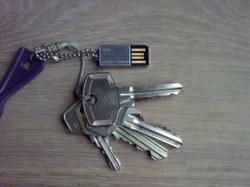
The SuperTalent Pico C is claiming the crown for the world's smallest USB drive, weighing less than 6 grams but that doesn’t prevent it from holding up to 32 GB of data. The 4 GB version comes in at £9.45 while the larger 32 GB edition costs £35.45.
This flash drive is speedy too, “the I/O performance results are amazing when it comes to the Super Talent Pico C.” explained Tom’s Hardware reviewer Patrick Schmid. However the Pico suffers from slower write speeds. Patrick went on to say “the flash-based thumb drive is great for file storage, but not for intensive access.”
Measuring just 1.5”x0.5”, it’s possible to attach the Pico USB drive to a key ring. This means there is no need to worry about losing it.
There is still a need for physical storage though as USB drives deliver much greater data transfer rates when compared with standard Internet connections. This looks to remain true for the next few years with the first USB 3.0 compatible hardware going on sale earlier this year, featuring up to 6 times the transfer speed of USB 2.0 connections.
The Pico USB drive is also shock and water resistant, meaning a few bumps aren’t going to cause it to lose any data. The Pico C USB Flash Drive is available now.

Enhanced by Zemanta

USB3 drives fastest in Digital Cameras and Camcorders

7m Set top boxes with USB3 by 2014

By Nick Flaherty www.flaherty.co.uk

USB has been extremely successful in the digital still camera and digital camcorder markets because most users want to download images to PCs to store video recordings and still pictures or to print pictures. But, given Intel's reluctant backing of USB3 (shipments of chips not until 2012), other segments are set to take advantage of the technology.
As picture file sizes increase with camera resolution, and as camcorders move from standard-definition (SD) to high-definition (HD), the desirability of SuperSpeed USB becomes even more apparent, according to In-Stat (www.in-stat.com). As a result, adoption of SuperSpeed USB into digital cameras and camcorders will be much more rapid than other CE device segments, with penetration levels reaching 50% and 60% respectively, by 2014.
“SuperSpeed USB can move 25GB of data in 70 seconds, the same amount of data would take nearly 14 minutes using high-speed USB,” says Brian O’Rourke, Principal Analyst. “This dramatic leap in download times makes the adoption of SuperSpeed USB into digital camcorders and cameras a natural migration. We expect to see the first SuperSpeed USB camcorders hit the market in the second half of 2011.”
In-Stat found that:
  • Nearly 160 million digital TVs will ship with USB in 2014.
  • By 2014 nearly 7 million set top boxes will be have integrated SuperSpeed USB
  • SuperSpeed USB will reach 40% penetration in the portable digital media player market in five years.
  • 225 million SuperSpeed USB flash drives will ship in 2014, representing a CAGR of 791.8% from 2009 to 2014.
  • More than 3 billion USB-enabled devices shipped in 2009; over 4 billion will ship in 2012.


Enhanced by Zemanta

Monday, August 16, 2010

Intel updates Atom processor for storage with DDR3

DDR3 for higher speed transfers marks shift in embedded market

By Nick Flaherty www.flaherty.co.uk

Two new processors for embedded data storage are marking the shift to DDR3.  
Since launching the D410 and D510 Atom processors into the home networking space in March, Intel has updated the chip to be faster with the 1.8GHz D425 single-core and D525 dual-core devices that now support DDR3 for Network Attached Storage (NAS).
Intel says leading storage manufacturers, including Acer, Cisco, LaCie, LG Electronics, NETGEAR, QNAP, Super Micro, Synology and Thecus have announced products based on the Atom.
The new processors will support the new memory technology, double-data-rate three small outline dual in-line memory modules, also known as DDR3 SODIMM. The new Intel Atom processors (D425 and D525) are paired with the Intel 82801 IR I/O Controller that delivers the input/output (I/O) connectivity to satisfy the growing throughput demands of leading storage vendors. Both additions to the storage platform offer the flexibility to support Microsoft Windows Home Server and open source Linux operating systems.
“Networked storage appliances based on the Intel Atom processor platform enable consumers and businesses to organize, manage, protect and share documents, photos, videos and music throughout the home or office,” said Dinesh Rao, product line manager, Intel Storage Group. “The versatile Atom processor, which is at the heart of a growing variety of small, innovative, Internet-connected devices, makes it possible for storage vendors to develop low-power appliances that can innocuously sit on a desk or shelf while keeping digital content safe and available anytime, anywhere.”
Since March, storage manufacturers have adopted the Intel Atom processor D410 single-core and D510 dual-core, each paired with the Intel 82801 IR I/O Controller, to power these affordable network-attached storage (NAS) appliances for the home and small business. Storage vendor products featuring the Intel Atom processor-based platform are currently available and additional devices will be released later this year.
“LaCie recently introduced two storage servers that leverage Intel’s Atom processor technology to deliver enterprise-level storage capabilities to small and medium businesses that were previously only experienced in large, corporate environments,” said Erwan Girard, LaCie Solutions business unit manager. “The new servers include the perfect mix of corporate-grade features and intuitive management software, enclosed in an award-winning 5big design for your desktop, allowing these products to fit seamlessly into any business environment.”
Enhanced by Zemanta

TI's 1GHz ARM Cortex A8 DaVinci chip to replace OMAP3

DM37x combines 1GHz ARM Cortex-A8 and 800MHz C64x+ DSP for 720p HD video
Hardware offers 50% boost in ARM performance, 40% in DSP, double the graphics performance with 40% less power consumption over OMAP3530 device
By Nick Flaherty www.flaherty.co.uk
TI is targetting its own OMAP3 processors with a new Da Vinci video processor family, the DM 37x. The DM3730 and DM3725 with their ARM Cortex-A8 and C64x+™ DSP core, imaging and video accelerator (IVA), PowerVR 3D graphics processor in the DM3730 and high-performance peripherals (USB 2.0, SD/MMC) integrated on a single system-on-chip (SoC), are suitable for applications requiring HD video processing or a large amount of data processing. These applications include navigation systems, media players, medical patient monitoring devices, industrial test and measurement devices, industrial vision and portable communications.
The DM37x processors are software compatible with the OMAP35x generation of processors and pin-to-pin compatible with the low end Sitara AM37x devices allowing for an easy product migration strategy to higher performing options. Customers moving to the DM3730 from the OMAP3530 can look forward to a 50 percent increase in ARM performance, a 40 percent increase in DSP performance, double the graphics performance and uses approximately 40 percent less power.
The 800MHz C64x+ DSP and hardware video accelerator enable audio and HD 720p video decoding and encoding (audio and video codecs included) independent of the ARM processor. This allows additional expansion on the ARM processor to run more high-level applications and a rich, responsive 2D or 3D graphical user interface, for applications such as an industrial personal digital assistant (PDA).
The DSP engine is programmable, allowing multiple general signal processing tasks such as digital filtering, math functions and image processing and analysis. For example, in a camera-enabled industrial application, the DSP can run an edge-detection algorithm on the video coming from a camera to detect the presence or absence of people or objects.
Key features and benefits:
  • DM3730 and DM3725 are pin-compatible and software compatible with each other, as well as with Sitara AM3715 and AM3703 processors. Each device can be configured to operate at multiple operating points enabling low power or high performance modes.
  • Up to 800MHz TMS320C64x+ DSP with 720p 30 frames per second (fps) HD video encoding and decoding
  • Allows intensive signal analysis and processing and seamless HD video decoding for multi-mediaapplications
  • DM3730 has a PowerVR 200MHz graphics accelerator, supports OpenGL ES 2.0 and renders 20 million polygons per second, coupled with the advanced display subsystem
  • Enables developers to create a user interface enabling stunning 3D graphics navigation with life-like effects
  • 20 percent increase in LPDDR controller performance and 100 percent increase in L1 cache compared to OMAP3530 (increased memory bandwidth)
  • Provides increased multi processor performance and reduces latency
Software and support
Helping make development easier, customers can start developing their designs today with the TMDXEVM3730 EVM, which includes a TI Bluetooth WiFi module. The SDK includes Linux kernel 2.6.32 board support package complete with graphical user interface, graphics, applications, demonstrations and development utilities. The SDK also offers a royalty-free library of DSP-optimized signal processing algorithms accessible from the ARM processor through a set of easy-to-use application programming interfaces (APIs). The DSP library contains more than 80 algorithms, including multi-media decoders and encoders, math functions, digital filtering including Fast Fourier Transform (FFT), and image processing including image filtering and analysis.
Support for the Linux and Android operating systems is available today. Windows CE™ support will be available in 4Q10.
Pricing and availability:
Customers can begin designing by downloading the DM3730 software for use on the DM3730 evaluation module, TMDXEVM3730, available for $1,495 USD from TI. Customers may also develop on the BeagleBoard-xM, a low-cost, open-source community board equipped with the DM3730 available for $179 from Digi-Key. The DM3730 will be available for purchase starting at $25.60 in 1,000 unit quantities (1ku) at http://www.ti.com/dm3730-prpf.

Sundance ships 12 core development system

Customer shipment three months after launch

By Nick Flaherty www.flaherty.co.uk

Sundance Multiprocessor Technology in Chesham, outside London, has started shipping its flagship multiprocessor development system to a customer three months after adding the system to its website. 
The EVP6472-941 (left) is directly targeted at the new breed of high intensity processing applications where performance and energy efficiency are critical.  Early adopter applications include digital recording, software defined radio (SDR), software reconfigurable applications in signals intelligence (SIGINT) and military communications (MILCOM) platforms.
The US$5,995 system uses two Texas Instruments (TI) TMS320C6472 multicore DSPs with twelve TMS320C64x+™ processor cores clocked at 500MHz for real time processing tasks.  A Xilinx Virtex-5 FX30T FPGA provides the co-processor, with an embedded PowerPC440 processor core and a quad channel 14-bit ADC sampling at up to 250 MSPS.  The EVP6472-941 offers two DDR2 SDRAM memory banks of 256MB assessable by each C6472 processor.
The EVP6472-941 is supplied with a complete board support package including the USB drivers, software functions and API for Windows.  Essential tools are TI’s Code Composer Studio 4.x that is supplied free of charge with the XDS100 USB JTAG Emulator for the C6472 DSP processor.  Xilinx ISE development software can be downloaded from xilinx.com to target the Virtex-5 FX30T FPGA.
A range of third party design tools for TI DSP and Xilinx’s FPGA also support the EVP6472-941; including 3L’s Diamond Multiprocessor Tool-Suite, RTW-EC and HDLCoder from The MathWorks™, comprehensive VHDL and Verilog support from EDA vendors, and Co-Developer and a growing range of IP-Cores from Impulse.
Extensive general purpose input/output (GPIO) connectors are available with the EVP6472-941.  Sundance Local Bus (SLB) interface to customize input/output (I/O) signals, four RS-232 ports, Gigabit Ethernet connection, LVTTL lines for synchronization, MicroSD Flash socket as an extension of the on-board Flash memories and JTAG headers to enable DSP and FPGA debugging.


"As we continue to see an uptick in business confidence and design starts, the launch of the EVP6472-941 signals a new generation of high intensity platform solutions architected around the C6472,"” said Flemming Christensen, Managing Director of Sundance Multiprocessor Technology Ltd.  “"Development of the EVP6472-941 reflects the strength of our collaboration with TI.  As we roll out the new family of Multicore Developer Platforms (MDPs), customers will have even greater flexibility to configure a platform solution that fits their power, performance and cost budgets.”"

Enhanced by Zemanta

Portable Multimedia: Just seven smartphone apps drive hardware designs

Portable Multimedia: Just seven smartphone apps drive hardware designs

By Nick Flaherty www.flaherty.co.uk

Friday, August 13, 2010

Wireless Tire Pressure Monitoring Systems in Cars May Pose Security Threat

Researchers spoof wireless monitoring systems 
By Nick Flaherty www.flaherty.co.uk

Reseachers in the US have 'spoofed' cars with wireless tire pressure monitoring systems, giving a false rading on the dashboard and potentally causing cars to stop. The reseachers at Rutgers University in New Jersey and the University of South Carolina also say that the new wireless technologies in cars may compromise a driver’s privacy and pose a security threat.
Modern cars are increasingly equipped with wireless sensors and devices, such as systems that monitor air pressure inside tires and trigger dashboard warnings if the tire pressure drops, which is a vry useful feature. However, the Rutgers researchers have shown that these wireless signals can be intercepted 120 feet away from the car using a simple receiver despite the shielding provided by the metal car body.
Since signals in tire pressure monitoring systems (TPMS) include unique codes from each wheel sensor, this raises concerns that drivers’ locations could be tracked more easily than through other means, such as capturing images of license plates.
TPMS wireless transmissions also lack security protections common in basic computer networking, such as input validation, data encryption or authentication. The researchers demonstrated how a transmitter that mimics, or “spoofs,” the sensor signal can easily send false readings and trigger a car’s dashboard warning display. This could prompt a driver into stopping his or her car when there is actually nothing wrong with the tires.
 “We have not heard of any security compromises to-date, but it’s our mission as privacy and security researchers to identify potential problems before they become widespread and serious,” said Marco Gruteser, associate professor of electrical and computer engineering and a member of the university’s Wireless Information Network Laboratory (WINLAB).
He notes that tire pressure monitoring is the first widespread use of in-car wireless networking, and because of the increasing cost and complexity of wired electronic systems, it’s reasonable to expect other aspects of automobile operation to come under wireless control.
“A spoofed signal could potentially cause serious safety concerns if stability control or anti-lock braking systems relied on the data,” he said. “So we are sounding the alarm right now.”
Gruteser acknowledged that intercepting and spoofing signals is not a casual effort. But the fact that people with college-level engineering expertise could carry out those actions using publicly available radio and computer equipment costing a few thousand dollars shows that systems are vulnerable.
Tire pressure monitoring was widely implemented starting around 2000 using systems that measure and compare wheel rotation speeds. A mismatch infers that a tire is underinflated. This method wasn’t accurate enough to meet U.S. regulatory requirements that took effect later in the decade, so automakers started installing systems that directly monitor air pressure inside the tires and transmit that information to a control unit. The two systems that Rutgers examined are commonly used in vehicles manufactured during the past three years.
“While we agree this technology is essential for driver safety, more can be done to improve security, such as using input validation or encryption,” said Wade Trappe, a collaborator on the project who is an associate professor of electrical and computer engineering and associate director of WINLAB.
The researchers’ South Carolina collaborators, led  by Wenyuan Xu, a former doctoral student at WINLAB and now an assistant professor at the University of South Carolina, were able to intercept a signal more than 30 feet from the car using a simple antenna and more than 120 feet away by adding an amplifier. They were able to analyze the radio signal and reverse-engineer the code using common laboratory instruments. With that knowledge, they built a transmitter that spoofed a sensor’s wireless message.
In tests using their own cars, the researchers were able to send false signals from one car and trigger a “low tire pressure” light in another while driving next to each other at 35 miles per hour. They were also able to trigger the dashboard “check tire pressure” light while driving next to each other at 65 miles per hour.
The researchers also found that at least one tire pressure system could be damaged through spoofed wireless signals.

Enhanced by Zemanta

Friday, August 06, 2010

OIF project to shrink tunable laser modules for 100G networks

By Nick Flaherty www.flaherty.co.uk

The Optical Internetworking Forum (OIF) is developing a specification for a micro-integrable tunable laser assembly (uITLA). This new form factor for tunable lasers is needed as the industry moves to an XFP form factor with reduced power dissipation.
The new uITLA project will propose changes to the assembly electrical interfaces, optical specifications, and mechanical specifications and provide an alternative laser solution for ITLA customers contemplating the integration of a specific vendor “gold box” laser on the host PCB due to space constraints. The aim is to cut the real eastate used on the base plate area by half compared to today's ITLA-MSA-1.2 modules.
Enhanced by Zemanta

Tuesday, August 03, 2010

Intel changes track on healthcare - video comment

Combines units with GE to focus on telehealth 

By Nick Flaherty www.flaherty.co.uk

Intel is merging its Digital Health group with GE Healthcare’s Home Health division to create a new healthcare technology company focused on telehealth and independent living. The new company will be owned equally by GE and Intel, with Louis Burns, currently vice president and general manager of Intel’s Digital Health Group, as CEO of the new company, and Omar Ishrak, senior vice president of GE and president and CEO, GE Healthcare Systems, as chairman.
If it weren't for Burns taking over as CEO, this would look like Intel getting out of the healthcare business - instead, it's an acknowledgment that this is becoming a system level 'sell' that needs back end communications and sofware support as much as the innovative terminal designs that Intel had been selling previously.
The deal builds on the GE-Intel healthcare alliance announced in April 2009 around independent living and chronic disease management. Both see technology as a way to bring more effective healthcare into millions of homes, and with the dramatic increase of people living with chronic conditions, and a global aging population, there is a need to find new models of healthcare delivery and extend care to the home and other residential settings.
Once formed by the end of the year, the new company will develop and market products, services and technologies that promote healthy, independent living at home and in assisted living communities around the world. It will focus on three major segments: chronic disease management, independent living and assistive technologies. GE Healthcare and Intel will contribute assets in remote patient monitoring, independent living concepts and assistive technologies, such as the Intel Health Guide, Intel Reader and GE Healthcare’s QuietCare.
“New models of care delivery are required to address some of the largest issues facing society today, including our aging population, increasing healthcare costs and a large number of people living with chronic conditions,” said Intel President and CEO Paul Otellini. “We must rethink models of care that go beyond hospital and clinic visits, to home and community-based care models that allow for prevention, early detection, behavior change and social support. The creation of this new company is aimed at accelerating just that.”
GE Chairman of the Board and CEO Jeff Immelt said “Controlling healthcare costs while bringing quality care to an increasingly aging population is one of the largest global challenges we face today. We think this joint venture will offer great potential to address these challenges by improving the quality of life for millions while lowering healthcare costs through new technology. This new company is the next step forward in a healthcare partnership that combines the complementary expertise and capabilities of GE and Intel to accelerate the development of innovative home health technology.”
Under the terms of the agreement, the new company will combine an experienced team, home health assets, technology development, products, sales and marketing. With the combined talent, capabilities and capital sharing, the new company will also provide the focus required to speed innovation and delivery of products to market.
The new company will have headquarters in the greater Sacramento area of California.
Comments by Steve Agritelley of Intel's Digital Health Group


Enhanced by Zemanta

Thursday, July 15, 2010

60GHz LAN chips take off

Startups and partnerships to drive 60GHz networks

By Nick Flaherty www.flaherty.co.uk

The development of chips for 60GHz networking is taking off, with UK startup Blu Wireless already developing a radio and baseband digital signal processing, and US WiFi chip maker Atheros joining with Wilocity for a 60GHz chipset.
The driver for this is the establishment of the WiGig Wireless Gigabit Alliance specification for networking, distinct from the WirelessHD 60GHz format for wireless HDMI short range links. This avoids the problems of multiple competing standards that killed UltraWideband (UWB), and the leader in 60GHz WirelessHD, SiBeam, is also developing parts for WiGig.
Blu Wireless has developed a 60GHz RF chip in 40nm and is now working on the underlying DSP, with 2Gbit/s and 4Gbit/s chips in a 10 x 10mm package due next year, volume production in 2012 and a target price of $10 in 2013. My story from the Wireless2.0 conference is here. 
At the same time, Wilocity, a leading Israeli developer of 60 GHz multi-gigabit wireless chipsets for the mobile computing, consumer electronics and peripheral markets, and WiFi chip maker Atheros Communications are collaborating to build tri-band wireless solutions that combine the ubiquity and coverage of Wi-Fi with the multi-gigabit performance of WiGig. Such “tri-band” capabilities will enhance the performance and functionality of wireless devices to enable a variety of new computing and entertainment applications.
Many devices and networks use dual-band 802.11n, which operates in the 2.4 GHz and 5 GHz bands, to share broadband connections, videos, music, photos and other content throughout a home or enterprise. Advanced 60 GHz technologies offer multi-gigabit speeds to complement existing Wi-Fi capabilities and enable new cutting-edge wireless applications. Tri-band devices that leverage all three bands will also maintain compatibility with the hundreds of millions of Wi-Fi products in use today, ensuring a seamless and simple user experience.
Atheros and Wilocity are jointly developing tri-band solutions based on both the IEEE 802.11n standard and the new WiGig multi-gigabit wireless specification. By integrating and optimizing Wi-Fi and WiGig solutions, the two companies aim to accelerate the design of tri-band wireless products and enable the next-generation wireless ecosystem.
Atheros serves on the board of directors for both the WiGig Alliance and Wi-Fi Alliance; Wilocity serves on the WiGig board and chairs its Marketing Work Group.

Enhanced by Zemanta

Sunday, July 04, 2010

Find out the latest on the mobile industry

By Nick Flaherty www.flaherty.co.uk

The international wireless industry meets in Bristol this week with 2010's Wireless2.0 conference on Friday July 9th at @Bristol, www.siliconsouthwest.co.uk

Market data direct from Will Strauss of Forward Concepts, future directions for the handset from Sony Ericsson, how to get good 2Mbit/s broadband into rural areas from Deltenna and a host of other speakers, from the ex CTOs of Orange and Microsoft Europe to the latest high speed connectivity in the home. If you are in mobile, you have to be there.

There's also a chance to meet the speakers at dinner on the 8th - see the website www.siliconsouthwest.co.uk for details.

• Keynotes – Multimedia in the hand
9.15 Welcome, Nick Flaherty, Editorial Director, Silicon South West
• 9.30 Joakim Nelson, General Manager, Head of Industry Collaboration & Asset Management, CTO, Sony Ericsson Mobile Communications – the future of mobile handsets
• 10.00 Will Strauss, President, Forward Concepts – market analysis of mobile multimedia
• 10.30 Simon Knowles, VP Strategy, Icera

11.00 Coffee

Multimedia in the street
11.30 Chair: Walter Tuttlebee, CEO, MobileVCE
• 11.45 Ray Williamson, Motorola - Video; the implications for mobile networks
• 12.15 Pete Keevil, CTO, Ubiquisys – Extending the reach of femtocells
• 12.45 Dr. Tim Wilkinson, VP Technical Marketing, IPWireless

1.15 Lunch

Multimedia In the home
• 2.15 Chair: Gurpritpal Singh, CTO, Cingular Consulting Services
• 2.30 Prof. David Bull, CTO, ProVision Communications – Research in video
• 3.00 Tim Haysom, CMO, OMTP / Bondi – The rise of the Widget
• 3.30 Peter Claydon, VP Sales & Marketing, Deltenna – Extending broadband coverage to rural areas
• 4.00 Mark Barrett, CEO, Blu Wireless – high speed connectivity in the home
4.30 Close Nick Flaherty, Silicon South West 
 
Enhanced by Zemanta

Tuesday, June 29, 2010

Lattice and Affarii put remote radio head on FPGA

COMPLETE RRH HARDWARE FOR WIRELESS INFRASTRUCTURE

By Nick Flaherty www.flaherty.co.uk

Lattice Semiconductor and Affarii Technologies have demonstrated the industry’s lowest cost, low power Remote Radio Head (RRH) solution at 1300mW per antenna. The integration of all RRH processing has been achieved on a single LatticeECP3-150 device.
The single chip solution supports 2x2 MIMO configurations for WCDMA, LTE and WiMAX applications and is part of an overall RRH hardware evaluation platform jointly
developed by Lattice and Affarii. The platform is comprised of the RF front-end, high-speed
data conversion devices and the digital signal processing portion. The functionality of the full
signal path package includes DDC/DUC, DPD, CFR and CPRI IP cores, supports multi-carrier
waveforms up to 20MHz bandwidth and is compatible with Class AB and Doherty amplifiers
using LDMOS and GaN transistors.
All features of this RRH solution, both hardware and soft IP, are fully integrated and supported by Lattice’s latest generation of design tools.
The RRH solution is built using Affarii’s digitalTRX technology that includes Digital Up/Down Converter (DUC/DDC), Crest Factor Reduction (CFR) and Digital Pre-Distortion (DPD) functionality. When used with industry standard Doherty amplifiers the Digital Pre- distortion solution provides up to 30dB of ACLR correction with PA output efficiencies exceeding 40%, allowing flexible and efficient RRH designs. The solution is fully customizable, with end applications including WCDMA, LTE, WiMAX, and DVB-T/S/H.
The RRH solution is supported by a development and test environment that includes GUI-based design simulation, performance analysis and a production test API with design examples.

Enhanced by Zemanta

Monday, June 28, 2010

Que? That’s Spanish for “Where The Hell is My E-Reader,” Right?

Que? That’s Spanish for “Where The Hell is My E-Reader,” Right?

Story from WSJ on the cancellation of pre-orders for Plastic Logic's Que reader, and no date for shipping - opps, not a good sign, and a real shame for a UK startup!