All the latest quantum computer articles

See the latest stories on quantum computing from eeNews Europe

Monday, October 09, 2017

SiFive adds linux support to RISC-V CPU cores

By Nick Flaherty at www.flaherty.co.uk

Open source CPU core designers SiFive have launched the first multi-core for embedded designs that uses the RISC-V architecture and supports the linux operating system.

The quad core U54-MC Coreplex IP is based around the MIPS-like RISC-V open source architecture, which is supported by an ecosystem comprising more than 70 companies and has seen significant growth in the embedded segment. Part of this has come from the uncertainty around the future of the MIPS architecture.
The release of the U54-MC Coreplex marks the architecture's expansion into the application processor space and wider IoT applications such as gateways.
The U54-MC contains four U54 CPUs along with a single E51 CPU, and is the first commercial RISC-V core to include multicore support and cache coherence. Each U54 CPU has a highly efficient five-stage in-order pipeline supporting the RV64GC ISA, which is expected to be the standard for Linux-based RISC-V devices.

The 64-bit E51 CPU serves as a management core and is fully coherent with the main U54 cores. This makes it suited to applications which need full operating system support such as AI, machine learning, networking, gateways and smart IoT devices.
"The ability for RISC-V developers to develop Linux and other Unix-based operating systems on commercial grade silicon will enable the RISC-V software ecosystem to quickly expand beyond embedded systems, and bring new solutions to market," said Rick O'Connor, executive director of the non-profit RISC-V Foundation.

The Coreplex has been taped out as part of SiFive's Freedom Unleashed family of high-performance, customisable RISC-V SoCs. This has the U54 and E51 CPUs running at 1.5 GHz in 28nm technology. Each of the U54 CPUs implement a 32KB Instruction Cache and 32KB Data Cache, and all of the cores share a coherent, 2MB L2 Cache. Customers can license the U54-MC Coreplex in a variety of configurations besides the 4+1 default configuration.

"The U54-MC Coreplex is the first fully Linux-compatible CPU based on RISC-V. It takes the industry one step closer to making custom silicon available to everyone," said Andrew Waterman, co-founder of SiFive. "We continue to be amazed by the support SiFive has received since we launched the industry's first open-source RISC-V SoC last year, and look forward to additional milestones in the coming months."

The U54-MC Coreplex can be accessed at https://www.sifive.com/products/coreplex-risc-v-ip/u54-mc/. A development board based on U54-MC Coreplex IP will be available in Q1 2018. 


HPC moves into embedded with rugged server designs

By Nick Flaherty at www.flaherty.co.uk


The Crystal Group is launching a new range of high end rugged liquid-cooled servers for embedded applications.

The Fully Optimized Rugged Computer Equipment (FORCE) combine the latest Intel Xeon Scalable Processors with high-speed networking, enhanced I/O, platform security, and thermal management in a modular, customisable high-performance computing (HPC) system.

Those with long memories may remember Force Computers, bought by Motorola in 2004 from Solectron and then becoming part of Emerson Network Power, now owned by a venture capital firm and renamed Vertiv. 

Crystal's FORCE rugged servers have single or dual Intel Xeon Scalable Processors (Purley/Skylake), each supporting up to 24 cores and 48 PCIe lanes. The Intel Advanced Vector Extensions 512 (AVX-512) ultra-wide vector processing simplifies repetitive tasks. The Platform Controller Hub (PCH) offers 10 Gigabit Ethernet (10GbE) ports for high-speed communication, up to 14 SATA 3 ports for expanded storage capacity, and QuickAssist Technology (QAT) for enhanced security, authentication, and compression.

The RS1104, RS2608, and RS3712 Rugged Servers are available now. The newly designed, lightweight chassis come in 1U, 2U, and 3U sizes with 19-, 22-, and 25-inch depths, with a choice of ATX or eATX motherboard, and air- or liquid-cooled thermal management. Front-end configuration options include serial and USB ports, 2.5-inch drives, CMOS battery, pump assembly for liquid cooling, circuit breaker, card reader, USB sound card, sanitize button for security, DVD, and LCD. 

"The Crystal Group FORCE RS1104L22 can dissipate an unprecedented 280 watts of CPU power with its state of the art liquid cooling. It is the world's first and only Xeon Skylake powered server capable of such a feat," said Jim Shaw, Crystal Group Executive Vice President of Engineering.

"The FORCE line comes in direct response to customer requests for faster processing speeds and greater storage capacities in a rugged enclosure with advanced thermal management – optimized for size, weight, power, and cost (SWaP-C)," said Shaw. "We continue to expand the Crystal Group portfolio of trusted rugged solutions to provide precisely what's needed on today's multi-domain battlefield: robust, rugged, and reliable systems capable of withstanding harsh environments and tackling complex, compute-intensive applications, such as sensor fusion, machine learning and artificial intelligence, autonomy, electronic warfare, and so much more."
Crystal Group is demonstrating 1U, 2U, and 3U air- and liquid-cooled configurations of the RS1104, RS2608, and RS3712 in the US this week. 

The servers meet or exceed IEEE, IEC, and military standards (MIL-STD-810, 167-1, 461, MIL-S-901) and are backed by warranty (5+ year) with in-house support.

crystalrugged.com

Friday, October 06, 2017

TiTAN wants to create an OS for the smart home

By Nick Flaherty at www.flaherty.co.uk

Korean startup TiTAN has launched a smart platform for the home based around secure content in the US.

The 'TiTAN Core' home hub has unique smart controls that give users unlimited access to their smart devices, says the company, It wants to use this as the basis for an IoT operating system across the home with its TiTAN Content Identifier (TCI) Encryption.

"The time has come for content, platforms, networks and devices to be unified. We will continue to expand our business here in the US and around the world providing smart services that will help users be more connected to their content and smart home devices," said Jae Young Yoon, founder of TiTANplatform. "Backed by our TCI patented encryption technology, we have created a secure ecosystem through which consumers can safely integrate their entire home through one device, and content producers can reach viewers on a highly transactional platform that protects their intellectual property."

TiTAN Play allows content owners to securely upload their IP and have access to consumers through a secure content marketplace. TiTAN Core is a smart home hub device married with a lean-back living room entertainment experience, allowing consumers to manage their connected or smart Internet of Things (IoT) devices and appliances.

"With TiTAN Play and Core, we are creating a new 'OS for the Home' - a unified ecosystem that provides a smarter content experience and device connectivity. Consumers are increasingly buying smart IoT devices to improve their lives, yet few of these devices truly talk with each other," said Adrian Sexton, CEO of TiTAN Platform US. "TiTAN Core's open platform changes that and does it with security being paramount. With TiTAN Play, content creators and studios will be able to monetise their content with a major access point in China - a difficult entry market for YouTube, Netflix, Facebook and Amazon - thanks to our joint venture with China Unicom.."

Content creators will also be able to quickly launch SVOD (Subscription Video on Demand) channels by uploading content directly through either the TiTAN Core smart device in their homes or via TiTAN Play on their mobile devices.

The company is currently raising $100 million on top of $32 million raised to date out of Asia.

www.titanplatform.com

Surge in processors for tablets

By Nick Flaherty at www.flaherty.co.uk

After two consecutive years of decline, the global tablet Applications Processor (AP) market returned to growth and registered a 5 percent year-over-year growth to reach $984 million in the first half of this year, according to Strategy Analytics Handset Component Technologies service report.
The report finds that Apple, Intel, Qualcomm, MediaTek and Samsung LSI captured the top-five revenue share rankings in the tablet AP market. Apple as market leader gained share and increased its  revenue share to 37 percent in 1H 2017. Intel and Qualcomm grabbed the number two and three spots with 18 percent revenue share and 16 percent share, respectively in 1H 2017.

“The global tablet AP market continued to show signs of stabilisation from past few quarters with slower year-on-year declines," said Sravan Kundojjala, Associate Director. "Despite this encouraging trend, tablet AP vendors have to contend with a significantly smaller overall market in 1H 2017 compared to two years ago. Strategy Analytics believes that the mature market pushed many of the tablet AP vendors to shift focus from high volume low-cost tablet APs to relatively lower volume but higher value tablet APs. This trend had boosted tablet AP average selling prices (ASPs) in 1H 2017 on a sequential basis.”

Stuart Robinson, Executive Director of the Strategy Analytics Handset Component Technologies service, added, “Strategy Analytics estimates that x86-based tablet AP shipments accounted for 14 percent of total tablet AP shipments 1H 2017, up from 10 percent in 1H 2016. Intel’s focus on Windows tablets paid off. The x86 chip maker Intel retrenched from the low-end Android tablet AP market but capitalised on Windows tablets and gain market share in 1H 2017. Intel is expected to maintain momentum through 2017." 

Aside from Intel, HiSilicon also performed well in the tablet AP market in 1H 2017. HiSilicon’s parent company Huawei increased its tablet shipments in recent quarters and this has helped HiSilicon to build a strong position in the tablet AP market says Robinson.

Related stories:

Thursday, October 05, 2017

Foghorn raises $30m to boost IoT development

By Nick Flaherty at www.flaherty.co.uk

FogHorn Systems has raised $30m in its second round of funding to expand its engineering teams in California and Pune, India that are working on Industrial IoT (IIoT) edge computing.

FogHorn recently launched Lightning ML with machine learning at the network edge. This uses FogHorn’s pioneering CEP (complex event processing)-driven edge analytics software that was launched in 2016 to allow industrial customers to train and execute machine learning algorithms on streaming sensor data at the source of the data.
Intel Capital and Saudi Aramco Energy Ventures led the round, with new investor Honeywell Ventures and all previous investors participating, including Series A investors March Capital Partners, GE Ventures, Dell Technologies Capital, Robert Bosch Venture Capital, Yokogawa Electric Corporation, Darling Ventures and seed investor The Hive. 

This new round brings FogHorn’s total funding to $47.5 million. “This major round of funding by many of the world’s largest and most innovative technology and industrial companies will enable FogHorn to continue its drive for industry-first innovation in the IIoT market segment,” said David King, CEO of FogHorn. “We have seen unprecedented interest from customers and partners in a huge variety of industries for advanced condition monitoring, predictive maintenance, asset performance management and process optimisation solutions.”

“Both the promise and challenge of IIoT lie in the ability to convert sensor data to actionable insights that improve customers’ operating efficiency and generate new sources of business value,” said Jonathan Ballon, Vice President and General Manager of Intel’s IoT Group. “As we’ve watched FogHorn’s progress with both leading IIoT solutions providers and major industrial end customers, we believe their edge analytics and machine learning technology will be a critical factor in enabling those operating efficiencies and delivering that business value.”

“For the oil and gas industry, harnessing IIoT insights will produce significant operating savings and spur major process improvements,” said Cory Steffek, Managing Director North America of Saudi Aramco Energy Ventures (SAEV). “We believe innovators like FogHorn will lead the way in redefining IIoT edge computing to deliver real-time analytics and machine learning value across our entire business — upstream, midstream and downstream.”

With more than 20 billion IoT-connected devices expected by 2020, according to Gartner’s latest projections, GE estimates that the industrial internet market segment will grow to $225 billion in that timeframe. This will require solving the fundamental computing challenge of generating actionable insights from all the real-time streaming data constantly being emitted by the profusion of physical, video/audio and other edge sensors deployed in any industrial environment — whether in manufacturing, energy, resources, transportation, smart cities or smart buildings — without the transport and hosting costs, cybersecurity risk and operational latency associated with sending all that operations technology data across a network to a public/private cloud or remote data centre.

www.foghorn-systems.com


Wednesday, October 04, 2017

Intel widens security for automated IoT rollout

By Nick Flaherty at www.flaherty.co.uk

Intel has launched technology that securely automates and brings IoT devices online within seconds rather than hours. The Secure Device Onboard (SDO) uses the Wind River Helix technology to provide a service for IoT developers to rollout thousands of connected devices.

Provisioning and management of devices is a huge challenge, as IoT devices are added manually. It involves coordination between installation technicians, IT network operations, and operational technology teams and can typically take more than 20 minutes for a single device. At present, it could take two years to install 10,00 smart lightbulbs. This is to say nothing of the effort required to maintain device privacy and security.

Intel SDO’s “zero touch” model allows devices to dynamically discover the customer’s IoT platform account at power-on for automatic registration. It offers a one-to-many, one-time enablement solution that can be integrated into almost any device or IoT platform, thereby eliminating the need to custom pre-load provisioning configurations for each IoT implementation.

The SDO also uses Intel’s Enhanced Privacy ID (EPID), to anonymously authenticate the device and establish an encrypted communication tunnel, thereby preventing hackers from tracing the device from factory to owner. EPID establishes a best practice identity model for IoT onboarding and is a proven method with over 2.7 billion keys distributed in Intel and non-Intel MCU processors since 2008.

Intel has expanded the availability of Intel SDO across the IoT ecosystem. Other silicon providers such as Infineon, Microchip and Cypress Semiconductor will embed the EPID identity capability in their hardware. Cloud service platform and device management software providers like Google Cloud, Amazon Web Services (AWS), Microsoft Azure and Intel’s Wind River Helix Device Cloud intend to provide integration to support Intel SDO’s zero touch model.

Intel SDO is now integrated with Wind River Helix Device Cloud, its device lifecycle management platform that enables IoT devices to securely connect, monitor, manage and service devices. With the integration of Intel SDO, Wind River’s latest release of Device Cloud includes zero touch roll out designed to mitigate the risk of security attacks to a device, ensure privacy and deliver automation that dramatically reduces installation time to mere seconds, among other new features and capabilities.

Weatherford, a leading oil and gas services company, was part of the Intel SDO pilot program. The company wanted to pull data from existing controllers and install new wireless sensors through a gateway to the cloud to drive oil and gas insights. By adopting the SDO and Wind River’s Device Cloud, Weatherford can reach 290,000 wells, representing 870,000 sensor data points and nearly 10,000 IoT gateways around the world.

Intel Secure Device Onboard page

SMT module for 26GHz pioneer 5G wireless

By Nick Flaherty at www.flaherty.co.uk

Plextek RFI in Cambridge has developed a surface mount multi-chip module (MCM) for the recently-designated European ‘Pioneer Band’ for millimetre-wave (mmWave) 5G around 26GHz. The development of the Front-End Module (FEM) was carried out in collaboration with Filtronic Broadband.

“The band 24.25 to 27.5GHz was designated at the end of last year by the EU Radio Spectrum Policy Group (RSPG) as the preferred band, or ‘Pioneer Band’, for mmWave 5G,” said Liam Devlin, CEO of Plextek RFI. “We welcome the opening up of this spectrum band for 5G, but we identified early on that there was a lack of components available at this frequency, and that led us to define this joint FEM development project.”

The FEM comprises a GaAs low-noise amplifier (LNA), power amplifier (PA) and transmit/receive switch housed in a custom laminate surface-mount (SMT) package measuring 10mm x 10mm. The receive path gain is 20dB across the full band, with a noise figure of 3.5dB. Transmit path gain is 19dB, and the output referred third order intermodulation (IP3) is +36dBm. Low-loss RF filtering has been integrated into the package structure, with a band-pass filter after the LNA and a harmonic rejection filter after the PA. Insertion loss figures are 0.7dB for the band-pass filter and 0.2dB for the harmonic rejection filter.

“This development has demonstrated that we can overcome the manufacturing challenges of integrating filters along with multiple die into an SMT package,” said Mike Weaver, managing director of Filtronic Broadband. “This is not easy at mmWave frequencies, and will give us a crucial head start towards eventual production when the market demand for 5G components at 26GHz begins to ramp up.”

Embedded barebone box for IoT gateways

By Nick Flaherty at www.flaherty.co.uk

Advantech has launched a thin bare-bone fanless system with Intel's Celeron N3160/N3060 or Atom x5-E8000 processors.

Designed with Advantech 3.5” PCM-9310 Single Board Computer, the EPC-S101 provides several I/O ports and Advantech's IoT software for remote devices management, and flexible mounting methods ready for use in various industrial and commercial application fields.

THe EPC-S101 measures only 188 x 39 x 150 mm, and is less than 1U in height. The fanless system provides 6 USB ports, 4 COM ports (RS-232/422/485), 2 GB Ethernet ports, 1 HDMI, 1 VGA, an 8-bit digital I/O port, an audio jack w/ mic in, and a line out port. It has reserved spaces for a 2.5” SATA SSD with SATA power, mSATA, and a full-size mini-PCIe with SIM holder for multiple expansion. 

For flexibility the box supports wall mount, VESA mount, and din rail mounting to cope with different application scenarios. With its reduced system size, multiple IO ports, and flexible mounting methods, the box is suitable for retail, commercial kiosk, and signage applications, environmental monitoring, and HMI device implementation.

The WISE-PaaS/RMM provides centralised management including HW/SW status monitoring, remote control, and system backup/recovery. It supports server redundancy and hierarchical server management, which increases service reliability and availability. WISE-PaaS/RMM uses standard IoT protocols such as MQTT to communicate with IPCs and IoT gateways and sensors. It provides a WISE Agent framework for data acquisition from devices, as well as the RESTful API web service, which allows the user to integrate RMM functions with other applications or for further customisation. 

Tuesday, October 03, 2017

STMicroelectronics teams with Objenious to speed up IoT nodes development for LoRa networks

By Nick Flaherty at www.flaherty.co.uk

STMicroelectronics has teamed up with french LPWAN network provider Objenious to accelerate the connection of Internet-of-Things (IoT) nodes to LoRa networks. ST’s development kits are certified on the Objenious LoRa network to reduce R&D effort and time to market.
LoRa especially suits applications where nodes have limited power capability, can be difficult to access, and data transfers don’t require high bandwidth. Industry analysts estimate there will be tens of billions of connected devices deployed in the world by 2020.

Objenious launched and operates the first LoRa network in France, with more than 4,200 antennas deployed around the country. Using network expertise inherited from Bouygues Telecom, Objenious now proposes its LoRa network, platform, and services for LPWAN IoT to partners and customers locally and internationally thanks to roaming agreements.

ST helps developers by providing tools and software libraries that aid the STM32 MCU-based embedded design as part of its freely available STM32 Open Development Environment (ODE). By integrating Objenious’ network access software on top of the STM32 ODE, developing connected devices is even easier.

“The collaboration of STMicroelectronics and Objenious offers customers an opportunity to easily and quickly develop LPWAN-connected objects for the Objenious network, accelerating the business and the development of the IoT,” said Stéphane Allaire, CEO of Objenious.

“Offering STM32-based LoRa-enabled kits that are already certified on the Objenious network is a valuable asset for developers as it hurdles a major challenge in their efforts to create new LoRa devices,” said Thierry Tingaud, West Europe Sales, and President of STMicroelectronics France. “In addition to pre-integrating the software development kit, the Objenious-LoRa-enabled STM32-based solution is ready to use on a live network, greatly reducing R&D effort and time to market.”

The STM32 Nucleo LoRa kits are now certified and available to developers.

Related stories:

Monday, October 02, 2017

Power news this week

By Nick Flaherty at www.flaherty.co.uk

POWER NEWS from eeNews Europe


. Team attacks ARM TrustZone via power management software


. Dyson invests £2bn in electric car and battery development


. ABB buys GE's industrial division for $2.6bn

TECHNOLOGIES TO WATCH
. Power management chip cuts inductor size by ten

. Thermoelectric wristband for personal temperature control

. New structure boosts SiC MOSFET efficiency

NEW POWER PRODUCTS
. 300mA LDO regulator for the IoT combines low quiescent bias current with high ripple rejection


. Versatile DC-DC power IC only draws 0.5mW in standby


. 80V MOSFETs save space with dual-device package

TECHNICAL PAPERS
. Primary protection against overvoltage events


. CUI: Improved Longevity and Performance in DC Fans


. Interference free cabling

LoRaWAN certified sensor node for LPWA IoT applications

By Nick Flaherty at www.flaherty.co.uk

Advantech has launched a an IoT LoRaWAN certified sensor node with an integrated Arm Cortex-M4 processor and LoRa transceiver.

The WISE-1510 provides multi-interfaces for sensors and I/O control such as UART, I2C, SPI, GPIO, PWM, and ADC.
The sensor node is ideal for smart cities, agriculture, metering, street lighting and environment monitoring. With power consumption optimisation and wide area coverage, LoRa sensors or applications with low data rate requirements can achieve years of battery life and kilometers of long distance connection.

The WISE-1510 is flexible enough to support either public LoRaWAN networks or private LoRa eco-systems and has LoRaWAN certification from the LoRa Alliance .

Depending on deployment requirements, developers can select to use Public LoRaWAN network services or build a private LoRa system using WISE-3 610 LoRa IoT gateway. This is a Qualcomm Arm Cortex A7 based hardware platform with private LoRa ecosystem solution that can connect up to 500 WISE-1510 sensor node devices. It uses Advantech’s WISE-PaaS IoT Software Platform to provide automatic cloud connection through its WISE-PaaS/WISE Agent service, manages wireless nodes and data via WSN management APIs, and helps customers streamline their IoT data acquisition development through sensor service APIs, and WSN drivers.

Developers can use the processors on WISE-1510 to build their own applications through the ARM Mbed OS and SDK for easy development with APIs and related documents. Developers can also find extensive resources from Github such as code review, library integration, and free core tools. The WISE-1510 also has worldwide certification which allow developers to leverage their IoT devices anywhere. 

Using the WISE-3 610 LoRa IoT Gateway, WISE-1510 can be connected to WISE- PaaS/RMM or Arm Mbed Cloud service with IoT communication protocols including LWM2M, CoAP, and MQTT. End-to-end integration assists system integrators to overcome complex challenges and helps them build IoT applications quickly and easily.

Embedded-IoT.advantech.com

Related stories:

Expandable embedded PC boxes with Kabylake and Xeon processors

By Nick Flaherty at www.flaherty.co.uk

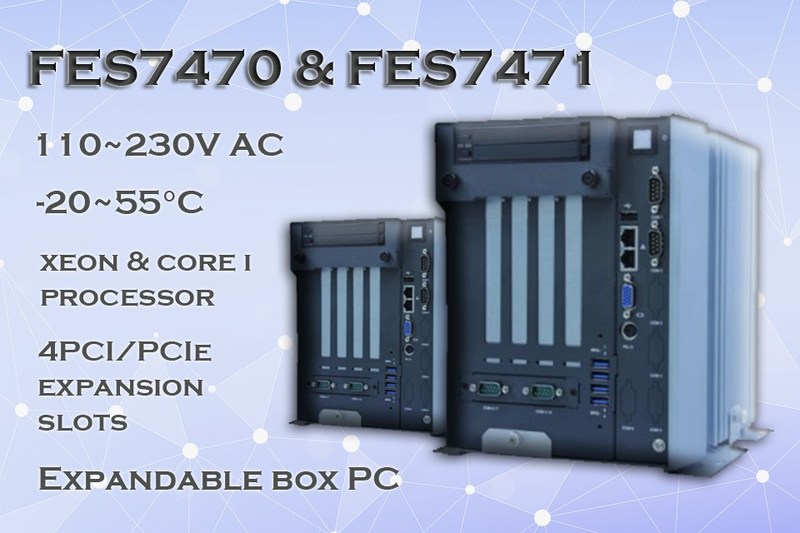
Acnodes in the US has launched a series of expandable embedded box PCs with 7th/6th Gen Intel Xeon & Core i processor. 

Both the box PCs include a 4th generation PCI/PCIe expansion slot and 110-230V AC power input with wide range of working temperature from -20~55°C.


The FES7470 provides different Core i7 processors to choose from. There are Kabylake options on Core i7-7700T or Core i7-7500T and these are only compatible with Windows 10. However, if users want to stay with Windows 7, there are Skylake options with the Core i7-6700TE and Core i7-6500TE. The chassis porvies 3-slot PCI, 1-slot PCIe x16 Expansion, 5 USB3.0, 4 COM, and swappable HDD box, 250W AC power supply voltage.

The FES7471 offers higher performance Intel Xeon E3 processor in a chassis with 1-slot PCIe x1, 2-slot PCIe x4, 1-slot PCIe x16 Expansion, 5 USB 3.0, 4 COM, swappable HDD box and 250W AC power supply voltage. The two SATA 3.0 (600 MB/sec) slots also support RAID 0/1.

The two chassis weigh 11.48lbs (5kg) with dimension of 7.34 x 9.31 x 9.54" with tests reports for MIL-STD-810G military standard on vibration shock. These two models also support power input of 110-230V AC with 4PCI/PCIe expansion slot. Moreover, FES7470 and FES7471 also feature in 4COM, 2GbE, 5 USB 3.0.

www.acnodes.com

First Sigfox cellular hybrid IoT chip

By Nick Flaherty at www.flaherty.co.uk

GCT Semiconductor has developed the first single chip that will support both LTE Category M1/NB1/EC-GSM and the Sigfox wireless low power wide area technology.
The development highlights the need for hybrid solutions that can operate with either network, particularly for tracking applications that may not always be in range of a Sigfox network, especially if the node breaches a goefencing application (by going outside the network).

Several OEM customers are designing solutions using GCT’s GDM7243I SoC to develop various IoT devices for applications such as tracking, wearables, security, agriculture, healthcare, industrial, and consumer applications.

The hybrid device enables ultra-long battery life tracking devices to connect using the Sigfox wireless IoT network for several years without the need for frequent battery re-charging.

“We’re pleased to be working closely with Sigfox to bring this unique capability to market and support ultra-long battery life and global coverage for our IoT customers,” says John Schlaefer, CEO of GCT Semiconductor, Inc. “Adding the hybrid mode Cellular connectivity + Sigfox to GCT’s GDM7243I further enhances our leadership position by enabling IoT devices to connect to the global Sigfox network during typical operation and switch to LTE Cat M1, NB1, or EC-GSM networks on-demand.”

“Telefonica announced its support for Sigfox wireless IoT connectivity as complementary to our cellular networks, at MWC in February 2017,” saidAndres Escribano, New IoT Connectivity Director of Telefonica, “The GDM7243I with hybrid mode Sigfox and Cellular connectivity is an innovative solution that aligns with our partnership with Sigfox and will enable innovative devices and novel usage models to accelerate the growth of the IoT market”.

“GCT provides a single chip innovative solution that further proves that Sigfox and Cellular (LTE Cat M1/NB1/EC-GSM) are complementary technologies by leveraging the best of both worlds – ultra-long battery life using Sigfox and high throughput cellular connectivity. We look forward to a successful launch of the GDM7243I by Sigfox operators and mobile network operators worldwide,” says Ludovic Le Moan, CEO of Sigfox.

Hybrid devices can connect to the Sigfox wireless IoT network and operate in low-power mode to send and receive notifications-only. The Sigfox network can also provide backup connectivity to hybrid devices in case of cellular network coverage limitations, congestion, breakdown, or jamming of security/alarm systems. Hybrid devices enhance device security by providing the ability to globally locate and deactivate stolen phones, and provide emergency alert and beacon capabilities.

www.gctsemi.com

Related stories:

Top stories in September on the Embedded blog

By Nick Flaherty at www.flaherty.co.uk

Low power networks for the Internet of Things are a strong theme for September, with a great piece fro, an analyst on the opportunities for LPWAN. It looks at the different technologies being used by different operators and the opportunities from going with other, less mainstream, options.

The Embedded blog has highlighted the move from standalone developments for the IoT to an end-to-end solution that is linked to particular cloud operators. This is at the heart of the Silicon Labs deal to team up with Microsoft for the Azure cloud service, integrating the APIs into the software development kit.

Interestingly there is also growing interest in quantum sensor technologies. The growth of the market is perhaps not as fast as might be expected (although I would probably quibble with the estimates are rather low) but the fact the market is there at all is is news to a lot of engineers. Quantum technology is advancing quickly, moving from the research lab to commercialisation in areas such as Bristol.

It was also gratifying to see the interest in the detail of the latest Sparc chip. This was a dominant architecture a decade ago with Sun Microsystems, and is now the bedrock of Oracle's server business.

One of the other themes for the Embedded blog was also strong in September, with blockchain secure ledger technology being used to secure components throughout the supply chain. This is a demonstrator for defence contractors but could be used to provide a reliable supply chain and tackle counterfeit devices in many different areas of the production of embedded designs.

Posts