All the latest quantum computer articles

See the latest stories on quantum computing from eeNews Europe

Wednesday, May 12, 2010

Lattice to develop Serial Rapid IO (SRIO) interface for Cavium network processors

Lattice FPGAs to link to Octeon II multicore processors
FPGA maker Lattice Semiconductor has announced plans to interoperate between Cavium Networks’ OCTEON II CN63XX multicore network processors and its LatticeECP3 family via a Serial Rapid IO (SRIO) Specification 2.1 link. SRIO is commonly used in 3G/4G wireless base stations and wireline switches and routers where low latency is critical. Cavium’s OCTEON II processor incorporates two to six cnMIPS64 cores and SERDES-based I/Os, including SRIO. Lattice’s ECP3 device has the lowest power in a mid-range FPGA family, rich memory density, DSP blocks and SERDES I/Os capable of supporting SRIO.
Cavium and Lattice have already begun executing their plan to demonstrate SRIO interoperability, and both companies will announce updates as they become available. “The addition of the SRIO interface in the OCTEON II processors, along with the wide variety of other standards-based interfaces, provides a new low-latency connectivity option,” said Tasha CastaƱeda, Senior Strategic Alliance Manager at Cavium Networks. “We are pleased to add Lattice to Cavium’s PACE (Partnership to Accelerate Customer End-solutions) ecosystem in order to offer our customers a strong FPGA design solution.”
“This SRIO interoperability testing will strengthen our rich portfolio of wireless IP," aid said Ted Marena, Director of Business Development for Lattice. "We are working to introduce future bridging applications for the OCTEON II and our ECP3 family, including SRIO to CPRI, SRIO to PCIe and SRIO to SGMII.” 
Reblog this post [with Zemanta]

DNA as the future of silicon chips?

In a single day, a solitary graduate student at a lab bench can produce more simple logic circuits than the world's entire output of silicon chips in a month. So says a Duke University engineer, who believes that the next generation of these logic circuits at the heart of computers will be produced inexpensively in almost limitless quantities in a story at Nanowerk.
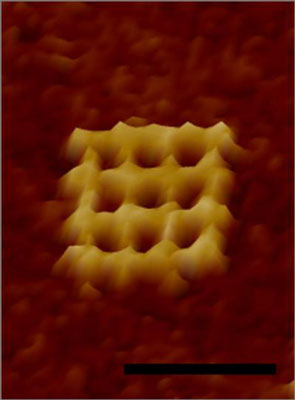
In his latest set of experiments, Chris Dwyer, assistant professor of electrical and computer engineering at Duke's Pratt School of Engineering, demonstrated that by simply mixing customized snippets of DNA and other molecules, he could create literally billions of identical, tiny, waffle-looking structures (left). Dwyer has shown that these nanostructures will efficiently self-assemble, and when different light-sensitive molecules are added to the mixture, the waffles exhibit unique and "programmable" properties that can be readily tapped. Using light to excite these molecules, known as chromophores, he can create simple logic gates, or switches. 

More on the story here
Reblog this post [with Zemanta]

Tuesday, May 11, 2010

Foundry business picks up

Revenue to Grow Nearly 40 Percent This Year
After a year that was decidedly skewed by macroeconomic forces impacting the entire electronics value chain, pure-play foundry suppliers will see revenues in 2010 jump by 39.5 percent, according to iSuppli.
Total pure-play foundry revenue in 2010 will reach $24.8 billion, up from $17.8 billion in 2009. This year’s projected revenue also is up 24.6 percent from 2008 levels of $19.9 billion. By 2013, iSuppli forecasts foundry revenue will reach $35.9 billion with a Compound Annual Growth Rate (CAGR) of 12.5 percent.
“Lured by innovative new features and a renewed economy, worldwide consumers again are purchasing electronic products,” said Len Jelinek, director and chief analyst for semiconductor manufacturing at iSuppli. “Unless conditions deteriorate once more, previously pent-up need for new consumer products will fuel foundry demand, iSuppli believes.”
Leading foundry manufacturers are ready to meet this demand from the consumer and wireless markets, having developed process technology capable of supporting such growth. As a result, revenue expansion in the foundry business will outperform that of the semiconductor industry in 2010. Growth won’t be limited to the leading foundry vendors but will also extend to specialty foundries, which stand to reap benefits as their niche products that are associated with new designs position them for impressive growth.

Gains for Global GlobalFoundries in 2009 purchased Chartered Semiconductor Manufacturing, a move that will create a new No. 2 player in the pure-play foundry market by the end of 2010, iSuppli believes.
With the merger complete, GlobalFoundries will focus on providing technology to the market. Because of its association with Advanced Micro Devices Inc. (AMD), technology from GlobalFoundries can be found at some of the most advanced manufacturing nodes available in the foundry space. And as the company brings its technology to the clients of Chartered and the rest of the global fabless market, iSuppli predicts a significant gain in market share for GlobalFoundries in 2010.

New deals coming The acquisition of Chartered by GlobalFoundries marks just the beginning of the buying season among foundries. iSuppli sees a number of new deals occurring in 2010, some of which already have been announced—including the agreement between United Microelectronics Corp. (UMC) and He Jian Technology. iSuppli also sees several Tier 2 foundries examining the need to expand capacity: with many Integrated Device Manufacturers (IDMs) looking to offload manufacturing facilities in order to cut costs, many buyers could end up waiting for product.

Such developments are sure to result in a dramatic reshaping of the foundry industry in 2010 and beyond.
Reblog this post [with Zemanta]

STMicro launches first EAL6+ high security smartcard controller

Supports latest security protocols and enhanced contact/contactless operation, surpass credentials of competing components

STMicroelectronics has announced details of its formal EAL6+ Common criteria certification - the highest security standard applicable - for its ST23YR80 secure dual microcontroller including its optional crypto libraries.
ST's chip is the world's first secure microcontroller to achieve EAL6+ according to the Common Criteria 3.1 methodology. Other processors have been accredited at lower levels or using less stringent methodologies. ST applied formal methods, which guarantee all states and transitions are known, from the beginning of the processor's design, resulting in formally proven high security with optimal ease of use and efficiency. The EAL6+ certified device is capable of completing a secure passport transaction in less than 3 seconds using secure embedded software from Sagem Securite, a hi-tech company in the Safran Group, called IDeal Pass, which is the fastest competitive solution certified to EAL5+. This is vital not just for obvious high secuirty applications such as passports, but also for medical cards and increasingly for bank cards.
Practical benefits will include high productivity and security at border controls and short wait times for travelers. All e-passport norms are supported, including Basic Access Control (BAC) and Extended Access Control (EAC) using the highest crypto-key length. In addition, the ST23YR80 obtained a Certificate of conformity to ISO/IEC 14443 standard from SOLIATIS LAB: Reference SL.E.CER.0912.001.

Key features of the ST23YR80:
-- Enhanced crypto-processor NESCRYPT
-- Optional full feature certified crypto library
-- High CPU clock frequency
-- Dense on-chip memories:
-- 80 Kbytes EEPROM
-- 390 Kbytes user ROM
-- 8Kbytes of Ram
-- Enhanced contactless performances using ISO14443 type B interface


Reblog this post [with Zemanta]

Monday, May 10, 2010

Wi-Fi Alliance and WiGig Cooperate on 60GHz Wi-Fi


  Agreement enables technology sharing for program development and triband certification
The Wi-Fi Alliance and the Wireless Gigabit Alliance (WiGig Alliance) are to copperate on multi-gigabit wireless networking, sharing technology specifications for the development of a next-generation Wi-Fi Alliance certification program in the 60 GHz frequency band. This agreement further encourages the development of products supporting 60 GHz technology to expand existing Wi-Fi capabilities.

Device connectivity in the 60 GHz band will complement the current family of Wi-Fi technologies. Targeted primarily for applications that require gigabit speeds, 60 GHz products are expected to be used in a wide range of high-performance devices. A significant portion, if not all, of these devices are expected to also support traditional Wi-Fi networking in the 2.4 and 5 GHz bands.

"60 GHz device connectivity will be an exciting enhancement to the capabilities of today's Wi-Fi technologies. It will expand the utility of Wi-Fi, used by hundreds of millions of people every day," said Wi-Fi Alliance chief executive officer Edgar Figueroa. "From its inception, the WiGig specification was designed to work on a wide variety of devices, making it a compelling input as we begin to define our certification program for 60 GHz wireless."

"Now that our specification is complete and published, it's time to set our sights on driving a great user experience through interoperability and certification," said Dr. Ali Sadri, president and chairman of the WiGig Alliance. "We are happy to work with the Wi-Fi Alliance to extend multi-gigabit capabilities to the Wi-Fi technology portfolio."

The WiGig Alliance, which shares many member companies in common with the Wi-Fi Alliance, was formed to unify the next generation of multi-gigabit wireless products by encouraging the adoption and widespread use of 60 GHz wireless technology worldwide.

The WiGig specification defines protocols to deliver data transfer rates measured in gigabits rather than megabits and supports a new range of applications and usages. The specification also defines procedures to enable WiGig compliant devices to hand over sessions to operate in the 2.4 or 5 GHz band. It is expected that a new class of tri-band Wi-Fi CERTIFIED devices will offer multi-gigabit wireless speeds while helping to ensure backward compatibility.

"There is no question that this agreement will enable 60 GHz technology to form an important part of the high-performance future for wireless networking," said Phil Solis, practice director for Wireless Connectivity at ABI Research. "By cooperating, the groups have set a course for interoperability and backward compatibility that will accelerate the adoption and usefulness of multi-gigabit wireless networking."

Reblog this post [with Zemanta]

Thursday, May 06, 2010

ALPS Aims Low Power Wireless Module at WiFi Smart Meters

WiFi automation networks set to take off

ALPS Electric has developed  an all-in-one WLAN module for wireless networks. The module’s built-in CPU and networking protocol combined with low energy consumption enables easy setup of sensor or other device networks, such as those used for smart meters.
Sensor network systems promote efficient energy usage by monitoring power consumption, temperature, humidity and lighting, and using collected data to control devices. Use of these networks is expanding into areas such as communication between appliances and smart meters in homes, energy-saving management for corporations, temperature control in server rooms, security, disaster prevention and plant factories. Zigbee applications have already been launched, yet with an environment increasingly ready for WiFi infrastructure, needs are developing for easily configurable, low-cost wireless network systems.
ALPS has created an all-in-one wireless LAN module to meet market needs, integrating the GainSpan-developed compact “GS1011” chip featuring an antenna, WiFi protocol and connection applications. In addition, the module provides a UART physical interface, ADC, I²C, PWM, and GPIO analogue/digital port which allow direct connection with devices such as humidity and lighting sensors. The product’s internal CPU chip eliminates the need for a host CPU or development of a network stack on the set device side. These features enable easier wireless network configuration while reducing development time and design resources for sensor devices.
Due to low energy consumption and power management functions, the module is able to operate for up to 10 years on a single AA type lithium thionyl chloride battery. Furthermore, the product’s serial interface connection allows wireless LAN capability to be integrated into devices and systems not originally equipped for networking. The module is suitable for medical instruments, healthcare devices such as weight scales, and real-time locating systems serving logistics and entry control management.

The module features:
  1. All-in-one type with built-in antenna, wireless LAN and application processor
  2. Single battery operation and low power consumption current (5μA or less on standby)
  3. Autonomous operation without a host CPU is possible
  4. Japan certification
Principal Applications
  • Smart meter and home appliance communication, factory air conditioning management, environmental management in plant factories, etc.
  • Security sensor communication, disaster prevention management, home condition management, etc.
  • Health care devices, medical instruments, real-time location information systems (logistics, and entry control systems), etc.
Reblog this post [with Zemanta]

Wednesday, May 05, 2010

STMicro and Infineon launch breakthrough power package

Maximizes efficiency advantages of MOSFETs and is standardised with Infineon

It's not often you can get excited about power packaging, but the latest development by STMicroelectronics has increased the power density achievable, and so reduced the size of equipment, with a key new surface mount package for its latest generation MDmesh V power MOSFET technology.
The new 1mm-high surface-mount package houses the industry-standard TO-220 die size within a leadless outline measuring only 8x8mm and features an exposed metal drain pad for efficient removal of internally generated heat. Its low profile will enable designers to achieve slimmer power supply enclosures enabling compact and stylish new products for today’s markets.
This new standard is available from two companies: STMicroelectronics and Infineon Technologies will introduce MOSFETs using this innovative package, which is named PowerFLAT 8x8 HV by ST and ThinPAK 8x8 by Infineon, providing customers with a high-quality alternative source.
The new package’s compact form factor and high thermal performance, combined with the unequalled low RDS(ON) per die area of ST’s MDmesh V technology, maximize power density and reliability to save PCB space.
“Our fruitful co-operation with Infineon has produced a high-performance package allowing customers to benefit from cutting-edge design in a footprint supported by two major global power-semiconductor suppliers,” said Maurizio Giudice, Marketing Director, Power Transistor Division, STMicroelectronics. “Our new MOSFETs combining this package breakthrough with our unique MDmesh V process technology, which is the most advanced in the industry, will deliver the highest power density and efficiency among devices of comparable voltage rating.”

Major features of STL21N65M5:
  • RDS(ON): 0.190 Ohms
  • Maximum rated current (ID): 17A
  • Junction-to-case thermal resistance (Rthj-c): 1.0 degrees C/W
Samples of the STL21N65M5 in the PowerFLAT 8x8 HV package are available now with full production scheduled for July 2010. Pricing is $8 in quantities of 10 pieces; further pricing options are available for larger quantities.
Reblog this post [with Zemanta]

Tuesday, May 04, 2010

Anders Electronics Claims Smallest, Most Power-Efficient PC

Fully-functional, palm-sized desktop PC for industrial and networking applications.

Anders Electronics, exclusive UK distributor of the Fit-PC line, has announced the availability of the Fit-PC2i NetTop computer - specifically designed for low-footprint, high-performance industrial and networking applications.
Anders claims it is one-fourth the size of its nearest competitor and uses 95% less electricity than a standard PC, running at 6-8W and using less than 1W on standby. However, the  VIA ArtiGo is a similar size with similar capability, as is the Cranberry SC21 'smart client'
Packaged in a fanless industrial-grade die-cast aluminium shell, featuring a miniaturized 4” x 4.5” x 1.05” footprint, and weighing a mere 13oz including hard disk, the Fit-PC2i still offers the full-featured computing power required to drive enterprise servers, mission-critical firewalls, and resource-intensive industrial applications.
Powered by the Intel Atom Z-series processors (up to 2 GHz), with an Intel US15W SCH chipset, and up to 2GB DDR2-533 RAM on-board, the Fit-PC2i has an internal bay for a 2.5″ SATA hard drive, a miniSD socket, serial port, and optional 4 GB on-board Flash. The robust Fit-PC2i runs Windows Server, Windows 7, Windows XP, and Ubuntu Linux.
Built for connectivity, the Fit-PC2i uniquely includes 2 x 1000 BaseT Ethernet, 802.11b/g WLAN, optional WiFi, and 4 USB 2.0 high speed ports. Ready to power even the most media-intensive application, the newest Fit-PC offers an Intel GMA500 graphics accelerator, DVI digital output up to 1920 x 1200, and full audio functionality including 5.1 Channels S/PDIF.
“The Fit-PC2 range has taken NetTop computing to the next level, and the 2i is an exciting expansion to that range” said Rob Anders, CEO of Anders Electronics. “With Dual-Ethernet and other industrial-focused features, along with the Fit PC2’s trademark low-power consumption, the Fit-PC2i meets a pressing market need for low-power, small-footprint, high-performance computing and networking,” he continued.
Volume purchase of most Fit-PC2i models is available via Anders immediately at www.fit-pc.co.uk, with full availability of volume purchase on all models by the end of May 2010.

Reblog this post [with Zemanta]

Industry looks up as DRAM market recovers

DDR3 transition continues at 35% of market

The volatile DRAM market lurched from one extreme to another in 2009, but in the fourth quarter overcame market sluggishness at the beginning of last year to finish on a high note, with the industry achieving profitability for the first time since 2007, according to iSuppli Corp.
Following a revenue low in the first quarter of 2009 not seen since 2001, the DRAM industry ended the fourth quarter at $8.7 billion, up a mighty 43 percent from $6.1 billion in the earlier quarter, said Mike Howard, iSuppli senior analyst for DRAM. Such an outcome was enough to qualify the period in consideration as among the Top 5 quarters of the last decade, he added.
“The DRAM industry in 2009 was one of extremes,” Howard said. “After dropping to revenue levels unseen in more than seven years, the DRAM market improved steadily throughout the year and finished strong at the end of 2009.”
The DRAM industry also realized a positive net income margin of 15 percent in the fourth quarter—the first after 10 consecutive quarters of negative net income dating back to the first quarter of 2007, Howard cites iSuppli statistics as showing. A number of factors accounted for the happy turnaround, including increased bit shipments and higher average selling prices (ASP). And with improving demand-style supply dynamics, DRAM pricing in the intermediate term appears to herald rosy prospects ahead for the industry and augur profitability.

Pricing behaviour is unusual and strong; transition to DDR3 continues The outstanding revenue performance of DRAM in the fourth quarter was driven largely by a firm pricing environment, in which DRAM ASP reached $2.66, a 20 percent increase from $2.21 in the third quarter.
While this is a substantial quarterly gain, a more dramatic comparison can be drawn to equivalent levels in the fourth quarter of 2008. Compared to the ASP during that period of $1.71, the ASP in the final quarter of 2009 represented a huge 55 percent increase—“significant and rare pricing behavior,” according to Howard. Such strong pricing performance puts the industry in a solid position going into 2010, iSuppli projects. “Even if the ASP deteriorated continuously this year—which iSuppli is forecasting—prices essentially will be flat compared to year-ago levels as they come off from such a peak,” Howard observed.
Among DRAM technologies, DDR3, which transfers at twice the data rate of its DDR2 predecessor, accounted for 35 percent of bit shipments in the fourth quarter. In comparison, the older DDR2 still commanded 48 percent of the market during the period but is on a ceaseless decline. Starting the first quarter of 2010, the two will swap places, and DDR3 will account for the lion’s share of DRAM bit shipments.
A key factor that will keep DDR3 pricing above that of DDR2 for much of this year is the high demand profile of DDR3. “The roadmap of Intel Corp. clearly points to a DDR3 future,” said Howard. Already, all of the company’s Nehalem-based chips run DDR3, and a DDR3-only Atom processor is also in imminent release, he added.
Prices for the two DRAM technologies will be kept close as major manufacturers shift production between DDR3 and DDR2 in order to optimize revenue, iSuppli is forecasting.
Reblog this post [with Zemanta]

VIA Launches first Nano E-Series Mini-ITX Board

Mini-ITX board brings 64-bit performance to embedded applications

VIA Technologies has launched a mini-ITX board specifically to meet the needs of next generation kiosk, POI and POS applications. The VIA EPIA-M830 places the latest 64-bit, high performance VIA Nano E-Series processor in a streamlined, application specific Mini-ITX form factor board.
Kiosk and POS systems will soon support an incredible array of increasingly complex human-machine interactions that reach beyond traditional ticketing or retail scenarios. The VIA EPIA-M830 is designed to take the kiosk to this next phase, providing the backbone of devices that offer cashless purchasing and self service infrastructures in supermarkets and gas stations as well as more secure and interactive, multimedia-rich POI, lotto and gaming machines.
“The VIA EPIA-M830 board represents a mile-stone in kiosk device design, packing a wealth of kiosk-oriented features and enhancements into a high performance, 64-bit platform,” said Daniel Wu, Vice President, VIA Embedded Platform Division, VIA Technologies, Inc. “This highly focused platform arms developers with the tools to build the next phase of interactive kiosks.”
VIA EPIA-M830 Mini-ITX Board
The VIA EPIA-M830 is available in both active and passive cooling configurations. A fanless 1.0GHz VIA Nano E-Series or performance oriented 1.3GHz VIA Nano E-Series processor is joined by the VIA VX800 media system processor providing DirectX9 integrated graphics, crystal clear HD audio and Gigabit networking. The VIA VX800 supports up to 2GB of DDR2 system memory and offers advanced video acceleration for MPEG-2, MPEG-4, WMV9 and VC-1 video formats, plus a VMR capable HD video processor.
Rear panel I/O includes a VGA port, an RS-232 connector (selectable to 5v/12v), four USB 2.0 ports and both line-in and lie-out jacks. On board connectors provide a wealth of options including a PCIe x4 slot, a Mini-PCIe socket, an LVDS connector (optional 240 bit dual channel panel support), two additional voltage selectable RS-232 pin headers, front audio pin-headers, PS/2, LPC and SMBUS headers and digital I/O including GPI and GPO options.
Reblog this post [with Zemanta]

SuperSpeed USB3.0 needs integration, says In-Stat

Will take 30% of the market by 2014

The debut of SuperSpeed USB devices in 2009 provided the seeds of dramatic change in the USB market,
reports In-Stat but needs more integration into the core chipset to make it really take off.
SuperSpeed USB, which offers a ten-fold bandwidth improvement over high-speed USB, will grow to just under 30 percent of the USB interface technology market by 2014, according to In-Stat forecasts. The success of SuperSpeed USB will be limited initially, however.
“It will take time for SuperSpeed USB to be integrated into the core  logic PC chipset,” says Brian O’Rourke, In-Stat analyst. “USB achieved its immense success primarily due to core logic integration, which
effectively allowed PC OEMs to offer it for free.  Integration is essential before a new USB standard becomes prominent in PCs.” This could be an issue as by far the biggest supplier, Intel, has yet to support the standard in its core chipsets.
Recent research by In-Stat found:

  •   More than 3 billion USB-enabled devices shipped in 2009; over 4 billion will ship in 2012.
  •   Nearly 160 million digital TVs will ship with USB in 2014.
  •   SuperSpeed USB core logic chipsets will begin shipping in late  2011. Shipments of devices with USB SuperSpeed will rise more than four-fold from 2011 to 2012.
  •   The USB Discrete Host Controller Average Selling Price will see a -21.6% Compound Annual Growth Rate from 2009 to 2013


Reblog this post [with Zemanta]

Friday, April 30, 2010

NetLogic Microsystems and TSMC Collaborate on 28nm Process Technology

Includes analogue capability for high speed interfaces 
Network processor developer NetLogic Microsystems  is working with leading foundry TSMC to extend their existing collaboration to include TSMC’s NEXSYS 28HP (28nm high performance) semiconductor process node. This will be used for NetLogic’s next-generation knowledge-based processors, multi-core processors and 10/40/100Gigabit PHY.
As an early development partner, NetLogic is using TSMC’s 28nm node to raise networking infrastructure performance and significantly differentiating its product line from the competition.In June 2009 Netlogic bought RMI (Raza Microsystems) to add a range of high performance multicore network processors to its range. 
NetLogic has launched advanced product development for multiple industry-leading product lines on the TSMC 28nm node. The 28HP process offers significant speed, and power efficiency advantages over previous process nodes. In addition, NetLogic Microsystems is developing a suite of custom high-performance circuits optimized around TSMC’s 28nm node, including high-speed serial interface technology, analogue and clocking circuitry, core processing elements and other standard cells, as well as refining the design and tape-out flow for this advanced node.
“By being a consistent early adopter across four generations of process technology, NetLogic Microsystems has consistently provided very high performance and low power products for mission-critical network infrastructure systems,” said Rick Cassidy, president of TSMC North America. “We welcome the extension of our close relationship to include NetLogic Microsystems’ role as an 28nm early technology adopter.”
“We are proud to have been one of the early partners for TSMC in 80nm, 55nm, 40nm and now 28nm for our best-in-class knowledge-based processors, multi-core processors and 10/40/100 Gigabit PHY product families,” said Ron Jankov, president and CEO at NetLogic Microsystems. “By combining the superior design and architecture of our products with TSMC’s proven leadership and track record in advanced manufacturing technologies, we are able to deliver highly innovative products with unprecedented performance, scalability and energy efficiency to our customers.”
NetLogic Microsystems offers high-performance multi-core, multi-threaded processors, knowledge-based processors, content processors, and high-speed 10/40/100 Gigabit Ethernet PHY solutions. These market-leading products are designed into high-performance systems such as switches, routers, wireless base stations, security appliances, networked storage appliances and service gateways to significantly enhance the performance and functionality of next-generation 3G/4G mobile wireless infrastructure, data center, enterprise, metro Ethernet, edge and core infrastructure networks.
Reblog this post [with Zemanta]

The Strange World of Nanotech - video narrrated by Steven Fry

An interesting video from Cambridge University, narrated by Stephen Fry

Wednesday, April 28, 2010

Farewell to the Internet Streaming Media Alliance

Merges with MPEG Industry Forum

The Board of Directors of the MPEG Industry Forum (MPEGIF) and Internet Streaming Media Alliance (ISMA) have agreed to merge the two organizations in a move that marks the end of the ISMA. In a slightly strange move, MPEGIF members will become ISMA members but the organisation will go forward as MPEGIF within the existing ISMA Californian non-profit corporation. As a result, MPEGIF’s current structure as a Swiss association will be dissolved, but ISMA willbe no more.

“ISMA delivered massively important technology contributions resulting in great value and lasting benefit to our industry over the years,” said Sebastian Moeritz, President of MPEGIF and CEO at dicas.

"MPEGIF is pleased to take this opportunity to increase its strength and to gain the operational efficiencies we will be able to bring to our members", said David Price, Vice President of MPEGIF and Vice President at Harmonic. "The industry is facing huge changes in the way video is enjoyed and the advocacy of MPEGIF for solution wide standards is more vital than ever."

“ISMA’s highly successful standards will gain additional visibility through the merger, and will continue to be widely available to the broader industry through the success and influence of MPEGIF,” said Yuval Fisher, Chair of ISMA and CTO of RGB Networks.

Founded in 2000, ISMA was an alliance for the adoption and deployment of open standards for streaming rich media such as video, audio, and associated data over Internet protocols.

Related articles by Zemanta
Reblog this post [with Zemanta]

Rugged XMC Module For Video Streaming From Unmanned Vehicles

ICS-8580 combines two TI DSP processors and Altera FPGA

GE Intelligent Platforms has launched a powerful, compact, easy to use and flexible answer to the problem of capturing, compressing and delivering video. The ICS-8580 responds to the rapid growth in unmanned vehicles and their requirement to deliver high quality mission video over links that are often bandwidth-constrained. It is designed to be a simple, plug-and-play solution that requires minimal integration or software development.
The ICS-8580’s XMC form factor means that it is small, lightweight at 100 grams/3.5 ounces and consumes little power – typically, 10 – 15 watts. These features, in conjunction with its rugged design, mean that it can be deployed in a wide range of demanding military and aerospace environments. Its flexibility is further enhanced by its ability to support numerous video formats with either two channels of high definition video or four channels of standard definition video. The ICS-8580 features the ultra-efficient, industry standard H.264 video compression codec, but is software-reconfigurable to enable it to support alternatives such as JPEG2000.
“With the ICS-8580, we have taken a task that was previously difficult, time-consuming and often costly and made it simple, quick and inexpensive,” said Christopher Lever, Global Product Manager, Sensor Processing and I/O at GE Intelligent Platforms. “For prime contractors, systems integrators and OEMs, the ICS-8580 delivers a sustainable competitive advantage through its use of innovative technologies, increasing customer productivity while minimizing program cost and risk and speeding time-to-market.”
The ICS-8580 provides input support for HD/ED/SD analog input signals, analog RGB formats from VGA to UXGA, as well as digital input formats such as 3G-SDI, DVI, and HDMI up to a maximum resolution of 1,920 x 1,080 or 1,600 x 1,200 pixels. An Altera Arria II GX FPGA combined with TI DSP signal processing provide exceptional compute power in a video XMC platform.
Two TI TMS320DM6467 DSPs provide processing capability to achieve two streams of up to 1080p H.264 (or JPEG 2000) encoding. Up to four streams of SD input data can be compressed in parallel. The encoded bitstream can be accessed via PCI Express, or output directly as Gigabit Ethernet RTP/UDP packets.
High-speed A/D devices - supporting resolutions up to 1,600 x 1,200 for graphics type inputs and 1,920 x 1,080 for HD video inputs - provide input digitization of the various supported analog video formats. The FPGA controls data capture and routing and can be used in a variety of ways, while the TI DSP co-processors provide efficient and streamlined video data processing. If required, the system can be loaded with custom FPGA and DSP code to perform a broad range of video processing functions on the video input streams.
Data input and output is available using a carrier card, PCI Express connectivity, or via rear I/O. Analog or digital input data can be supported through the rear I/O connectors. Up to 768 MB of DDR2 SDRAM is supplied on-board. The FPGA has 256 MB and each DSP device has 256 MB.
Reblog this post [with Zemanta]

TI fights back in wireless networking

New CC430 MCUs and developer support accelerate time to market for building automation, smart meters and asset tracking
With the recent launches of the Dust SoCs and Silicon Labs wireless mesh network module, Texas Instruments is fighting back with its single-chip RF CC430F513x microcontrollers and developer ecosystem offering complete, scalable hardware and software.
The CC430F513x MCUs combine the world’s leading ultra-low power MSP430 MCU with the high performance, sub-1GHz CC1101 RF transceiver. This provides up to 20 MIPS performance in a small package (7mm x 7mm) and support security options such as an integrated AES hardware module.
TI is also expanding its LCD product offering with the CC430F61xx series of devices, providing developers with more options to meet varying design needs.
With the capability to support multiple protocols and a broad frequency range, the CC430 MCUs, along with the extensive third party ecosystem, spur innovation in applications like home and building automation, smart metering, energy harvesting, asset tracking and portable medical applications. Developers can also immediately jumpstart CC430 MCU-based designs with the EM430F6137RF900 and eZ430-Chronos wireless development tools that include all the hardware design information required to develop a complete wireless project.

Key features and benefits of CC430 MCUs and third party ecosystem:

Eight devices offer non-LCD (CC430F513x) and LCD (CC430F61xx) options, as well as a range of pin count, memory and high-performance analog integration to meet varying design needs
For LCD-based applications, the CC430F61xx MCU with integrated LCD capabilities reduces system cost and size
Ultra-low power MSP430 MCU core and sub-1GHz CC1101 RF transceiver are combined on one chip to reduce system complexity and shrink package and printed circuit board (PCB) size by up to 50 percent compared to two-chip solutions
Devices draw low enough current to enable battery-operated wireless networking applications that operate without servicing for several years, reducing maintenance costs and overall BOM
eZ430-Chronos and EM430F6137RF900 are complete wireless development kits that provide all the hardware and software support necessary to instantly develop and deploy projects

A broad third party ecosystem of hardware and software developers include AMBER Wireless, BM innovations, the DASH7 Alliance, Digikey, IAR Systems, LS Research, Sensinode, Steinbeis Transfer Center Embedded Design and Networking, and Virtual Extension
Software stacks and protocols are an important factor in making it easy and reduce time to market for developers. TI is working closely with industry leading third party developers to bring various industry accepted software stacks to customers. Examples include 6LoWPAN (building control, lighting control and smart grid), Wireless MBUS (smart metering), Opentag, an open source firmware library for DASH7(building automation, smart grid, asset tracking), VEmesh (wireless mesh smart meter and sensor networking) and BlueRobin (personal health and fitness) solutions.

Availability
Production quantities of the CC430F513x MCUs are immediately available to order starting at $4.15 (1K units). Sampling in May, the CC430F61xx family with integrated LCD is also immediately available to order and pricing starts at $4.35 (1 K units).
Reblog this post [with Zemanta]

Microsoft launches Windows 7 Embedded

Tries again with Media Centre
As Windows 7 actually seems to be working after the debacle of Vista in the desktop market, Microsoft has launched the embedded version, but aiming mainly, again, at the Media Centre and set top box.
Windows Embedded Standard 7 provides the familiarity of Windows 7 in a highly customizable and componentized form so that OEMs can use it to create differentiated interfaces for products. “With the release of Windows Embedded Standard 7, Microsoft has furthered its commitment to the integration of Windows 7 technologies in the specialized consumer and enterprise device markets by providing OEMs with the latest innovative technologies to differentiate through rich, immersive user experiences and streamlined connectivity,” said Kevin Dallas, general manager of the Windows Embedded Business Unit at Microsoft. “The addition of the Windows Media Centre feature in Windows Embedded Standard 7 is driving the set-top box, connected media device and TV markets by providing OEMs with opportunities to develop uniquely branded experiences and service providers with capabilities to explore addition
The key is that the platform also features the latest Windows technology such as multigesture touch interfaces and context-aware applications with Windows Touch, and the ability to develop “green” solutions with smart power management APIs. As well as support for enterprise devices, STBs, CMDs and TVs, the Windows Media Centre feature will enable consumers to merge multimedia content from disparate sources, including Internet and broadcast TV, social media portals, and personal libraries of photos, music and videos, into a centralized home entertainment hub.
Industry analyst firm Strategy Analytics estimates the potential market opportunity for connected STBs, digital video recorders, digital media adapters and flat-panel TVs to experience annual growth of more than 50 percent through 2014, expanding from 40 million units to more than 360 million. OEMs can take advantage of this opportunity by coupling Windows Media Center and additional features within Windows Embedded Standard 7, such as Windows Defender and Parental Controls for heightened security, to create differentiated consumer entertainment devices with integrated user experiences. This includes leveraging the customizable, extensible platform in Windows Media Center for content, services and applications, as well as powerful backend support for metadata, TV listings and content providers.
Windows Embedded partners and customers already have plans to begin shipping products and solutions for a variety of specialized devices built on the Windows Embedded Standard 7 platform. Examples include AOpen, C-nario, DT Research Inc., Micro Industries and YCD Multimedia for digital signage; HP and Wyse Technology for thin clients; and Heber for industrial control systems.

Reblog this post [with Zemanta]

Wolfson teams with Tensilica for audio platform

Setting the benchmark for world-class HD audio
Leading audio chip maker Wolfson Microelectronics has teamed up with configurable processor IP provider Tensilica to create a low power, high definition (HD) sound platform.
Combining Wolfson's world-leading mixed-signal technology and audio expertise with Tensilica's HiFi audio DSP processor cores, this licence agreement will bring HD sound to multimedia platforms, including mobile handsets, netbooks, smartbooks, digital TVs and other multimedia devices.
With HD video a well-established standard in today's consumer electronics world, this partnership will set the benchmark for HD sound and address consumer demand for crystal clear audio. This is an interesting step for Wolfson more into the digital side of the business by licensing the Tensilica core - the silicon implementation and mixed signal integration will come from Wolfson with software and drivers from Tensilica.
Mike Hickey, CEO of Wolfson, said, "We are delighted to be working with Tensilica and integrating their unique and high quality digital signal processing IP cores into our solutions to enhance the quality of the consumer audio experience. Including Tensilica IP in Wolfson's audio system will enable customers to maximise audio quality in multimedia products with a low power and cost efficient audio subsystem."
Jack Guedj, CEO of Tensilica, said, "Wolfson is a leader in high quality and low-power mixed-signal audio and we are pleased to be at the forefront of their expansion into the digital audio realm utilising the HiFi EP Audio DSP.  Tensilica will enable Wolfson to offer a best-in-class complete audio sub-system, and we look forward to further partnerships with our complementary technology offering."
Reblog this post [with Zemanta]